AUVA Research Center, Ludwig Boltzmann Institute for Experimental and Clinical Traumatology, Linz/Vienna, Austria.
Austrian Cluster for Tissue Regeneration, Vienna, Austria.
J Extracell Vesicles. 2021 Oct;10(12):e12156. doi: 10.1002/jev2.12156.
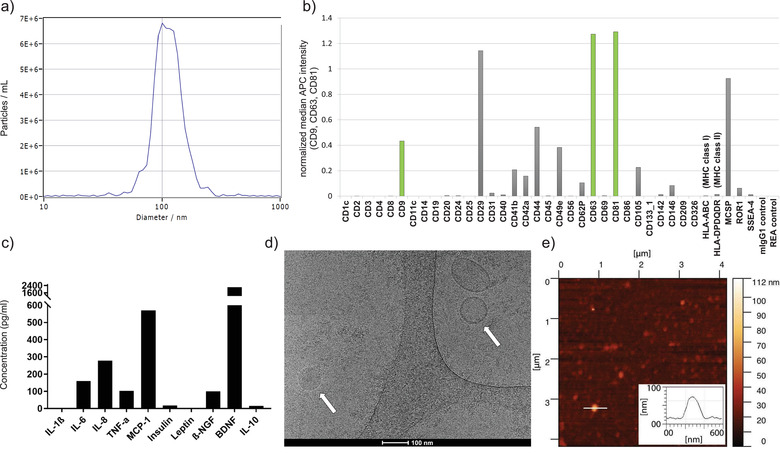
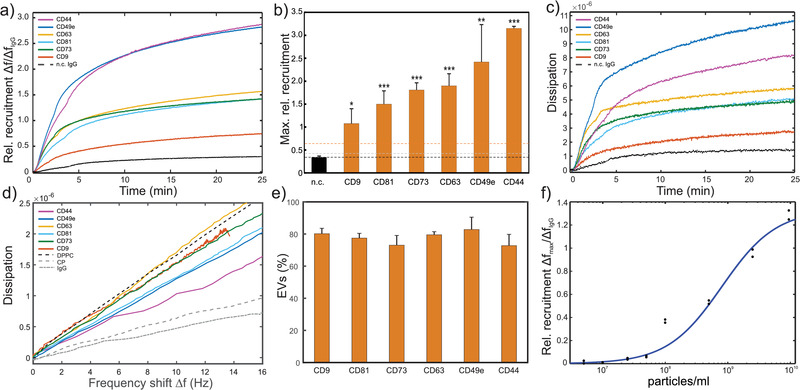
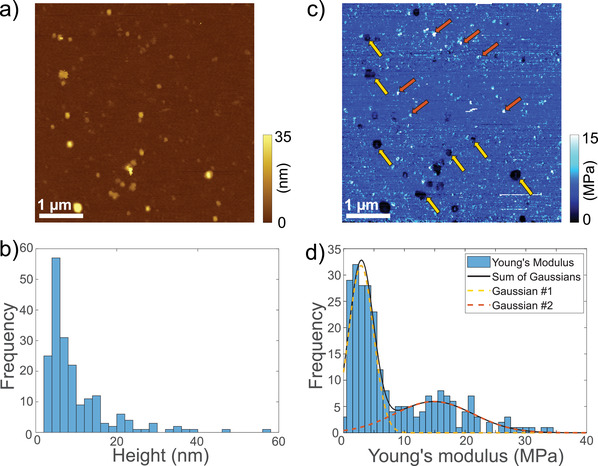
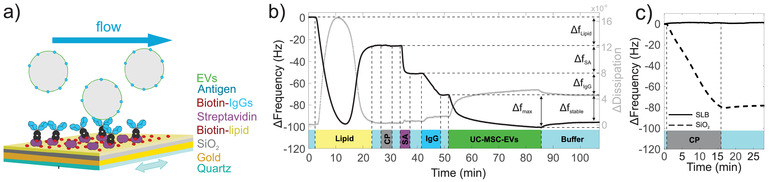
Interest in mesenchymal stem cell derived extracellular vesicles (MSC-EVs) as therapeutic agents has dramatically increased over the last decade. Current approaches to the characterization and quality control of EV-based therapeutics include particle tracking techniques, Western blotting, and advanced cytometry, but standardized methods are lacking. In this study, we established and verified quartz crystal microbalance (QCM) as highly sensitive label-free immunosensing technique for characterizing clinically approved umbilical cord MSC-EVs enriched by tangential flow filtration and ultracentrifugation. Using QCM in conjunction with common characterization methods, we were able to specifically detect EVs via EV (CD9, CD63, CD81) and MSC (CD44, CD49e, CD73) markers. Furthermore, analysis of QCM dissipation versus frequency allowed us to quantitatively determine the ratio of marker-specific EVs versus non-vesicular particles (NVPs) - a parameter that cannot be obtained by any other technique so far. Additionally, we characterized the topography and elasticity of these EVs by atomic force microscopy (AFM), enabling us to distinguish between EVs and NVPs in our EV preparations. This measurement modality makes it possible to identify EV sub-fractions, discriminate between EVs and NVPs, and to characterize EV surface proteins, all with minimal sample preparation and using label-free measurement devices with low barriers of entry for labs looking to widen their spectrum of characterization techniques. Our combination of QCM with impedance measurement (QCM-I) and AFM measurements provides a robust multi-marker approach to the characterization of clinically approved EV therapeutics and opens the door to improved quality control.
在过去的十年中,间充质干细胞衍生的细胞外囊泡 (MSC-EVs) 作为治疗剂的兴趣显著增加。目前,基于 EV 的治疗方法的特征描述和质量控制包括粒子跟踪技术、Western 印迹和高级细胞术,但缺乏标准化方法。在这项研究中,我们建立并验证了石英晶体微天平 (QCM) 作为一种高度灵敏的无标记免疫传感技术,用于表征通过切向流过滤和超速离心富集的临床批准的脐带 MSC-EVs。使用 QCM 结合常见的特征描述方法,我们能够通过 EV(CD9、CD63、CD81)和 MSC(CD44、CD49e、CD73)标志物特异性检测 EV。此外,分析 QCM 耗散与频率的关系使我们能够定量确定标记特异性 EV 与非囊泡颗粒 (NVPs) 的比值 - 这是迄今为止任何其他技术都无法获得的参数。此外,我们通过原子力显微镜 (AFM) 对这些 EV 的形貌和弹性进行了表征,使我们能够在 EV 制剂中区分 EV 和 NVPs。这种测量模式可以识别 EV 亚群,区分 EV 和 NVPs,并对 EV 表面蛋白进行表征,所有这些都只需进行最小的样品制备,并使用无标记测量设备,为希望拓宽其表征技术范围的实验室提供了低进入壁垒。我们将 QCM 与阻抗测量 (QCM-I) 和 AFM 测量相结合,提供了一种强大的多标志物方法来表征临床批准的 EV 治疗药物,并为提高质量控制开辟了道路。