Green Tara Nepal, Kathmandu, Nepal.
Health Action and Research, Kathmandu, Nepal.
PLoS One. 2021 Oct 20;16(10):e0258834. doi: 10.1371/journal.pone.0258834. eCollection 2021.
This is a one-year post-intervention study following an initiative to provide orientation to female community health volunteers (FCHVs) on postpartum family planning in Nepal. In light of positive results in the earlier post-intervention study, this study was designed to provide a more long-term perspective on sustainability by assessing the effect at one-year post-intervention.
This mixed-methods study was conducted in January 2020 in Morang district, Nepal. We collected quantitative data from a knowledge assessment of FCHVs who had participated in the intervention on postpartum family planning, data on their community-based counseling coverage and through interviews with postpartum mothers in two selected hospitals. Qualitative data were collected through six key informant interviews with health providers and four focus group discussions with FCHVs involved in the intervention. We performed descriptive and multivariate analyses for quantitative data and thematic analysis for qualitative data.
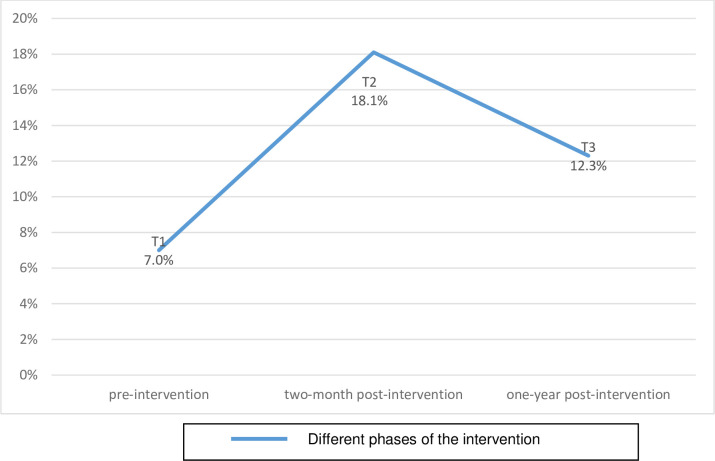
In total, 206 FCHVs participated in the one-year post-intervention study with significant improvement in knowledge of postpartum family planning as compared to pre-intervention period. The adjusted odds ratios (AOR) for knowledge of the 5 key messages on postpartum family planning as compared to the pre-intervention period included 1) knowledge on postpartum family planning can be used immediately after birth (AOR = 18.1, P<0.001), 2) postpartum intra-uterine device (PPIUD) can provide protection up to 12 years (AOR = 2.9, P = 0.011), 3) mothers who undergo cesarean section can use PPIUD (AOR = 2.3, P<0.001), 4) PPIUD can be inserted immediately after birth (AOR = 6.2, P <0.001), and 5) women should go for follow-up immediately if the IUD strings are seen outside vulva (AOR = 2.0, P = 0.08). The FCHVs answering 4 or more questions correctly was 10 times higher (AOR = 10.1, P<0.001) at one-year post-intervention, whereas it was 25 times higher at immediate-post-test (AOR = 25.1, p<0.001) as compared to pre-intervention phase. The FCHVs had counseled 71% of the pregnant women (n = 538) within their communities at one-year post-intervention. The postpartum mothers in hospitals had a 2 times higher odds of being counseled by FCHVs during their pregnancy at one-year post-intervention (AOR = 1.8, P = 0.039) than in pre-intervention phase. The qualitative findings suggested a positive impression regarding the FCHV's involvement in postpartum family planning counseling in the communities, however, supervision and monitoring over a longer term was identified as a key challenge and that may influence sustainability of community-based and hospital-based postpartum family planning services.
The FCHVs' knowledge and community-based activities on postpartum family planning remained higher than in the pre-intervention. However, it declined when compared to the immediate post-intervention period. We propose regular supervision and monitoring of the work of the FCHVs to sustain progress.
这是一项为期一年的干预后研究,针对尼泊尔为社区卫生志愿者(FCHV)提供产后计划生育方面的定向指导。鉴于早期干预后研究的积极结果,本研究旨在通过评估干预后一年的效果,提供更长期的可持续性视角。
本混合方法研究于 2020 年 1 月在尼泊尔莫朗区进行。我们从参加产后计划生育干预的 FCHV 的知识评估中收集定量数据,从他们在两个选定医院的社区咨询覆盖情况中收集数据,并通过采访产后母亲收集数据。定性数据通过与参与干预的卫生提供者进行的 6 次关键知情人访谈和与 FCHV 进行的 4 次焦点小组讨论收集。我们对定量数据进行描述性和多变量分析,对定性数据进行主题分析。
共有 206 名 FCHV 参加了干预后一年的研究,与干预前相比,他们对产后计划生育的知识有了显著提高。与干预前相比,关于产后计划生育的 5 个关键信息的知识的调整后比值比(AOR)包括:1)产后计划生育知识可以在分娩后立即使用(AOR = 18.1,P <0.001);2)产后宫内节育器(PPIUD)可提供长达 12 年的保护(AOR = 2.9,P = 0.011);3)接受剖腹产的母亲可以使用 PPIUD(AOR = 2.3,P <0.001);4)PPIUD 可以在分娩后立即插入(AOR = 6.2,P <0.001);5)如果看到宫内节育器的线在阴道外,妇女应立即进行随访(AOR = 2.0,P = 0.08)。在干预后一年,回答 4 个或更多正确问题的 FCHV 是干预前的 10 倍(AOR = 10.1,P <0.001),而在即时后测试中是 25 倍(AOR = 25.1,P <0.001)。干预后一年,FCHV 在社区中为 71%(n = 538)的孕妇提供了咨询。与干预前相比,在干预后一年,医院的产后母亲由 FCHV 在怀孕期间进行咨询的几率增加了两倍(AOR = 1.8,P = 0.039)。定性研究结果表明,FCHV 在社区参与产后计划生育咨询方面的印象积极,但发现长期监督和监测是一个关键挑战,这可能会影响社区和医院产后计划生育服务的可持续性。
FCHV 在产后计划生育方面的知识和社区活动仍然高于干预前。然而,与即时干预后相比,它有所下降。我们建议定期监督和监测 FCHV 的工作,以保持进展。
