O'Donovan James, O'Donovan Charles, Kuhn Isla, Sachs Sonia Ehrlich, Winters Niall
Department of Education, University of Oxford, Oxford, UK.
Faculty of Medicine and Health, University of Leeds, Leeds, UK.
BMJ Open. 2018 Apr 28;8(4):e021467. doi: 10.1136/bmjopen-2017-021467.
Understanding the current landscape of ongoing training for community health workers (CHWs) in low-income and middle-income countries (LMICs) is important both for organisations responsible for their training, as well as researchers and policy makers. This scoping review explores this under-researched area by mapping the current delivery implementation and evaluation of ongoing training provision for CHWs in LMICs.
Systematic scoping review.
MEDLINE, Embase, AMED, Global Health, Web of Science, Scopus, ASSIA, LILACS, BEI and ERIC.
Original studies focusing on the provision of ongoing training for CHWs working in a country defined as low income and middle income according to World Bank Group 2012 classification of economies.
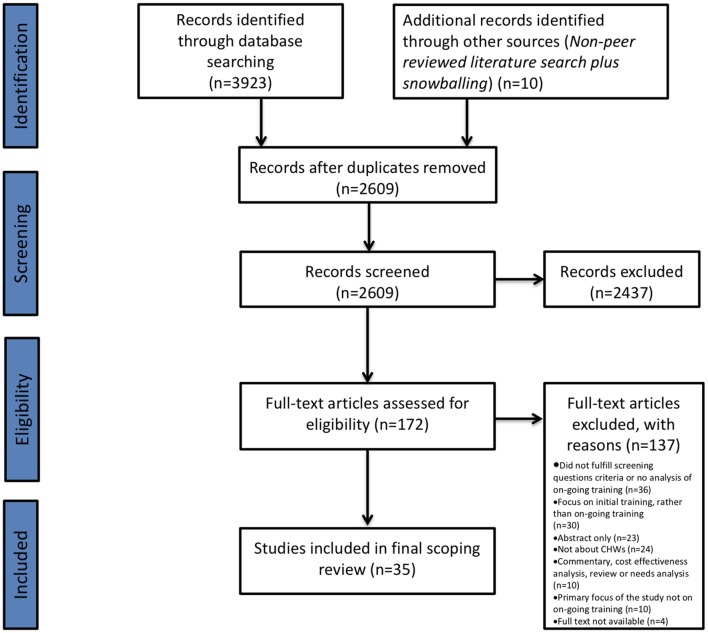
The scoping review found 35 original studies that met the inclusion criteria. Ongoing training activities for CHWs were described as supervision (n=19), inservice or refresher training (n=13) or a mixture of both (n=3). Although the majority of studies emphasised the importance of providing ongoing training, several studies reported no impact of ongoing training on performance indicators. The majority of ongoing training was delivered inperson; however, four studies reported the use of mobile technologies to support training delivery. The outcomes from ongoing training activities were measured and reported in different ways, including changes in behaviour, attitudes and practice measured in a quantitative manner (n=16), knowledge and skills (n=6), qualitative assessments (n=5) or a mixed methods approach combining one of the aforementioned modalities (n=8).
This scoping review highlights the diverse range of ongoing training for CHWs in LMICs. Given the expansion of CHW programmes globally, more attention should be given to the design, delivery, monitoring and sustainability of ongoing training from a health systems strengthening perspective.
了解低收入和中等收入国家(LMICs)社区卫生工作者(CHWs)正在进行的培训的当前情况,这对负责其培训的组织以及研究人员和政策制定者而言都很重要。本范围综述通过梳理LMICs中CHWs正在进行的培训提供的当前实施情况和评估情况,来探索这一研究不足的领域。
系统范围综述。
MEDLINE、Embase、AMED、全球卫生、科学网、Scopus、ASSIA、LILACS、BEI和ERIC。
根据世界银行集团2012年经济分类,聚焦于为在低收入和中等收入国家工作的CHWs提供正在进行的培训的原始研究。
范围综述发现35项符合纳入标准的原始研究。CHWs正在进行的培训活动被描述为监督(n = 19)、在职或进修培训(n = 13)或两者结合(n = 3)。尽管大多数研究强调提供正在进行的培训的重要性,但有几项研究报告称正在进行的培训对绩效指标没有影响。大多数正在进行的培训是面对面进行的;然而,有四项研究报告了使用移动技术来支持培训提供。正在进行的培训活动的结果以不同方式进行测量和报告,包括以定量方式测量的行为、态度和实践的变化(n = 16)、知识和技能(n = 6)、定性评估(n = 5)或结合上述模式之一的混合方法(n = 8)。
本范围综述突出了LMICs中CHWs正在进行的培训的多样性。鉴于全球CHW项目的扩大,应从加强卫生系统的角度,更多地关注正在进行的培训的设计、提供、监测和可持续性。