
Evolutionarily conserved regions of the human c-myc protein can be uncoupled from transforming activity.
作者信息
Sarid J, Halazonetis T D, Murphy W, Leder P
出版信息
Proc Natl Acad Sci U S A. 1987 Jan;84(1):170-3. doi: 10.1073/pnas.84.1.170.
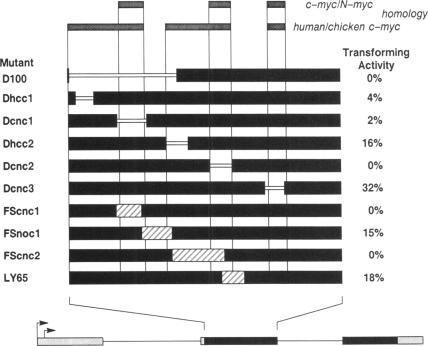
The myc family of oncogenes contains coding sequences that have been preserved in different species for over 400 million years. This conservation (which implies functional selection) is broadly represented throughout the C-terminal portion of the human c-myc protein but is largely restricted to three clusters of amino acid sequences in the N-terminal region. We have examined the role that the latter three regions of the c-myc protein might play in the transforming function of the c-myc gene. Several mutations, deletions and frameshifts, were introduced into the c-myc gene, and these mutant genes were tested for their ability to collaborate with the EJ-ras oncogene to transform rat embryo fibroblasts. Complete elimination of the first two N-terminal conserved segments abolished transforming activity. In contrast, genes altered in a portion of the second or the entire third conserved segment retained their transforming activity. Thus, the latter two segments are not required for the transformation process, suggesting that they serve another function related only to the normal expression of the c-myc gene.
 Zotero 插件