Department of Orthopedic Surgery, Beijing Jishuitan Hospital, Fourth Clinical College of Peking University, No.31 Xinjiekou East Road, Xicheng District, Beijing, 100035, China.
Department of Orthopaedics, Chinese PLA General Hospital, No. 28 Fuxing Road, Haidian District, Beijing, 100039, China.
BMC Musculoskelet Disord. 2021 Oct 21;22(1):895. doi: 10.1186/s12891-021-04756-x.
The relevance between the presence of a sinus tract and the failure risk after debridement, antibiotics and implant retention (DAIR) for periprosthetic joint infection (PJI) after hip or knee arthroplasty is still unclear. This study aimed to compare the success rate of DAIR between patients with or without a sinus tract and to explore the possible risk factors for failure after DAIR in patients with a sinus tract.
Consecutive DAIR cases for PJI after hip or knee arthroplasty between January 2009 and June 2019 with a minimum 1-year follow-up in two tertiary joint arthroplasty centers were included. Patients were classified into the sinus tract group and the non-sinus tract group according to the presence of a sinus tract. The success rate after DAIR were compared using Kaplan-Meier survival analysis. Potential risk factors for failure in the sinus group were also explored.
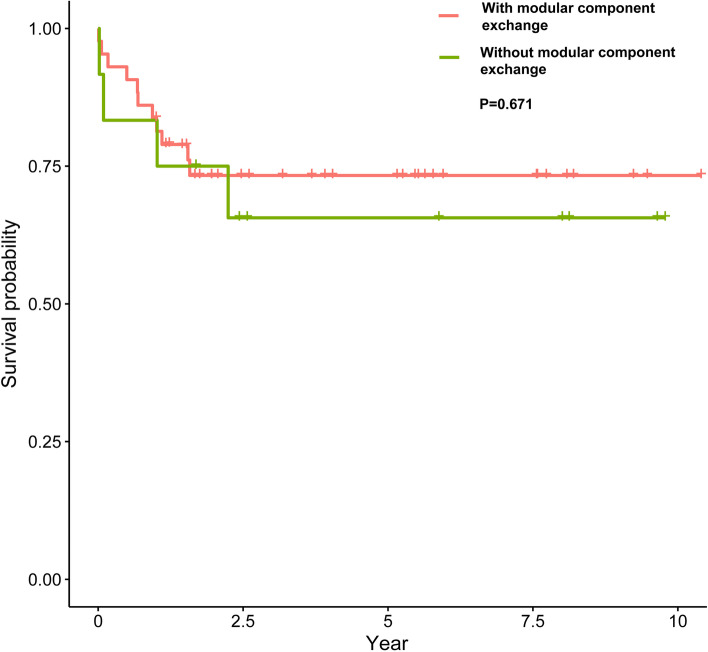
One hundred seven patients were included. At a median 4.4 years of follow-up, 19 of 52 (36.5%) cases failed in the sinus tract group, while 15 of 55 (27.3%) cases failed in the non-sinus tract group. The 1-year and 5-year cumulative success rates were 71.2% (95% confidence interval (CI): 59.8-84.6%) and 56.8% (95% CI: 42.6-75.7%) in the sinus tract group, respectively, which were similar to the counterparts in the non-sinus tract group (P = 0.214). Among patients with a sinus tract, DAIR with the exchange of modular components showed a higher success rate (75.8% versus 47.4%, P = 0.038).
The presence of a sinus tract does not affect the success rate of DAIR. Modular component exchange in DAIR was proposed for patients with a sinus tract for an improved infection control rate.
髋关节或膝关节置换术后假体周围关节感染(PJI)清创、抗生素和保留植入物(DAIR)后窦道的存在与失败风险之间的相关性尚不清楚。本研究旨在比较有窦道和无窦道患者 DAIR 的成功率,并探讨窦道患者 DAIR 后失败的可能危险因素。
纳入 2009 年 1 月至 2019 年 6 月在两家三级关节置换中心行髋关节或膝关节置换术后 PJI 行 DAIR 治疗且至少随访 1 年的连续病例。根据窦道的存在,将患者分为窦道组和非窦道组。采用 Kaplan-Meier 生存分析比较 DAIR 后的成功率。还探讨了窦道组失败的潜在危险因素。
共纳入 107 例患者。在中位数为 4.4 年的随访中,窦道组 52 例中有 19 例(36.5%)失败,而非窦道组 55 例中有 15 例(27.3%)失败。窦道组的 1 年和 5 年累积成功率分别为 71.2%(95%置信区间[CI]:59.8-84.6%)和 56.8%(95% CI:42.6-75.7%),与非窦道组相似(P=0.214)。在有窦道的患者中,模块化组件的 DAIR 置换显示出更高的成功率(75.8%比 47.4%,P=0.038)。
窦道的存在并不影响 DAIR 的成功率。对于有窦道的患者,建议在 DAIR 中更换模块化组件,以提高感染控制率。