Lu Ping, Cui Lingyun, Zhao Xingquan
Department of Neurology, Beijing Tiantan Hospital, Capital Medical University, Beijing, People's Republic of China.
China National Clinical Research Center for Neurological Diseases, Capital Medical University, Beijing, People's Republic of China.
Neuropsychiatr Dis Treat. 2021 Oct 7;17:3069-3079. doi: 10.2147/NDT.S331874. eCollection 2021.
We aimed to determine the prognostic impact of prominent veins (PVS) after an acute ischemic stroke identified on susceptibility-weighted imaging (PVS-SWI).
We searched for studies published in PubMed, Embase, Cochrane Library and Chinese Biomedical Literature Database. Poor functional prognosis, early neurological deterioration, and hemorrhagic transformation were evaluated. Risk ratios (RR) were pooled implementing a random effect model. We performed a subgroup analysis by treatment, location (cortical/medullary) and a sensitivity analysis by follow-up time.
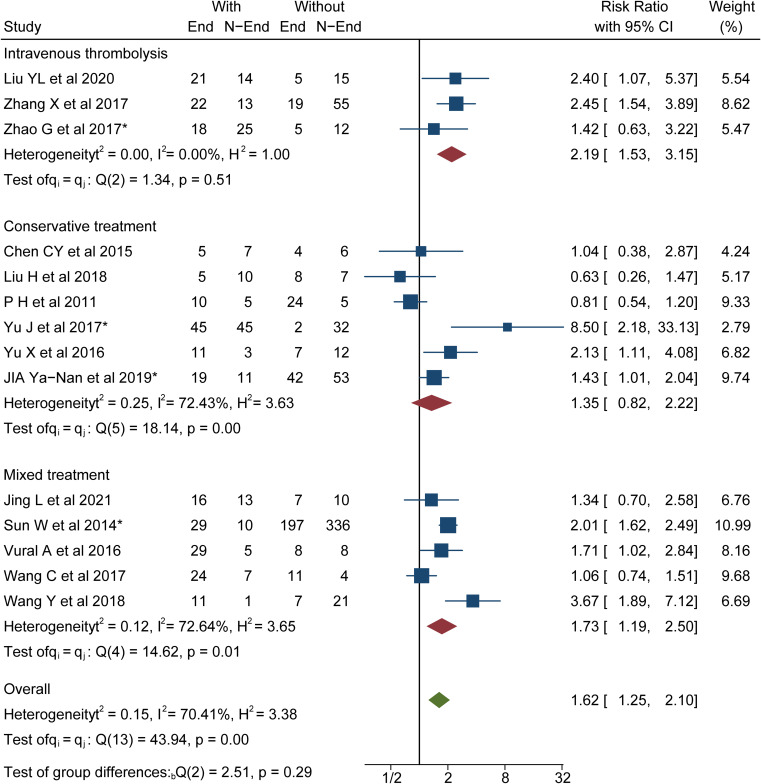
Sixteen studies were included (a total of 1605 patients) in the quantitative meta-analysis. PVS-SWI were related with a poor functional outcome (RR 1.62, 95% CI 1.25 to 2.10), especially in the patients receiving thrombolysis (RR 2.19, 95% CI 1.53 to 3.15) and an augmented risk of early neurological damage (RR 2.85, 95% CI 2.31 to 3.51). Both cortical and medullary prominent veins were accompanied by a poor functional outcome (RR 1.82, 95% CI 1.30 to 2.56/RR 2.59, 95% CI 1.98 to 3.38). PVS-SWI were not associated with poor functional outcomes when patients were treated conservatively (RR 1.35, 95% CI 0.82 to 2.22), or with an increased risk of hemorrhagic transformation (RR 0.97, 95% CI 0.64 to 1.47).
PVS-SWI were related to a poor functional prognosis and an increased risk of early neurological damage. In patients treated conservatively, PVS-SWI were not accompanied by a poor prognosis. PVS-SWI were not associated with an augmented risk of hemorrhagic transformation.
我们旨在确定在磁敏感加权成像(PVS-SWI)上识别出的急性缺血性卒中后显著静脉(PVS)的预后影响。
我们检索了发表在PubMed、Embase、Cochrane图书馆和中国生物医学文献数据库中的研究。评估了功能预后不良、早期神经功能恶化和出血性转化情况。采用随机效应模型汇总风险比(RR)。我们按治疗、部位(皮质/髓质)进行了亚组分析,并按随访时间进行了敏感性分析。
定量荟萃分析纳入了16项研究(共1605例患者)。PVS-SWI与功能预后不良相关(RR 1.62,95%CI 1.25至2.10),尤其是在接受溶栓治疗的患者中(RR 2.19,95%CI 1.53至3.15),且早期神经损伤风险增加(RR 2.85,95%CI 2.31至3.51)。皮质和髓质显著静脉均伴有功能预后不良(RR 1.82,95%CI 1.30至2.56/RR 2.59,95%CI 1.98至3.38)。当患者接受保守治疗时,PVS-SWI与功能预后不良无关(RR 1.35,95%CI 0.82至2.22),也与出血性转化风险增加无关(RR 约0.97,95%CI 0.64至1.47)。
PVS-SWI与功能预后不良及早期神经损伤风险增加相关。在接受保守治疗的患者中,PVS-SWI不伴有预后不良。PVS-SWI与出血性转化风险增加无关。