Department of Neurology, Dongguan People's Hospital (Affiliated Dongguan Hospital, South Medical University), Dongguan, China.
Department of Radiology, Dongguan People's Hospital (Affiliated Dongguan Hospital, South Medical University), Dongguan, China.
Brain Behav. 2020 Jul;10(7):e01657. doi: 10.1002/brb3.1657. Epub 2020 May 20.
To assess whether the asymmetrical cortical vessel sign (ACVS) on susceptibility-weighted imaging (SWI) could predict 90-day poor outcomes in anterior circulation acute ischemic stroke (AIS) patients treated with recombinant tissue plasminogen activator (r-tPA).
Clinical data of consecutive patients with anterior circulation AIS treated with r-tPA were retrospectively analyzed. Clinical variables included age, sex, vascular risk factors, NIHSS score, onset to treatment time, and initial hematologic and neuroimaging findings. Follow-up was performed 90 days after onset. Poor outcome was defined as a modified Rankin scale (mRS) ≥3 at 90 days.
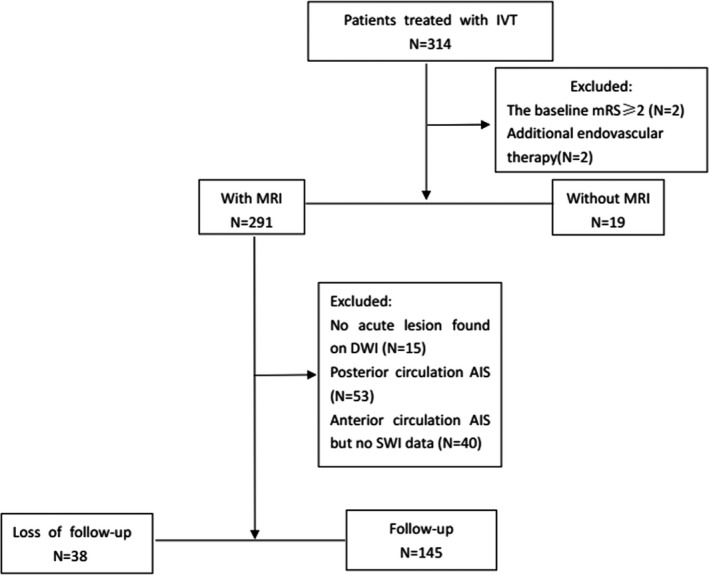
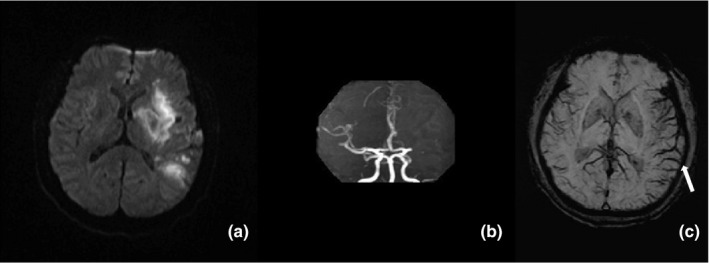
A total of 145 patients were included, 35 (24.1%) patients presented with ACVS (≥Grade 1) on SWI. Fifty-three (36.6%) patients had a poor outcome at 90 days. ACVS (≥Grade 1) occurred in 21 (39.6%) patients with poor outcome compared with 14 (15.2%) patients with favorable outcome (p = .001). Univariate analysis indicated that age, NIHSS score on admission, previous stroke, hemorrhagic transformation, severe intracranial large artery stenosis or occlusion (SILASO), and ACVS were associated with 90-day poor outcome (p < .05). Since SILASO and ACVS were highly correlated and ACVS had different grades, we used three logistic regression models. Results from the three models showed that ACVS was associated with 90-day poor outcome.
In r-tPA-treated patients with anterior circulation AIS, ACVS might be a helpful neuroimaging predictor for poor outcome at 90 days.
评估磁敏感加权成像(SWI)上不对称皮质血管征(ACVS)是否可以预测接受重组组织型纤溶酶原激活剂(r-tPA)治疗的前循环急性缺血性脑卒中(AIS)患者的 90 天不良结局。
回顾性分析连续接受 r-tPA 治疗的前循环 AIS 患者的临床数据。临床变量包括年龄、性别、血管危险因素、NIHSS 评分、发病至治疗时间以及初始血液学和神经影像学发现。随访时间为发病后 90 天。不良结局定义为 90 天时改良 Rankin 量表(mRS)≥3。
共纳入 145 例患者,35 例(24.1%)SWI 上出现 ACVS(≥1 级)。53 例(36.6%)患者在 90 天时预后不良。与预后良好的 14 例(15.2%)患者相比,预后不良的 21 例(39.6%)患者出现 ACVS(≥1 级)(p=0.001)。单因素分析表明,年龄、入院时 NIHSS 评分、既往卒史、出血性转化、严重颅内大血管狭窄或闭塞(SILASO)和 ACVS 与 90 天不良预后相关(p<0.05)。由于 SILASO 和 ACVS 高度相关且 ACVS 存在不同等级,因此我们使用了三个逻辑回归模型。三个模型的结果均表明 ACVS 与 90 天不良预后相关。
在接受 r-tPA 治疗的前循环 AIS 患者中,ACVS 可能是预测 90 天不良结局的有用神经影像学指标。