Dang Wantai, Xu Xiaohui, Luo Danling, Luo Hui, Hu Jin, Zhou Jingguo, Liu Jian, You Lanlan
Department of Rheumatism and Immunity, Clinical Medical College and The First Affiliated Hospital of Chengdu Medical College, Chengdu, Sichuan, 610500, People's Republic of China.
Department of Ultrasound, Clinical Medical College and The First Affiliated Hospital of Chengdu Medical College, Chengdu, Sichuan, 610500, People's Republic of China.
Int J Gen Med. 2021 Oct 5;14:6367-6378. doi: 10.2147/IJGM.S336220. eCollection 2021.
To explore the effects of different blood uric acid levels in gout patients on the two-dimensional image of the kidney and the risk factors for gout-related kidney damage for providing clinical evidence to enable early prevention and treatment of gout-related kidney damage.
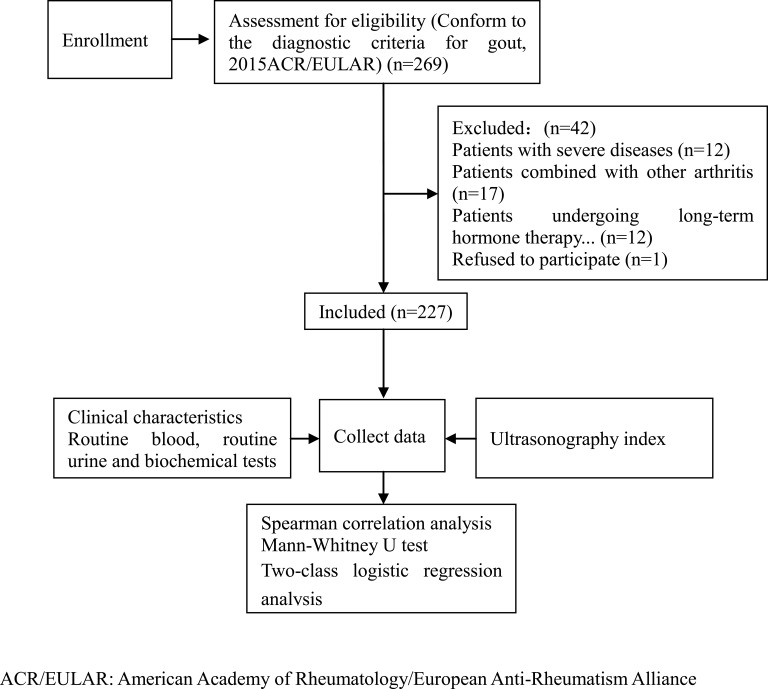
We obtained information of 227 patients with primary gout and estimated the association between two-dimensional kidney images and clinical indicators using binary logistic regression.
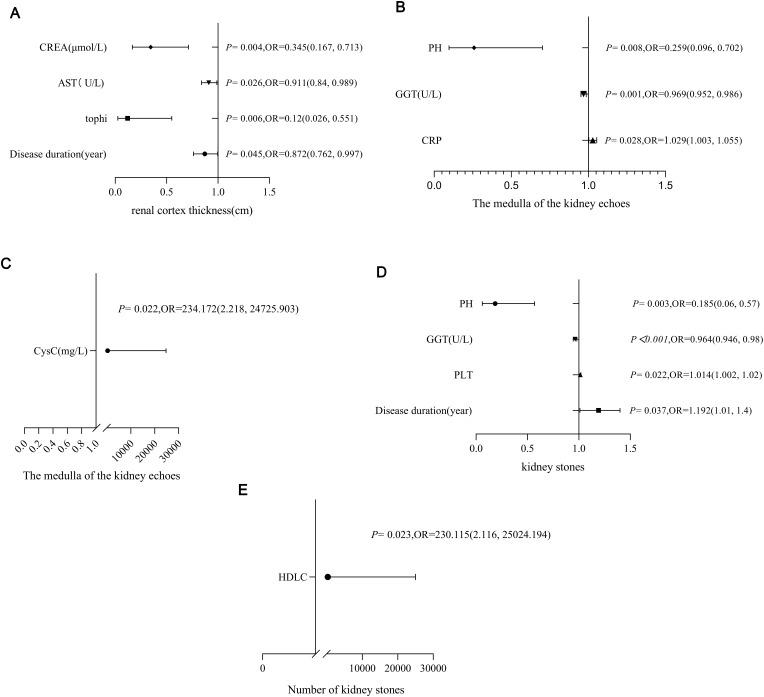
Our study showed that different uric acid levels, age, disease course, cystatin C (CysC) level, and γ-glutamyl transpeptidase level were correlated with echo of the renal medulla ( < 0.05). CysC level was correlated with the renal cortex thickness and kidney stones in different uric acid-level groups ( < 0.05). Disease course, aspartate transaminase (AST) level, creatinine (CREA) level, and tophi were risk factors for renal cortex thinning in gout patients ( = 0.045, 0.026, 0.004, 0.006, respectively). The disease course, platelet (PLT) count, and high-density lipoprotein (HDL-C) level were risk factors for kidney stone formation in gout patients ( = 0.037, 0.022, 0.023, respectively), while CysC level and C-reactive protein (CRP) level were risk factors for increased renal medulla echo in these patients ( = 0.022, 0.028, respectively).
Our study revealed disease course, AST level, CREA level, tophi, PLT count, HDL-C level, CysC level and CRP level may be important predictors of renal image changes.
探讨痛风患者不同血尿酸水平对肾脏二维图像的影响及痛风相关肾损害的危险因素,为痛风相关肾损害的早期防治提供临床依据。
收集227例原发性痛风患者的资料,采用二元logistic回归分析肾脏二维图像与临床指标之间的关联。
研究表明,不同尿酸水平、年龄、病程、胱抑素C(CysC)水平和γ-谷氨酰转肽酶水平与肾髓质回声相关(P<0.05)。在不同尿酸水平组中,CysC水平与肾皮质厚度和肾结石相关(P<0.05)。病程、天冬氨酸转氨酶(AST)水平、肌酐(CREA)水平和痛风石是痛风患者肾皮质变薄的危险因素(分别为P=0.045、0.026、0.004、0.006)。病程、血小板(PLT)计数和高密度脂蛋白(HDL-C)水平是痛风患者肾结石形成的危险因素(分别为P=0.037、0.022、0.023),而CysC水平和C反应蛋白(CRP)水平是这些患者肾髓质回声增强的危险因素(分别为P=0.022、0.028)。
本研究显示病程、AST水平、CREA水平、痛风石、PLT计数、HDL-C水平、CysC水平和CRP水平可能是肾脏图像变化的重要预测指标。