Bhunu Benjamin, Riccio Isabel, Intapad Suttira
Department of Pharmacology, Tulane University School of Medicine, New Orleans, LA, 70112, USA.
Integr Blood Press Control. 2021 Oct 9;14:141-152. doi: 10.2147/IBPC.S312868. eCollection 2021.
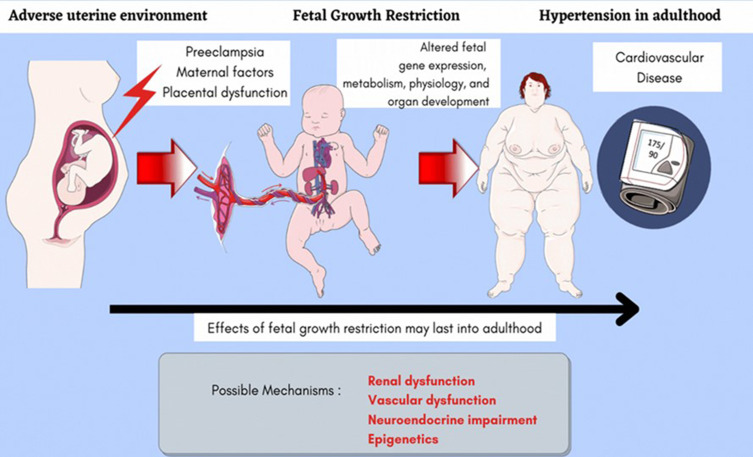
In recent decades, both clinical and animal studies have shown that fetal growth restriction (FGR), caused by exposure to adverse uterine environments, is a risk factor for hypertension as well as for a variety of adult diseases. This observation has shaped and informed the now widely accepted theory of developmental origins of health and disease (DOHaD). There is a plethora of evidence supporting the association of FGR with increased risk of adult hypertension; however, the underlying mechanisms responsible for this correlation remain unclear. This review aims to explain the current advances in the field of fetal programming of hypertension and a brief narration of the underlying mechanisms that may link FGR to increased risk of adult hypertension. We explain the theory of DOHaD and then provide evidence from both clinical and basic science research which support the theory of fetal programming of adult hypertension. In addition, we have explored the underlying mechanisms that may link FGR to an increased risk of adult hypertension. These mechanisms include epigenetic changes, metabolic disorders, vascular dysfunction, neurohormonal impairment, and alterations in renal physiology and function. We further describe sex differences seen in the developmental origins of hypertension and provide insights into the opportunities and challenges present in this field.
近几十年来,临床和动物研究均表明,因暴露于不利子宫环境而导致的胎儿生长受限(FGR)是高血压以及多种成人疾病的危险因素。这一观察结果形成并推动了如今被广泛接受的健康与疾病发育起源(DOHaD)理论。有大量证据支持FGR与成人高血压风险增加之间的关联;然而,导致这种相关性的潜在机制仍不清楚。本综述旨在解释高血压胎儿编程领域的当前进展,并简要叙述可能将FGR与成人高血压风险增加联系起来的潜在机制。我们阐述了DOHaD理论,然后提供临床和基础科学研究的证据,以支持成人高血压胎儿编程理论。此外,我们探讨了可能将FGR与成人高血压风险增加联系起来的潜在机制。这些机制包括表观遗传变化、代谢紊乱、血管功能障碍、神经激素损伤以及肾脏生理和功能改变。我们进一步描述了高血压发育起源中存在的性别差异,并深入探讨了该领域存在的机遇和挑战。