Endocrinology, Diabetes and Metabolism, Department of Medical Sciences, University of Turin, Turin, Italy.
Oncological Endocrinology, Department of Medical Sciences, University of Turin, Turin, Italy.
Front Endocrinol (Lausanne). 2021 Oct 5;12:747549. doi: 10.3389/fendo.2021.747549. eCollection 2021.
Hypercortisolism accounts for relevant morbidity and mortality and is often a diagnostic challenge for clinicians. A prompt diagnosis is necessary to treat Cushing's syndrome as early as possible.
The aim of this study was to develop and validate a clinical model for the estimation of pre-test probability of hypercortisolism in an at-risk population.
We conducted a retrospective multicenter case-control study, involving five Italian referral centers for Endocrinology (Turin, Messina, Naples, Padua and Rome). One hundred and fifty patients affected by Cushing's syndrome and 300 patients in which hypercortisolism was excluded were enrolled. All patients were evaluated, according to current guidelines, for the suspicion of hypercortisolism.
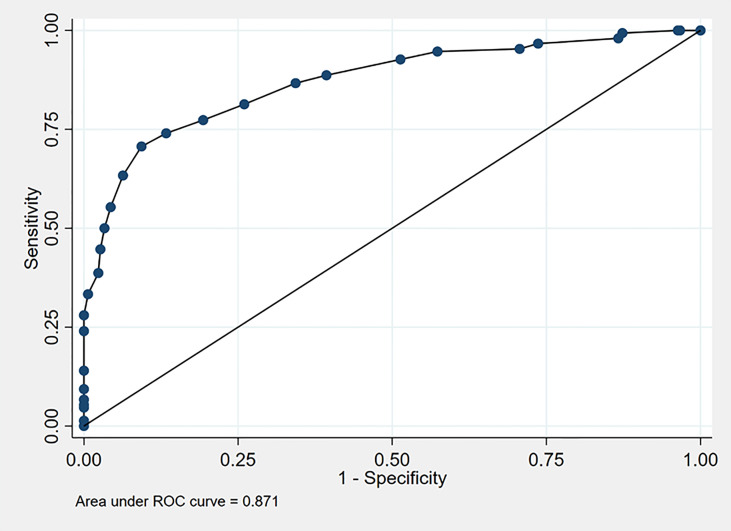
The Cushing score was built by multivariable logistic regression, considering all main features associated with a clinical suspicion of hypercortisolism as possible predictors. A stepwise backward selection algorithm was used (final model AUC=0.873), then an internal validation was performed through ten-fold cross-validation. Final estimation of the model performance showed an average AUC=0.841, thus reassuring about a small overfitting effect. The retrieved score was structured on a 17.5-point scale: low-risk class (score value: ≤5.5, probability of disease=0.8%); intermediate-low-risk class (score value: 6-8.5, probability of disease=2.7%); intermediate-high-risk class (score value: 9-11.5, probability of disease=18.5%) and finally, high-risk class (score value: ≥12, probability of disease=72.5%).
We developed and internally validated a simple tool to determine pre-test probability of hypercortisolism, the Cushing score, that showed a remarkable predictive power for the discrimination between subjects with and without a final diagnosis of Cushing's syndrome.
皮质醇增多症与相关发病率和死亡率有关,对临床医生来说常常是一个诊断挑战。为了尽早治疗库欣综合征,需要迅速做出诊断。
本研究旨在开发和验证一种临床模型,用于评估高危人群中皮质醇增多症的术前可能性。
我们进行了一项回顾性多中心病例对照研究,涉及意大利五家内分泌学转诊中心(都灵、墨西拿、那不勒斯、帕多瓦和罗马)。共纳入 150 例库欣综合征患者和 300 例皮质醇增多症排除患者。所有患者均根据当前指南评估皮质醇增多症的可疑性。
库欣评分通过多变量逻辑回归建立,考虑到所有与皮质醇增多症临床怀疑相关的主要特征作为可能的预测因素。使用逐步向后选择算法(最终模型 AUC=0.873),然后通过十折交叉验证进行内部验证。模型性能的最终估计显示平均 AUC=0.841,因此可以确定存在较小的过拟合效应。所获得的评分基于 17.5 分制:低危组(评分值:≤5.5,疾病概率=0.8%);中低危组(评分值:6-8.5,疾病概率=2.7%);中高危组(评分值:9-11.5,疾病概率=18.5%);最后是高危组(评分值:≥12,疾病概率=72.5%)。
我们开发并内部验证了一种简单的工具,用于确定皮质醇增多症的术前可能性,即库欣评分,该评分在区分有和无库欣综合征最终诊断的患者方面具有显著的预测能力。