Behavioral Physiology and Sociobiology (Zoology II), Biocenter, University of Würzburg, 97074, Würzburg, Germany.
J Comp Physiol A Neuroethol Sens Neural Behav Physiol. 2022 Jan;208(1):125-133. doi: 10.1007/s00359-021-01511-4. Epub 2021 Oct 22.
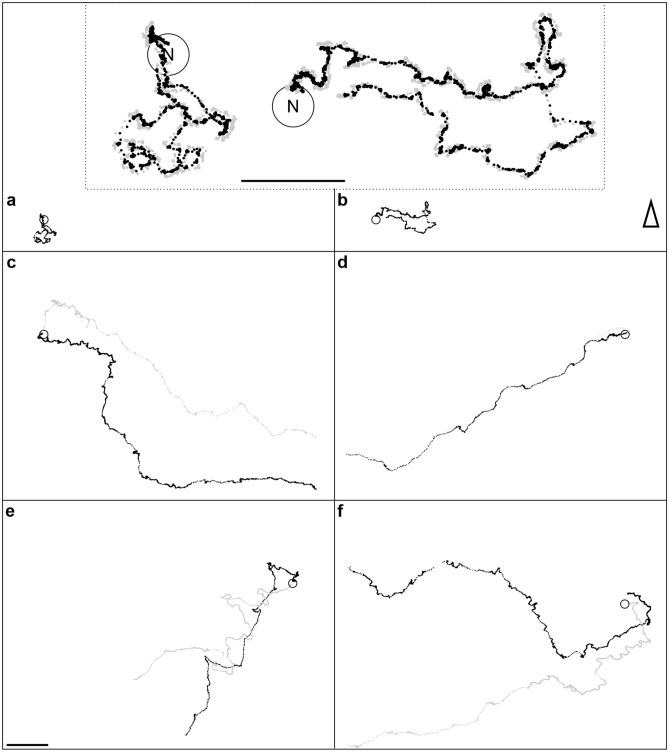
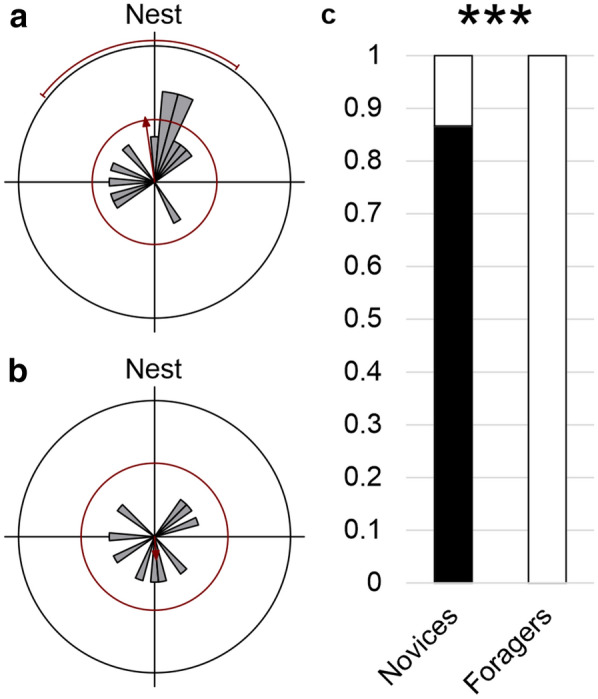
At the beginning of their foraging careers, Cataglyphis desert ants calibrate their compass systems and learn the visual panorama surrounding the nest entrance. For that, they perform well-structured initial learning walks. During rotational body movements (pirouettes), naïve ants (novices) gaze back to the nest entrance to memorize their way back to the nest. To align their gaze directions, they rely on the geomagnetic field as a compass cue. In contrast, experienced ants (foragers) use celestial compass cues for path integration during food search. If the panorama at the nest entrance is changed, foragers perform re-learning walks prior to heading out on new foraging excursions. Here, we show that initial learning walks and re-learning walks are structurally different. During re-learning walks, foragers circle around the nest entrance before leaving the nest area to search for food. During pirouettes, they do not gaze back to the nest entrance. In addition, foragers do not use the magnetic field as a compass cue to align their gaze directions during re-learning walk pirouettes. Nevertheless, magnetic alterations during re-learning walks under manipulated panoramic conditions induce changes in nest-directed views indicating that foragers are still magnetosensitive in a cue conflict situation.
在觅食生涯的开始,沙漠蚂蚁 Cataglyphis 通过执行结构化的初始学习行走来校准它们的罗盘系统并学习巢穴入口周围的视觉全景。在旋转身体运动(旋转)过程中,天真的蚂蚁(新手)会回头看向巢穴入口,以记住返回巢穴的路线。为了对齐他们的视线方向,他们依靠地磁场作为罗盘线索。相比之下,经验丰富的蚂蚁(觅食者)在寻找食物时使用天体罗盘线索进行路径整合。如果巢穴入口处的全景发生变化,觅食者会在开始新的觅食探险之前进行重新学习行走。在这里,我们表明初始学习行走和重新学习行走在结构上是不同的。在重新学习行走中,觅食者在离开巢穴区域寻找食物之前会在巢穴入口处盘旋。在旋转过程中,它们不会回头看向巢穴入口。此外,觅食者在重新学习行走的旋转过程中不会使用磁场作为罗盘线索来对齐他们的视线方向。然而,在受操纵的全景条件下的重新学习行走过程中的磁场变化会引起指向巢穴的视图发生变化,这表明觅食者在出现线索冲突的情况下仍然对磁场敏感。