Gomes Susana I L, Neves Ana B, Scott-Fordsmand Janeck J, Amorim Mónica J B
Department of Biology & CESAM, University of Aveiro, 3810-193 Aveiro, Portugal.
Department of Bioscience, Aarhus University, Vejlsovej 25, P.O. Box 314, DK-8600 Silkeborg, Denmark.
Toxics. 2021 Sep 24;9(10):232. doi: 10.3390/toxics9100232.
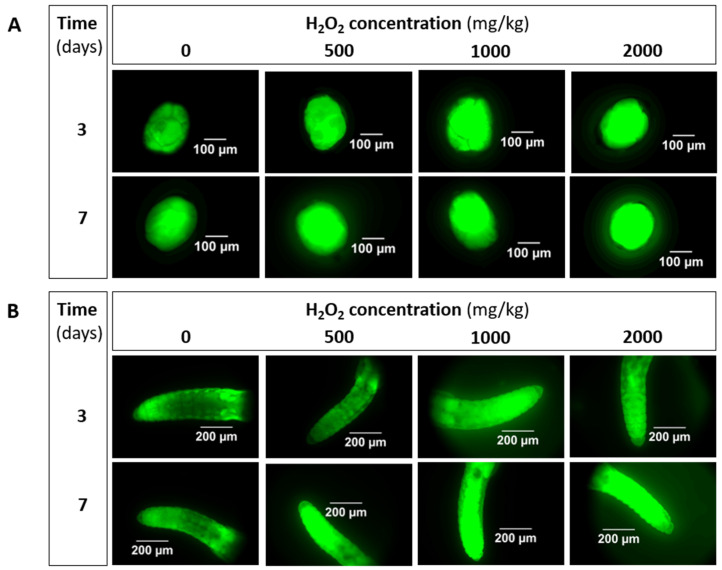
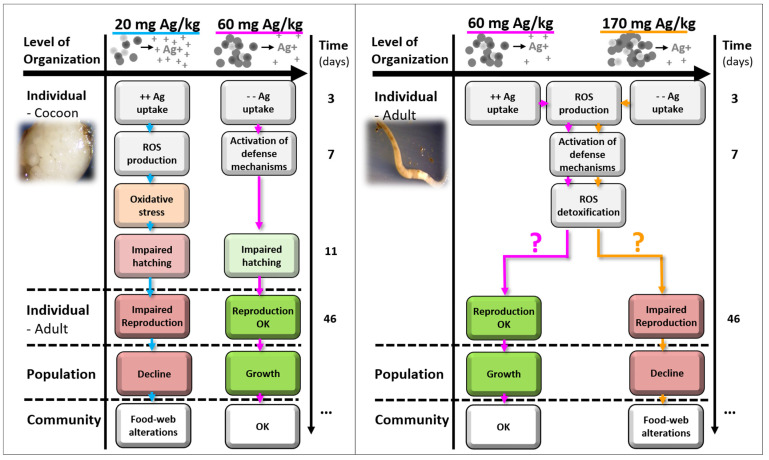
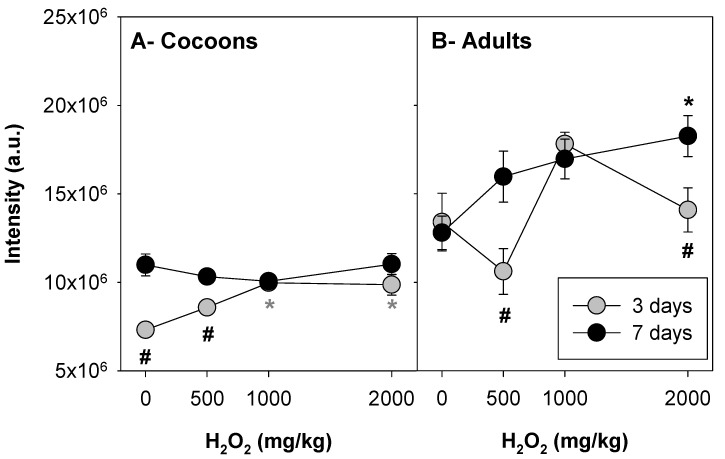
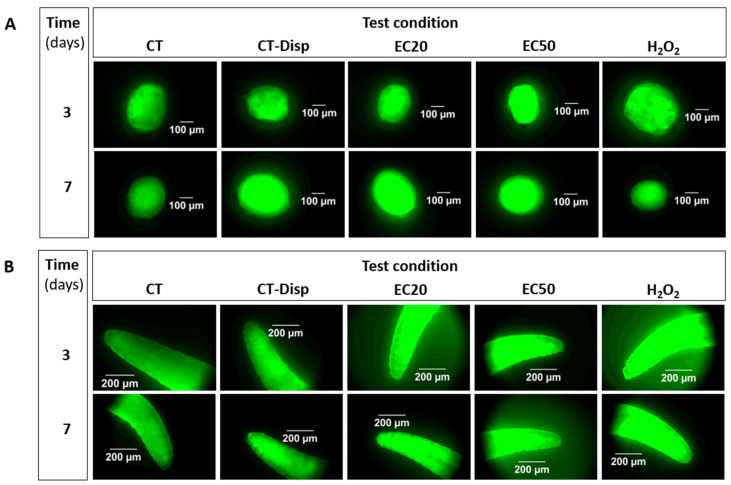
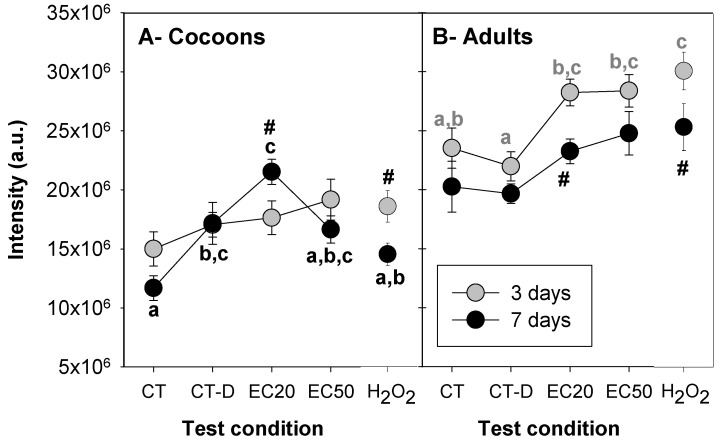
An imbalance between reactive oxygen species (ROS) and antioxidants in a living organism results in oxidative stress. Measures of such imbalance can be used as a biomarker of stress in ecotoxicology. In this study, we implemented the ROS detection method based on the oxidant-sensing probe dichloro-dihydro-fluorescein diacetate (DCFH-DA), detected by fluorescence microscopy, in adults and cocoons, i.e., also covering the embryo stage. Hydrogen peroxide (HO), a well-known ROS inducer, was used both to optimize the method and as positive control. Implementation was successful, and the method was used to assess ROS formation in cocoons and adults when exposed to the reference silver nanomaterial Ag NM300K, at two effect concentrations (EC20 and EC50) for both hatching and reproduction over 3 and 7 days. The measured ROS levels varied with time, concentration, and developmental stage, with higher levels detected in adults compared with cocoons. In cocoons, ROS levels were higher at the EC20 than the EC50, which could be explained by non-monotonic concentration-response curve for hatching and reproduction, as previously observed. The increase in ROS levels at day 3 preceded the oxidative damage, as reported to occur later (day 7) in adults. The DCFH-DA method was successfully implemented here and can be further used as a new tool to detect ROS formation in , especially after short-term exposure to chemicals, including nanomaterials. We recommend the use of 3 and 7 days in the exposure design for this assessment.
活生物体中活性氧(ROS)与抗氧化剂之间的失衡会导致氧化应激。这种失衡的测量方法可作为生态毒理学中应激的生物标志物。在本研究中,我们采用基于氧化剂感应探针二氯二氢荧光素二乙酸酯(DCFH-DA)的ROS检测方法,通过荧光显微镜进行检测,应用于成虫和茧,即也涵盖胚胎阶段。过氧化氢(HO)作为一种众所周知的ROS诱导剂,既用于优化该方法,也用作阳性对照。实施成功后,该方法被用于评估茧和成虫在暴露于参考银纳米材料Ag NM300K时ROS的形成情况,暴露时间为3天和7天,针对孵化和繁殖设置了两个效应浓度(EC20和EC50)。所测量的ROS水平随时间、浓度和发育阶段而变化,成虫中的ROS水平高于茧。在茧中,EC20时的ROS水平高于EC50,这可以用先前观察到的孵化和繁殖的非单调浓度 - 反应曲线来解释。如报道在成虫中氧化损伤发生在后期(第7天),第3天ROS水平的升高先于氧化损伤。DCFH-DA方法在此成功实施,可进一步用作检测ROS形成的新工具,特别是在短期接触包括纳米材料在内的化学物质之后。我们建议在该评估的暴露设计中使用3天和7天。