Kalantzakos Thomas J, Sullivan Travis B, Gloria Thales, Canes David, Moinzadeh Alireza, Rieger-Christ Kimberly M
Department of Translational Research, Lahey Hospital & Medical Center, Burlington, MA 01805, USA.
Department of Urology, Lahey Hospital & Medical Center, Burlington, MA 01805, USA.
Cancers (Basel). 2021 Oct 14;13(20):5160. doi: 10.3390/cancers13205160.
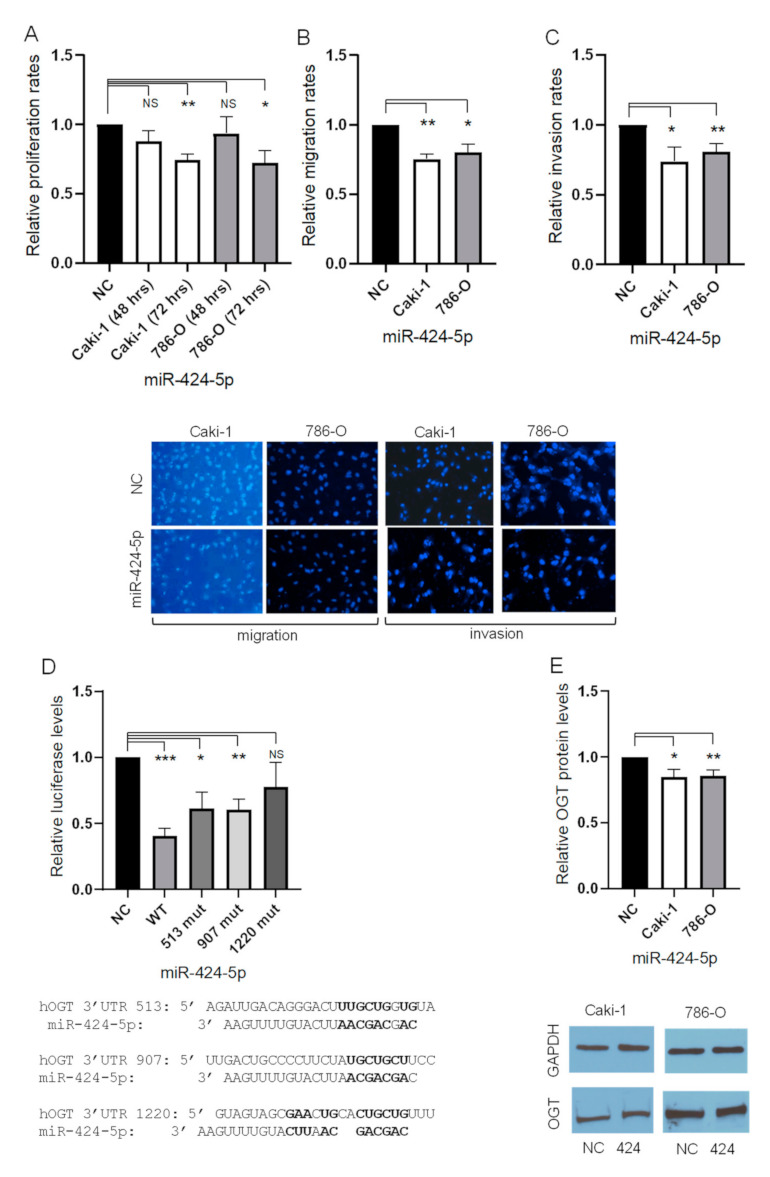
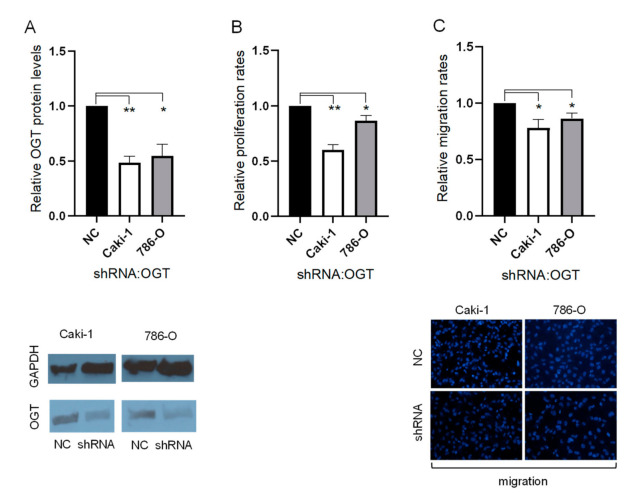
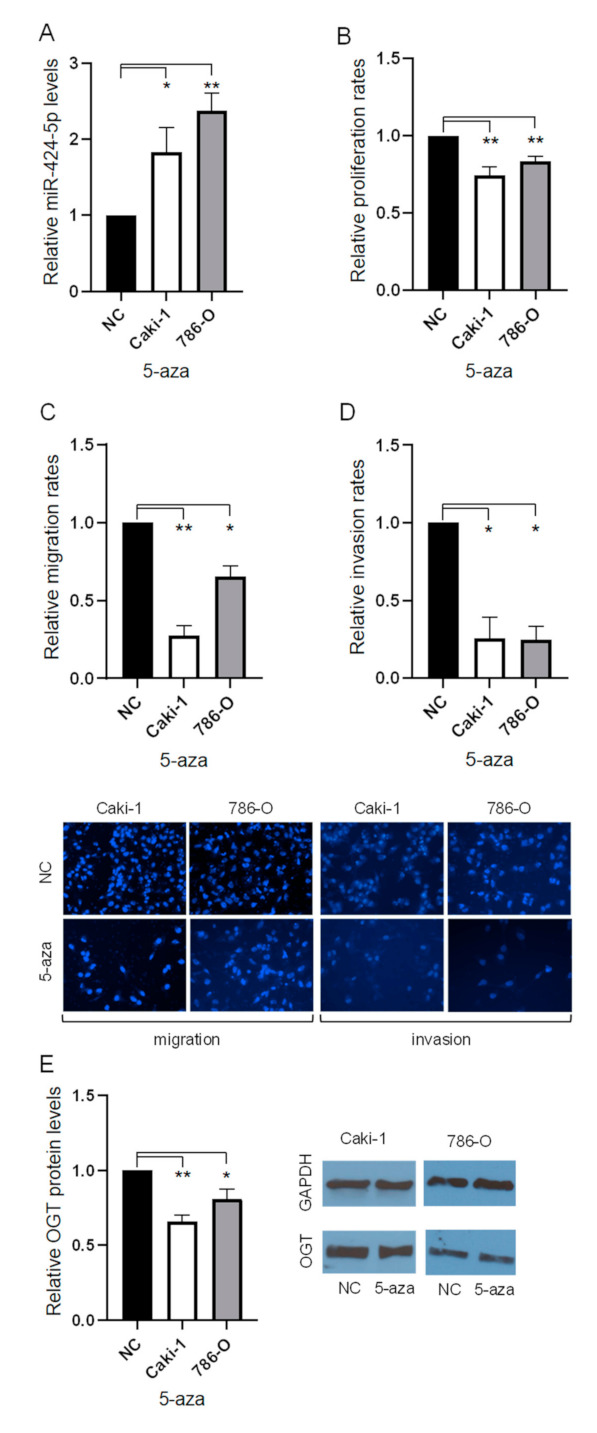
MicroRNAs (miRNAs) are non-coding post-transcriptional regulators of gene expression that are dysregulated in clear cell renal cell carcinoma (ccRCC) and play an important role in tumor progression. Our prior work identified a subset of miRNAs in pT1 ccRCC tumors, including miR-424-5p, that are associated with an aggressive phenotype. We investigate the impact of this dysregulated miRNA and its protein target O-GlcNAc-transferase (OGT) to better understand the mechanisms behind aggressive stage I ccRCC. The ccRCC cell lines 786-O and Caki-1 were used to assess the impact of miR-424-5p and OGT. Cells were transfected with pre-miR-424-5p, a lentiviral anti-OGT shRNA, or were treated with the demethylating agent 5-Aza-2'-deoxycytidine. Cell proliferation was measured via MT cell viability assay. Cell migration and invasion were analyzed using Transwell assays. The expression of miR-424-5p was determined through qRT-PCR, while OGT protein expression was evaluated through Western blotting. The interaction between miR-424-5p and OGT was confirmed via luciferase reporter assay. The transfection of ccRCC cells with pre-miR-424-5p or anti-OGT shRNA significantly inhibited cell proliferation, migration, and OGT expression, while miR-424-5p also attenuated cell invasion. Addition of the demethylating agent significantly reduced cell proliferation, migration, invasion, and OGT expression, while significantly increasing the expression of miR-424-5p. Altogether, these findings suggest that epigenetic downregulation of miR-424-5p, which in turn augments OGT expression, contributes to the creation of aggressive forms of stage I ccRCC.
微小RNA(miRNA)是基因表达的非编码转录后调节因子,在透明细胞肾细胞癌(ccRCC)中表达失调,并在肿瘤进展中发挥重要作用。我们之前的研究在pT1期ccRCC肿瘤中鉴定出了一组miRNA,包括miR-424-5p,它们与侵袭性表型相关。我们研究了这种失调的miRNA及其蛋白靶点O-连接的N-乙酰葡糖胺转移酶(OGT)的影响,以更好地理解I期侵袭性ccRCC背后的机制。使用ccRCC细胞系786-O和Caki-1来评估miR-424-5p和OGT的影响。细胞用pre-miR-424-5p、慢病毒抗OGT shRNA转染,或用去甲基化剂5-氮杂-2'-脱氧胞苷处理。通过MT细胞活力测定法测量细胞增殖。使用Transwell测定法分析细胞迁移和侵袭。通过qRT-PCR测定miR-424-5p的表达,而通过蛋白质印迹法评估OGT蛋白表达。通过荧光素酶报告基因测定法确认miR-424-5p与OGT之间的相互作用。用pre-miR-424-5p或抗OGT shRNA转染ccRCC细胞可显著抑制细胞增殖、迁移和OGT表达,而miR-424-5p也可减弱细胞侵袭。添加去甲基化剂可显著降低细胞增殖、迁移、侵袭和OGT表达,同时显著增加miR-424-5p的表达。总之,这些发现表明miR-424-5p的表观遗传下调反过来增强了OGT表达,有助于形成I期侵袭性ccRCC。