Hartmann Sylvia, Scharf Sonja, Steiner Yvonne, Loth Andreas G, Donnadieu Emmanuel, Flinner Nadine, Poeschel Viola, Angel Stephanie, Bewarder Moritz, Bein Julia, Brunnberg Uta, Bozzato Alessandro, Schick Bernhard, Stilgenbauer Stephan, Bohle Rainer M, Thurner Lorenz, Hansmann Martin-Leo
Dr. Senckenberg Institute of Pathology, Goethe University Frankfurt am Main, Theodor-Stern-Kai 7, 60590 Frankfurt am Main, Germany.
Frankfurt Institute of Advanced Studies, 60438 Frankfurt am Main, Germany.
Cancers (Basel). 2021 Oct 17;13(20):5208. doi: 10.3390/cancers13205208.
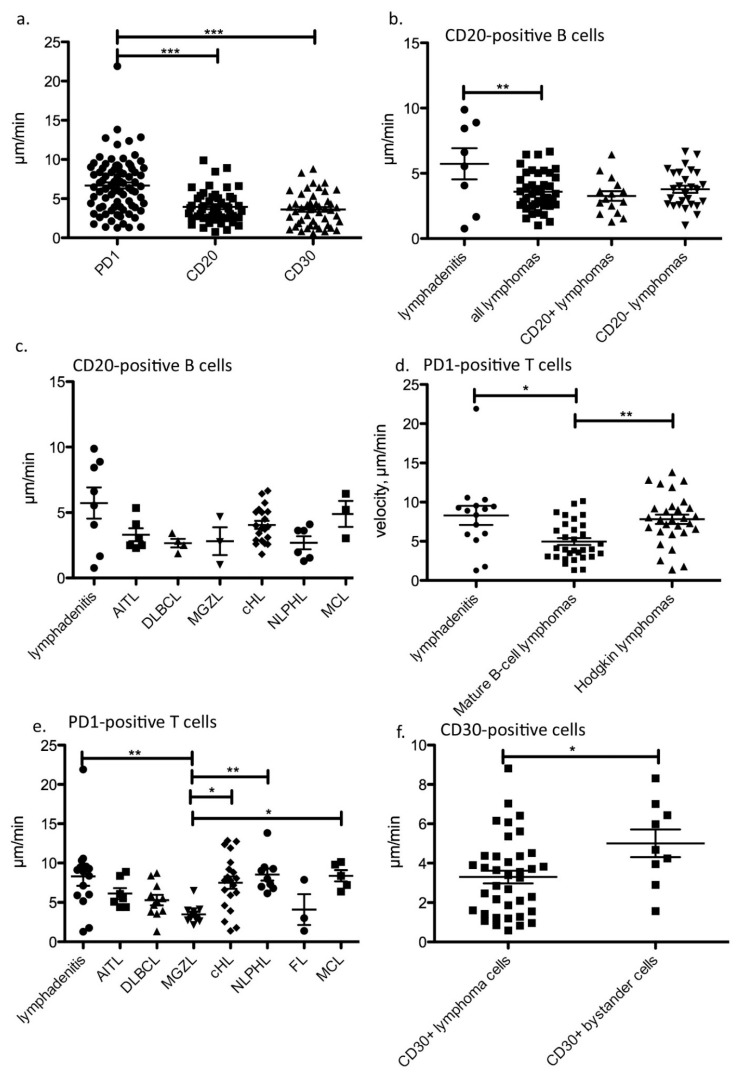
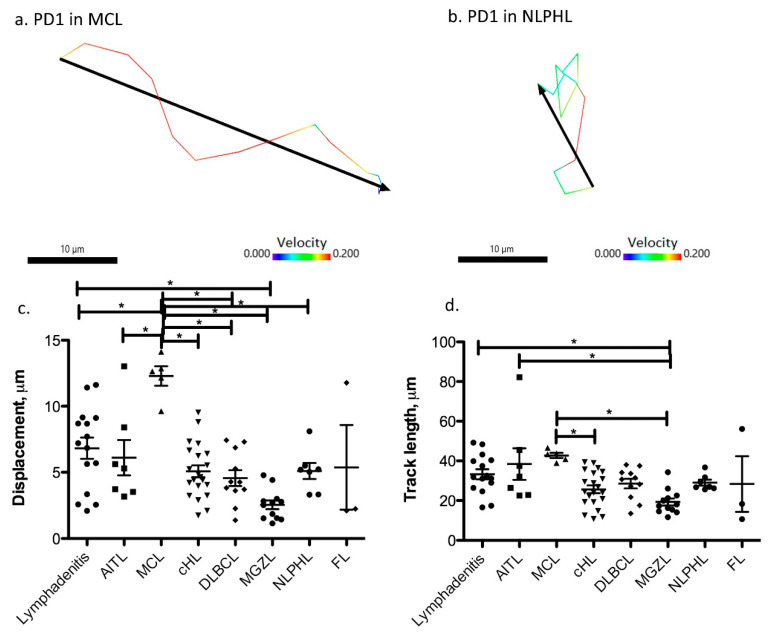
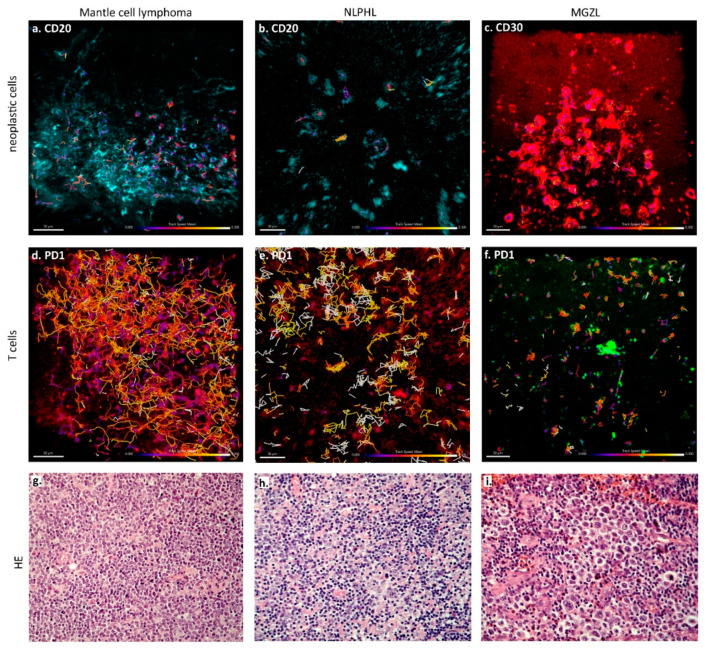
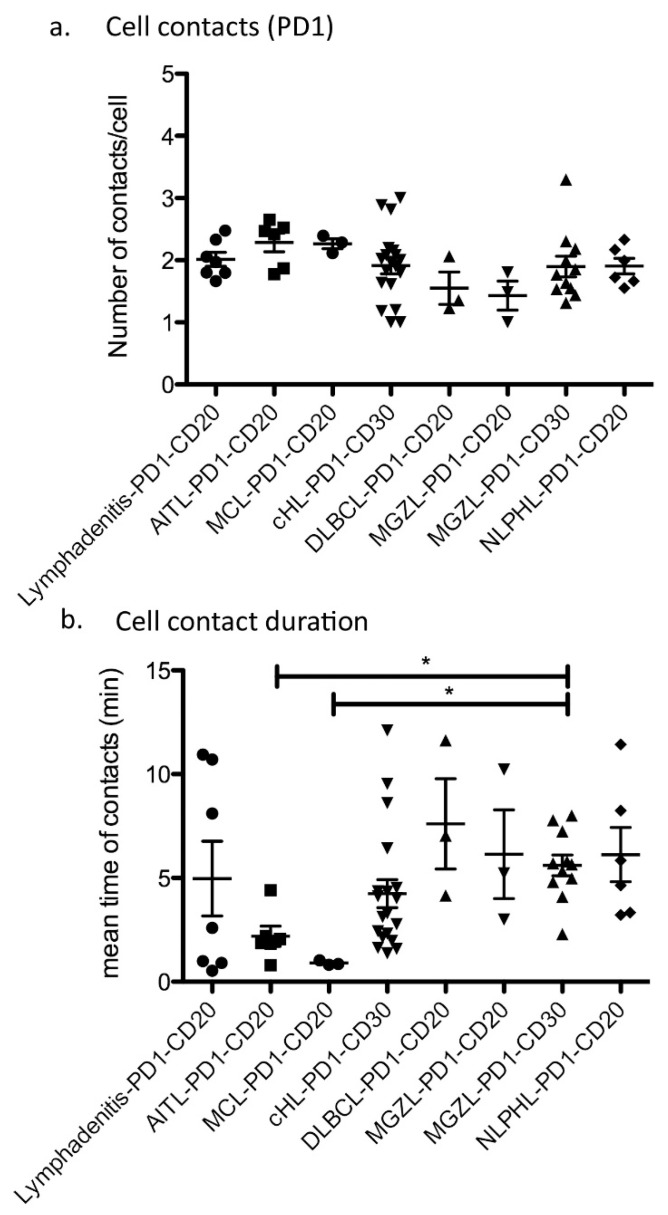
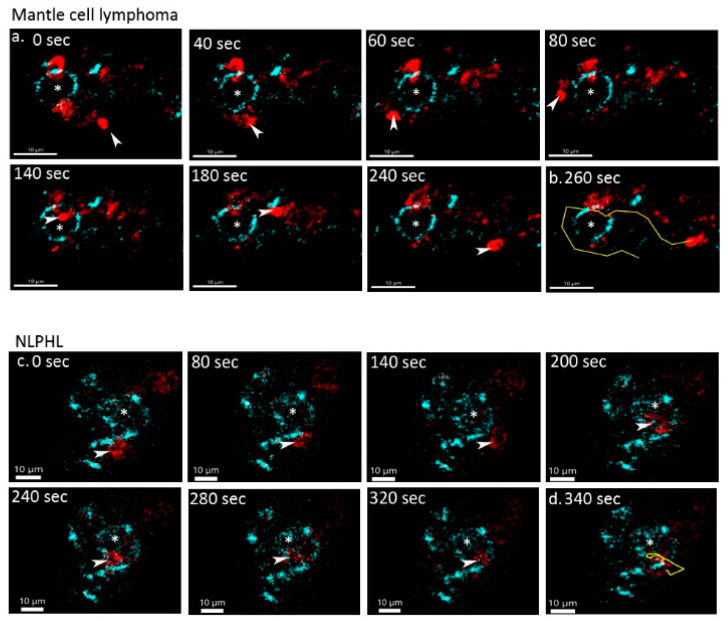
Profound knowledge exists about the clinical, morphologic, genomic, and transcriptomic characteristics of most lymphoma entities. However, information is currently lacking on the dynamic behavior of malignant lymphomas. This pilot study aimed to gain insight into the motility of malignant lymphomas and bystander cells in 20 human lymph nodes. Generally, B cells were faster under reactive conditions compared with B cells in malignant lymphomas. In contrast, PD1-positive T cells did not show systematic differences in velocity between reactive and neoplastic conditions in general. However, lymphomas could be divided into two groups: one with fast PD1-positive T cells (e.g., Hodgkin lymphoma and mantle cell lymphoma; means 8.4 and 7.8 µm/min) and another with slower PD1-positive T cells (e.g., mediastinal grey zone lymphoma; mean 3.5 µm/min). Although the number of contacts between lymphoma cells and PD1-positive T cells was similar in different lymphoma types, important differences were observed in the duration of these contacts. Among the lymphomas with fast PD1-positive T cells, contacts were particularly short in mantle cell lymphoma (mean 54 s), whereas nodular lymphocyte-predominant Hodgkin lymphoma presented prolonged contact times (mean 6.1 min). Short contact times in mantle cell lymphoma were associated with the largest spatial displacement of PD1-positive cells (mean 12.3 µm). Although PD1-positive T cells in nodular lymphocyte-predominant Hodgkin lymphoma were fast, they remained in close contact with the lymphoma cells, in line with a dynamic immunological synapse. This pilot study shows for the first time systematic differences in the dynamic behavior of lymphoma and bystander cells between different lymphoma types.
目前对于大多数淋巴瘤实体的临床、形态学、基因组和转录组特征已有深入了解。然而,关于恶性淋巴瘤的动态行为,目前仍缺乏相关信息。这项初步研究旨在深入了解20例人类淋巴结中恶性淋巴瘤及旁观细胞的运动情况。一般来说,与恶性淋巴瘤中的B细胞相比,反应性条件下的B细胞移动速度更快。相比之下,PD1阳性T细胞在反应性和肿瘤性条件下的速度总体上没有系统性差异。然而,淋巴瘤可分为两组:一组是PD1阳性T细胞移动速度快的(如霍奇金淋巴瘤和套细胞淋巴瘤;平均速度分别为8.4和7.8 µm/分钟),另一组是PD1阳性T细胞移动速度较慢的(如纵隔灰色地带淋巴瘤;平均速度为3.5 µm/分钟)。尽管不同淋巴瘤类型中淋巴瘤细胞与PD1阳性T细胞之间的接触数量相似,但在这些接触的持续时间上观察到了重要差异。在PD1阳性T细胞移动速度快的淋巴瘤中,套细胞淋巴瘤的接触时间特别短(平均54秒),而结节性淋巴细胞为主型霍奇金淋巴瘤的接触时间则较长(平均6.1分钟)。套细胞淋巴瘤中短接触时间与PD1阳性细胞的最大空间位移相关(平均12.3 µm)。尽管结节性淋巴细胞为主型霍奇金淋巴瘤中的PD1阳性T细胞移动速度快,但它们与淋巴瘤细胞保持密切接触,这与动态免疫突触一致。这项初步研究首次表明不同淋巴瘤类型之间淋巴瘤及旁观细胞的动态行为存在系统性差异。