Balta Igori, Stef Lavinia, Pet Ioan, Iancu Tiberiu, Stef Ducu, Corcionivoschi Nicolae
Bacteriology Branch, Veterinary Sciences Division, Agri-Food and Biosciences Institute, Belfast BT4 3SD, UK.
Faculty of Animal Science and Biotechnologies, University of Agricultural Sciences and Veterinary Medicine, 400372 Cluj-Napoca, Romania.
Biomedicines. 2021 Oct 14;9(10):1466. doi: 10.3390/biomedicines9101466.
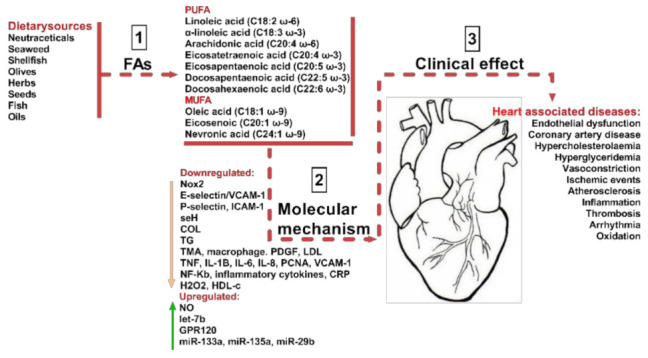
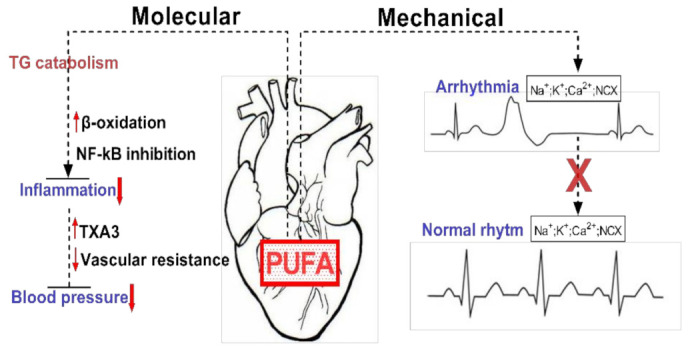
The destructive impact of cardiovascular diseases on health, including heart failure, peripheral artery disease, atherosclerosis, stroke, and other cardiac pathological conditions, positions these health conditions as leading causes of increased global mortality rates, thereby impacting the human quality of life. The considerable changes in modern lifestyles, including the increase in food intake and the change in eating habits, will unavoidably lead to an unbalanced consumption of essential fatty acids, with a direct effect on cardiovascular health problems. In the last decade, essential fatty acids have become the main focus of scientific research in medical fields aiming to establish their impact for preventing cardiovascular diseases and the associated risk factors. Specifically, polyunsaturated fatty acids (PUFA), such as omega 3 fatty acids, and monounsaturated fatty acids from various sources are mentioned in the literature as having a cardio-protective role, due to various biological mechanisms that are still to be clarified. This review aims to describe the major biological mechanisms of how diets rich in essential fatty acids, or simply essential fatty acid administration, could have anti-inflammatory, vasodilatory, anti-arrhythmic, antithrombotic, antioxidant, and anti-atherogenic effects. This review describes findings originating from clinical studies in which dietary sources of FAs were tested for their role in mitigating the impact of heart disorders in human health.
心血管疾病对健康具有破坏性影响,包括心力衰竭、外周动脉疾病、动脉粥样硬化、中风以及其他心脏病理状况,这些健康问题已成为全球死亡率上升的主要原因,进而影响人类生活质量。现代生活方式发生了显著变化,包括食物摄入量增加和饮食习惯改变,不可避免地导致必需脂肪酸摄入不均衡,直接影响心血管健康问题。在过去十年中,必需脂肪酸已成为医学领域科学研究的主要焦点,旨在确定它们对预防心血管疾病及相关风险因素的影响。具体而言,文献中提到,诸如欧米伽3脂肪酸之类的多不饱和脂肪酸(PUFA)以及各种来源的单不饱和脂肪酸,由于其各种尚未明确的生物学机制,具有心脏保护作用。本综述旨在描述富含必需脂肪酸的饮食或单纯给予必需脂肪酸如何产生抗炎、血管舒张、抗心律失常、抗血栓形成、抗氧化和抗动脉粥样硬化作用的主要生物学机制。本综述描述了来自临床研究的结果,其中对脂肪酸的饮食来源在减轻心脏疾病对人类健康影响方面的作用进行了测试。