Pancera Simone, Lopomo Nicola F, Bianchi Luca N C, Pedersini Paolo, Villafañe Jorge H
IRCCS Fondazione Don Carlo Gnocchi, 20148 Milan, Italy.
Department of Information Engineering, University of Brescia, Via Branze 38, 25123 Brescia, Italy.
Healthcare (Basel). 2021 Oct 19;9(10):1397. doi: 10.3390/healthcare9101397.
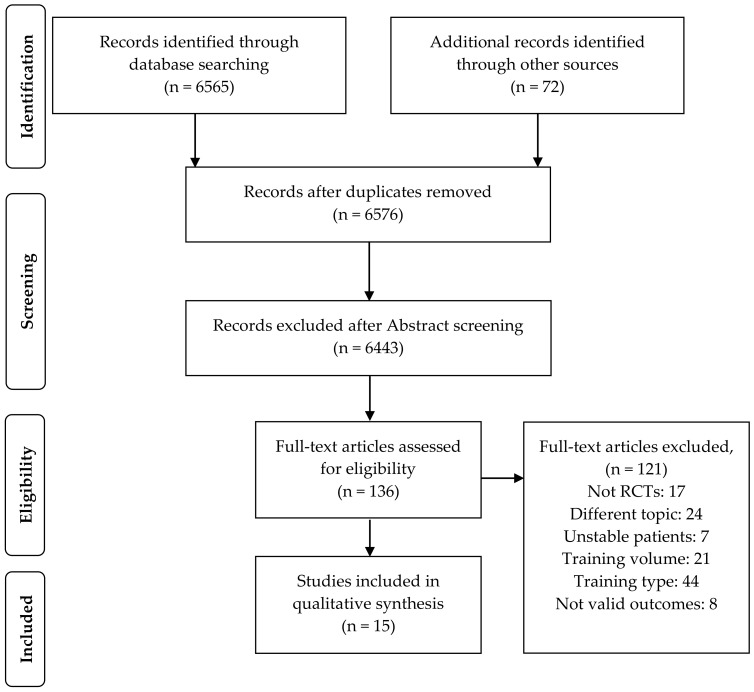
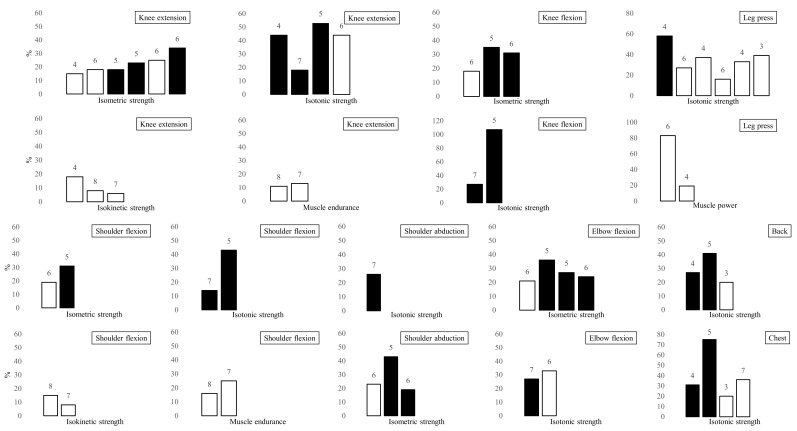
This systematic review aims to establish which isolated resistance training (RT) programs have been used in outpatients with chronic obstructive pulmonary disease (COPD) and their impact on all aspects of peripheral skeletal muscle function. Electronic databases were systematically searched up to June 2021. The eligibility criteria were: (1) randomized controlled trials investigating the effects of supervised and isolated RT programs in outpatients with COPD and (2) RT programs lasting 8-12 weeks, (3) including at least one outcome measure related to trainable muscle characteristics. Initially, 6576 studies were identified, whereas 15 trials met the inclusion criteria. All the included trials reported that isolated RT improved both upper and lower limbs' maximal strength. Muscle endurance and power also increased after RT but received less attention in the analysis. Furthermore, few studies assessed the effect of RT on muscle mass and cross-sectional area, reporting only limited improvement. Isolated RT programs carried out 2-3 days a week for 8-12 weeks improved skeletal muscle function in individuals with COPD. The RT program should be specifically focused to the trainable muscle characteristic to be improved. For this reason, we further encourage the introduction of a detailed assessment of muscle function and structure during the pulmonary rehabilitation practice.
本系统评价旨在确定哪些孤立性抗阻训练(RT)方案已用于慢性阻塞性肺疾病(COPD)门诊患者,以及这些方案对周围骨骼肌功能各方面的影响。截至2021年6月,我们对电子数据库进行了系统检索。纳入标准为:(1)调查有监督的孤立性RT方案对COPD门诊患者影响的随机对照试验;(2)持续8 - 12周的RT方案;(3)至少包括一项与可训练肌肉特征相关的结局指标。最初,共识别出6576项研究,其中15项试验符合纳入标准。所有纳入试验均报告,孤立性RT改善了上肢和下肢的最大力量。RT后肌肉耐力和功率也有所增加,但在分析中受到的关注较少。此外,很少有研究评估RT对肌肉质量和横截面积的影响,报告的改善程度有限。每周进行2 - 3天、持续8 - 12周的孤立性RT方案可改善COPD患者的骨骼肌功能。RT方案应特别针对有待改善的可训练肌肉特征。因此,我们进一步鼓励在肺康复实践中引入对肌肉功能和结构的详细评估。