Department of Medical and Surgical Specialties and Dentistry, University of Campania "Luigi Vanvitelli", Via de Crecchio, 6, 80138 Naples, Italy.
Rheumatology Unit, Department of Clinical and Experimental Medicine, University of Pisa, 56122 Pisa, Italy.
Medicina (Kaunas). 2021 Sep 25;57(10):1015. doi: 10.3390/medicina57101015.
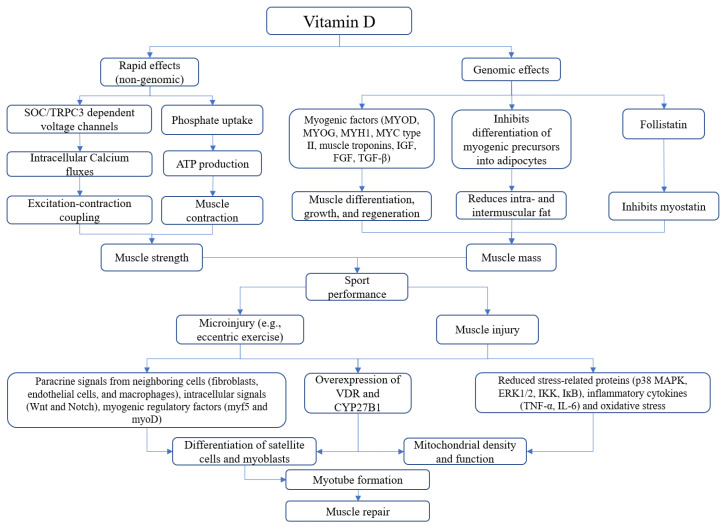
Muscle is one of the main targets for the biological effects of vitamin D. This hormone modulates several functions of skeletal muscles, from development to tissue repair after injury, through genomic and non-genomic mechanisms. Vitamin D deficiency and supplementation seem to significantly affect muscle strength in different populations, including athletes, although optimal serum 25(OH)D3 level for sport performance has not been defined so far. Additionally, vitamin D deficiency results in myopathy characterized by fast-twitch fiber atrophy, fatty infiltration, and fibrosis. However, less is known about regenerative effects of vitamin D supplementation after sport-related muscle injuries. Vitamin D receptor (VDR) is particularly expressed in the embryonic mesoderm during intrauterine life and in satellite cells at all stages of life for recovery of the skeletal muscle after injury. Vitamin D supplementation enhances muscle differentiation, growth, and regeneration by increasing the expression of myogenic factors in satellite cells. The objective of this narrative review is to describe the role of vitamin D in sport-related muscle injury and tissue regeneration.
肌肉是维生素 D 生物学效应的主要靶标之一。这种激素通过基因组和非基因组机制调节骨骼肌肉的多种功能,从发育到损伤后的组织修复。维生素 D 缺乏和补充似乎会显著影响不同人群的肌肉力量,包括运动员,尽管迄今为止尚未确定最佳的血清 25(OH)D3 水平以提高运动表现。此外,维生素 D 缺乏会导致肌病,其特征是快肌纤维萎缩、脂肪浸润和纤维化。然而,关于运动相关肌肉损伤后维生素 D 补充的再生作用知之甚少。维生素 D 受体 (VDR) 在宫内生命期间特别在胚胎中胚层表达,并在所有生命阶段的卫星细胞中表达,以在受伤后恢复骨骼肌肉。维生素 D 补充通过增加卫星细胞中肌生成因子的表达来增强肌肉分化、生长和再生。本综述的目的是描述维生素 D 在与运动相关的肌肉损伤和组织再生中的作用。