School of Clinical Dentistry, University of Sheffield, Claremont Crescent, Sheffield, S10 2TA, UK.
School of Psychology, University of Leeds, Lifton Place, Leeds, LS2 9JT, UK.
BMC Oral Health. 2021 Oct 22;21(1):546. doi: 10.1186/s12903-021-01907-3.
Dental caries in adolescents remains a significant public health problem with few oral health promotion interventions aimed at reducing dental caries in secondary school-aged students. Previous oral health and mobile health (mHealth) research has suggested the need for the development of a school-based behaviour change intervention incorporating a digital component. This study aimed to describe the development process of a behaviour change intervention to improve the oral health of students aged 11-16 years attending secondary schools in the UK.
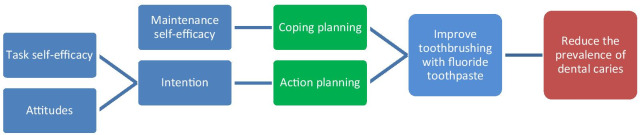
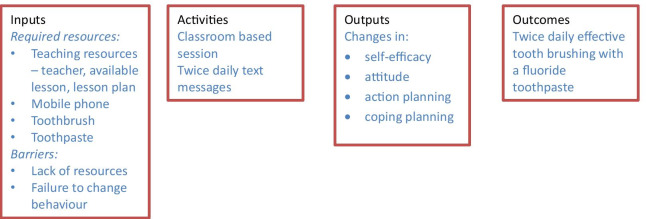
A six-step process was used to develop the complex intervention informed by behaviour change theory and involving students, young people, parents and teachers in the process. The steps were: (1) identifying the target behaviours, namely tooth brushing with a fluoride toothpaste (2) identifying the theoretical basis and developing the causal model (3) reviewing the relevant literature and developing the logic model (4) designing the intervention with young people, parents and school staff (5) specifying the intervention content and (6) translating this content into features of the intervention and piloting.
The resultant intervention included a quality-assured classroom-based session (CBS) (guided by a lesson plan and teaching resources), delivered by school teachers which was embedded within the school curriculum. This CBS was followed by a series of (Short Message Service) SMS texts delivered twice daily to student's mobile telephones with the content, duration and timing of the messages informed by involvement of students and young people.
An intervention to improve the oral health of secondary school students through improved tooth brushing was rigorously developed based on behaviour change theory and work with young people, parents and school staff. Further research is needed to evaluate the outcomes and processes involved following the delivery of this intervention. BRIGHT Trial Trial Registration ISRCTN12139369.
青少年龋齿仍然是一个重大的公共卫生问题,针对中学生减少龋齿的口腔健康促进干预措施很少。以前的口腔健康和移动健康(mHealth)研究表明,需要开发一种基于学校的行为改变干预措施,纳入数字组成部分。本研究旨在描述一种行为改变干预措施的开发过程,以改善英国中学年龄在 11-16 岁的学生的口腔健康。
使用六步过程来开发复杂的干预措施,该干预措施以行为改变理论为依据,并让学生、年轻人、家长和教师参与该过程。这些步骤是:(1)确定目标行为,即使用含氟牙膏刷牙;(2)确定理论基础并开发因果模型;(3)审查相关文献并开发逻辑模型;(4)与年轻人、家长和学校工作人员一起设计干预措施;(5)指定干预内容;(6)将此内容转化为干预措施的特征并进行试点。
最终的干预措施包括一个由学校教师提供的、以课程计划和教学资源为指导的课堂为基础的课程(CBS),该课程嵌入在学校课程中。该 CBS 之后是一系列每天两次发送到学生手机的短消息服务(SMS)文本,这些短信的内容、持续时间和时间由学生和年轻人的参与决定。
通过改善刷牙习惯来提高中学生口腔健康的干预措施是基于行为改变理论,并与年轻人、家长和学校工作人员合作严格开发的。需要进一步研究来评估该干预措施实施后的结果和过程。BRIGHT 试验试验注册号 ISRCTN12139369。