Ainsworth Hannah, Marshman Zoe, Whiteside Katie, Sykes Debbie, Fairhurst Caroline, Turner Emma, Chestnutt Ivor, Day Peter, Dey Donna, Elliott Louise, El-Yousfi Sarab, Hewitt Catherine, Jones Claire, Pavitt Sue, Robertson Mark, Torgerson David, Innes Nicola
York Trials Unit, Department of Health Sciences, University of York, York, UK.
School of Clinical Dentistry, University of Sheffield, Claremont Crescent, Sheffield, UK.
Pilot Feasibility Stud. 2023 Jan 27;9(1):17. doi: 10.1186/s40814-023-01243-z.
Dental caries is common in young people and has wide-ranging ramifications for health and quality of life. Text messaging interventions show promise as a means to promote oral health behaviour change among young people. This paper reports the internal pilot of the Brushing RemInder 4 Good oral HealTh (BRIGHT) trial, which is evaluating an intervention comprising an oral health classroom lesson and text messages about toothbrushing, on caries in young people. Pilot trial objectives were to evaluate the feasibility and appropriateness of recruitment and data collection methods, the randomisation strategy, and intervention delivery against progression criteria for the main trial.
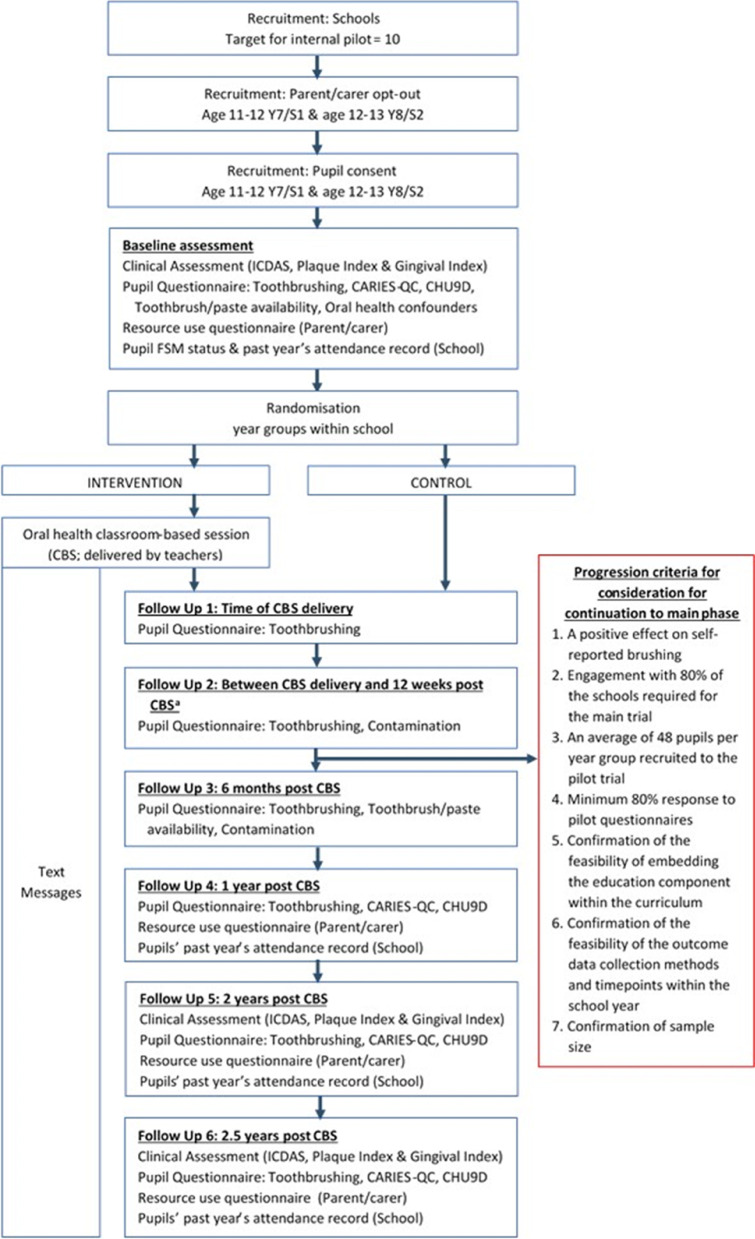
This is an internal pilot trial embedded within an assessor-blinded, two-arm, cluster randomised controlled trial. Participants were pupils aged 11-13 years (in year 7/S1 or year 8/S2) in secondary schools in England, Scotland, and Wales with above average pupil eligibility for free school meals. Following completion of pupil baseline questionnaires and dental assessments, year groups within schools were randomised to the intervention or control arm. Approximately 12 weeks later, participants completed a follow-up questionnaire, which included questions about sources of oral health advice to assess intervention contamination between year groups. At the end of the pilot phase, trial conduct was reviewed against pre-specified progression criteria.
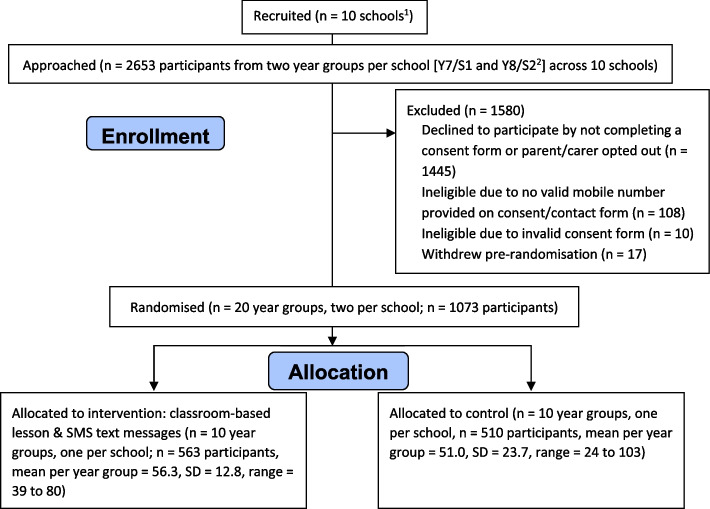
Ten schools were recruited for the pilot, with 20 year groups and 1073 pupils randomised (average of 54 pupils per year group). Data collection methods and intervention delivery were considered feasible, the response rate to the follow-up questionnaire was over 80%, there was an indication of a positive effect on self-reported toothbrushing, and interest was obtained from 80% of the schools required for the main trial. Despite partial intervention contamination between year groups, within-school randomisation at the level of the year-group was considered appropriate for the main trial, and the sample size was revised to account for partial contamination. Facilitators and barriers to recruitment and data collection were identified and strategies refined for the main trial.
Progression to the main trial of BRIGHT, with some design refinements, was concluded. The internal pilot was an efficient way to determine trial feasibility and optimise trial processes.
ISRCTN registry, ISRCTN12139369 , registered 10/05/2017.
龋齿在年轻人中很常见,对健康和生活质量有广泛影响。短信干预作为促进年轻人口腔健康行为改变的一种手段显示出前景。本文报告了“刷牙提醒促进良好口腔健康(BRIGHT)试验”的内部预试验,该试验正在评估一项包括口腔健康教育课和关于刷牙的短信的干预措施对年轻人龋齿的影响。预试验的目标是根据主要试验的进展标准评估招募和数据收集方法、随机化策略以及干预措施实施的可行性和适宜性。
这是一项嵌入评估者盲法、双臂、整群随机对照试验的内部预试验。参与者是英格兰、苏格兰和威尔士中学11至13岁(7年级/S1或8年级/S2)的学生,其享受免费学校餐的资格高于平均水平。在完成学生基线问卷和牙科评估后,学校内的年级被随机分配到干预组或对照组。大约12周后,参与者完成一份随访问卷,其中包括关于口腔健康建议来源的问题,以评估年级之间的干预污染情况。在预试验阶段结束时,根据预先设定的进展标准对试验实施情况进行了审查。
招募了10所学校进行预试验,20个年级和1073名学生被随机分组(每个年级平均54名学生)。数据收集方法和干预措施的实施被认为是可行的,随访问卷的回复率超过80%,有迹象表明对自我报告的刷牙行为有积极影响,并且获得了主要试验所需80%学校的参与意向。尽管年级之间存在部分干预污染,但在年级层面进行的校内随机化被认为适用于主要试验,并对样本量进行了修订以考虑部分污染情况。确定了招募和数据收集的促进因素和障碍,并为主要试验完善了策略。
得出结论,在进行一些设计改进后,BRIGHT试验可推进至主要试验阶段。内部预试验是确定试验可行性和优化试验流程的有效方法。
ISRCTN注册库,ISRCTN12139369,于2017年5月10日注册。