Fernández-Rodríguez Eduardo José, González-Sánchez Jesús, Puente-González Ana Silvia, Recio-Rodríguez José Ignacio, Sánchez-Gómez Celia, Méndez-Sánchez Roberto, Cruz-Hernández Juan Jesús, Rihuete-Galve María Isabel
Department of Nursing and Physiotherapy, University of Salamanca, Salamanca, Spain.
Medical Oncology Service, University Hospital Complex of Salamanca, Salamanca, Spain.
BMC Nurs. 2021 Oct 22;20(1):207. doi: 10.1186/s12912-021-00734-9.
The increase in the survival of oncology patients include multiple side effects as cancer-related asthenia and dyspnea, which represents a serious health problem. An implementation of the conventional clinical practice, developed through multimodal physical exercise and functional rehabilitation program intervention, may be useful in controlling dyspnoea. This study aims to evaluate the effects of a multimodal exercise and functional rehabilitation program on fatigue, pain, functional capacity, and quality of life in cancer patients with cancer-related asthenia.
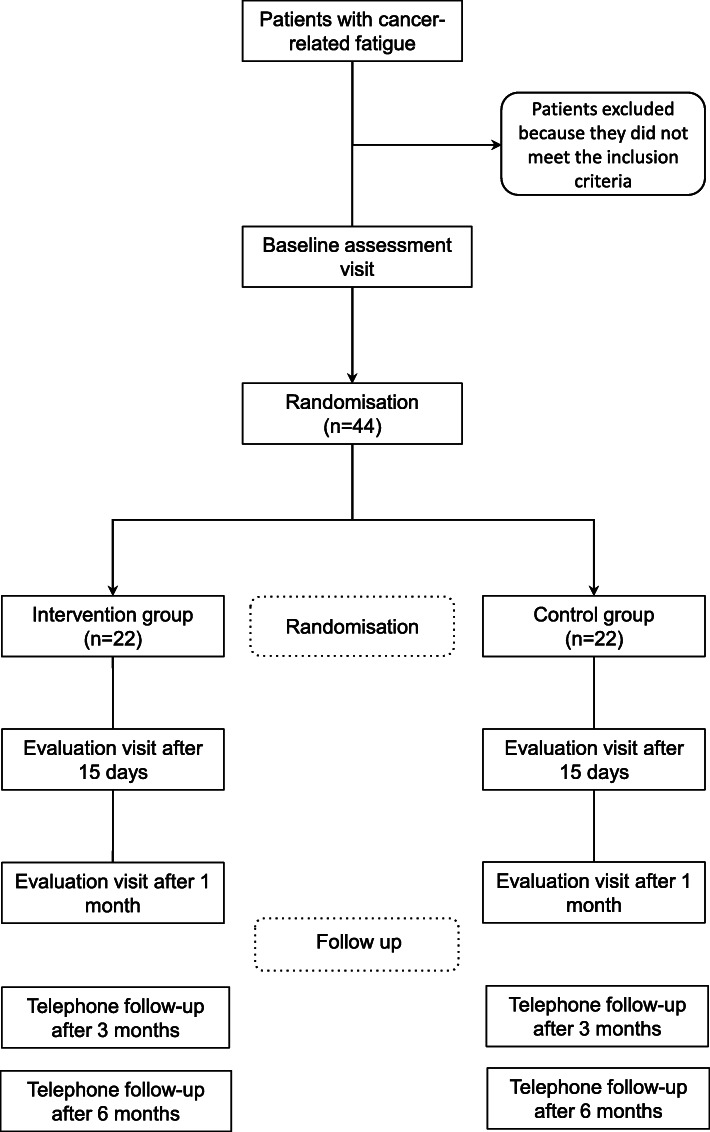
This is a protocol for an experimental, prospective, randomised study using a parallel, fixed assignment scheme, with an experimental group and a control group in patients from the oncology hospitalisation unit at the Salamanca University Hospital Complex in Spain, using consecutive sampling to select 50 participants with oncological asthenia who are hospitalised at the time of inclusion. After the baseline evaluation, the participants will be randomised into two groups. Both groups will receive standard clinical practice care and the normal health education program at discharge, but in addition, the participants assigned to the experimental group will also complete a multimodal exercise and functional rehabilitation program lasting one month. The primary outcomes will be basic activities of daily living (Barthel Index) and degree of asthenia (FACT-An scale). Additionally, physical performance will be evaluated with the Short Physical Performance Battery (SPPB), as will the attention and executive functions (Trail-Making Test), fear/avoidance of movement (TAMPA scale), pain (VAS scale), and body composition (waist, hip, brachial, thigh, wrist, and ankle circumferences).
The results of this study may be translated to clinical practice, incorporating a specific autonomy recovery programme into comprehensive rehabilitation programmes of care for cancer patients with asthenia. The current study addresses to improve the conventional clinical practice by proposing a multimodal physical exercise and functional rehabilitation program intervention, which will be implemented by an interdisciplinary team, to try to improve the autonomy of cancer patients with cancer-related asthenia.
ClinicalTrials.gov; ID: NCT04761289. (February 18, 2021). https://clinicaltrials.gov/ct2/show/ NCT04761289.
肿瘤患者生存率的提高伴随着多种副作用,如癌症相关性乏力和呼吸困难,这是一个严重的健康问题。通过多模式体育锻炼和功能康复计划干预制定的传统临床实践的实施,可能有助于控制呼吸困难。本研究旨在评估多模式运动和功能康复计划对患有癌症相关性乏力的癌症患者的疲劳、疼痛、功能能力和生活质量的影响。
这是一项实验性、前瞻性、随机研究的方案,采用平行、固定分配方案,在西班牙萨拉曼卡大学医院综合肿瘤住院部的患者中设立实验组和对照组,采用连续抽样法选择50名纳入时正在住院的患有肿瘤性乏力的参与者。在基线评估后,参与者将被随机分为两组。两组在出院时都将接受标准临床实践护理和正常的健康教育计划,但此外,分配到实验组的参与者还将完成一个为期一个月的多模式运动和功能康复计划。主要结局指标将是日常生活基本活动能力(巴氏指数)和乏力程度(FACT-An量表)。此外,将使用简短体能测试电池(SPPB)评估身体表现,以及注意力和执行功能(连线测验)、对运动的恐惧/回避(坦帕量表)、疼痛(视觉模拟量表)和身体成分(腰围、臀围、臂围、大腿围、腕围和踝围)。
本研究结果可能转化为临床实践,将特定的自主性恢复计划纳入针对患有乏力的癌症患者的综合康复护理计划中。当前研究旨在通过提出多模式体育锻炼和功能康复计划干预来改进传统临床实践,该干预将由一个跨学科团队实施,以试图提高患有癌症相关性乏力的癌症患者的自主性。
ClinicalTrials.gov;标识符:NCT04761289。(2021年2月18日)。https://clinicaltrials.gov/ct2/show/NCT04761289