Heidelberg Institute of Global Health, Heidelberg University Medical Cente, Heidelberg, Germany.
Department of Public Health, Erasmus MC, University Medical Center Rotterdam, Rotterdam, The Netherlands.
Malar J. 2021 Oct 23;20(1):416. doi: 10.1186/s12936-021-03948-z.
Although the association between malaria and anaemia is widely studied in patient cohorts, the population-representative causal effects of malaria on anaemia remain unknown. This study estimated the malaria-induced decrease in haemoglobin levels among young children in malaria-endemic Burkina Faso.
The study was based on pooled individual-level nationally representative health survey data (2010-2011, 2014, 2017-2018) from 17 599 children under 5 years of age. This data was used to estimate the effects of malaria on haemoglobin concentration, controlling for household fixed-effects, age, and sex in a series of regression analyses. The fixed-effects controlled for observed and unobserved confounding on the household level and allowed to determine the impact of malaria infection status on haemoglobin levels and anaemia prevalence. Furthermore, the diagnostic results from microscopy and rapid diagnostic tests were leveraged to provide a quasi-longitudinal perspective of acute and prolonged effects after malaria infection.
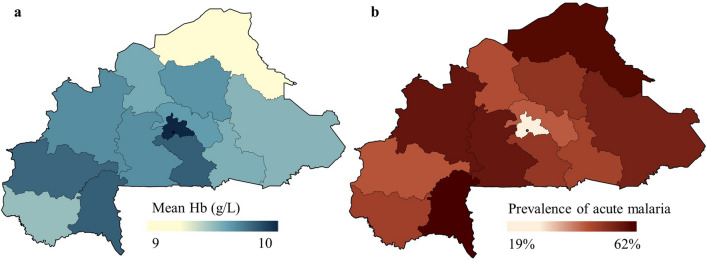
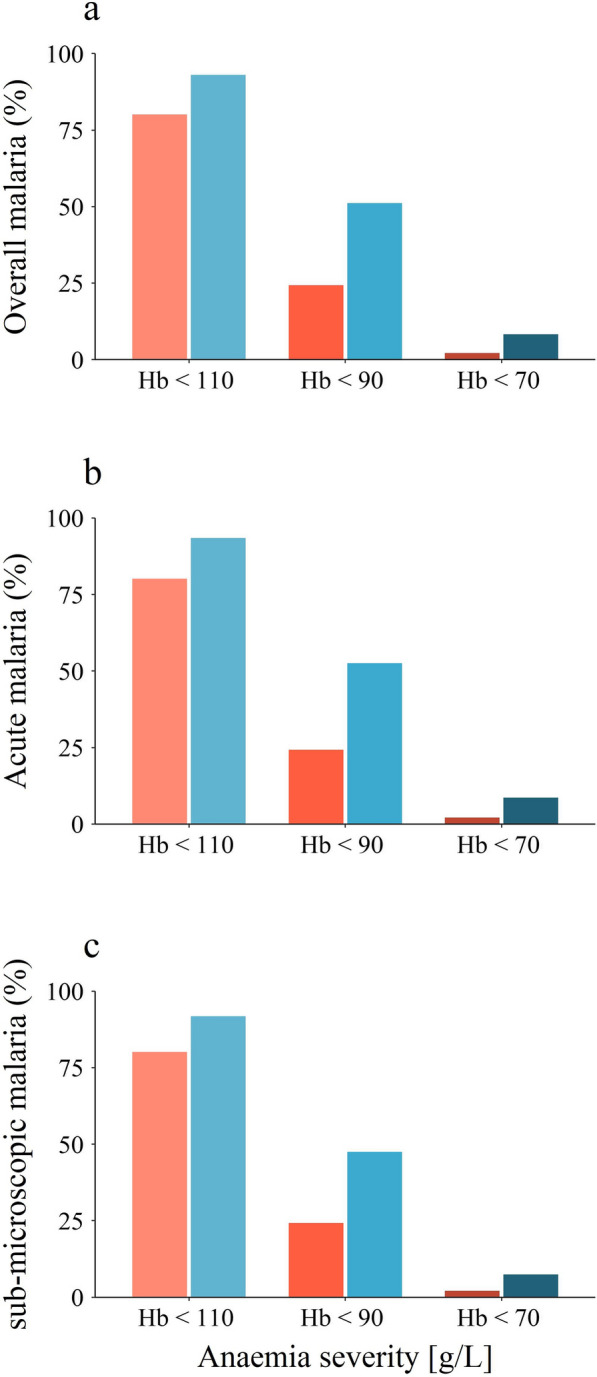
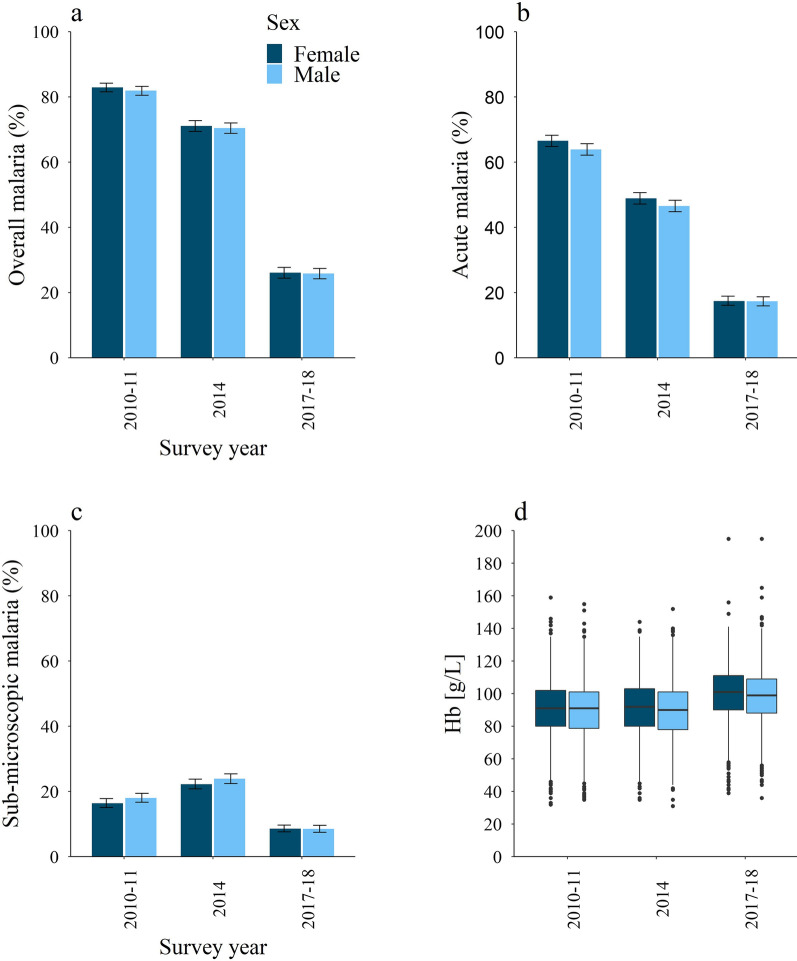
The prevalence of both malaria (survey prevalence ranging from 17.4% to 65.2%) and anaemia (survey prevalence ranging from 74% to 88.2%) was very high in the included surveys. Malaria was estimated to significantly reduce haemoglobin levels, with an overall effect of - 7.5 g/dL (95% CI - 8.5, - 6.5). Acute malaria resulted in a - 7.7 g/dL (95% CI - 8.8, - 6.6) decrease in haemoglobin levels. Recent malaria without current parasitaemia decreased haemoglobin concentration by - 7.1 g/dL (95% CI - 8.3, - 5.9). The in-sample predicted prevalence of severe anaemia was 9.4% among malaria positives, but only 2.2% among children without malaria.
Malaria infection has a strong detrimental effect on haemoglobin levels among young children in Burkina Faso. This effect seems to carry over even after acute infection, indicating prolonged haemoglobin reductions even after successful parasite-elimination. The quasi-experimental fixed-effect approach adds a population level perspective to existing clinical evidence.
尽管疟疾与贫血之间的关联在患者队列中得到了广泛研究,但疟疾对贫血的人群代表性因果效应仍不清楚。本研究旨在估计布基纳法索疟疾流行地区幼儿疟疾导致的血红蛋白水平下降。
本研究基于来自 17599 名 5 岁以下儿童的 2010-2011 年、2014 年和 2017-2018 年全国代表性健康调查的 pooled 个体水平数据。在一系列回归分析中,通过家庭固定效应、年龄和性别来控制,估计疟疾对血红蛋白浓度的影响。固定效应控制了家庭层面上的可观察和不可观察的混杂因素,并确定了疟疾感染状况对血红蛋白水平和贫血患病率的影响。此外,还利用显微镜和快速诊断检测的诊断结果提供了疟疾感染后急性和长期影响的准纵向视角。
纳入的调查中,疟疾(调查患病率为 17.4%至 65.2%)和贫血(调查患病率为 74%至 88.2%)的患病率都非常高。疟疾被估计会显著降低血红蛋白水平,总体效应为-7.5g/dL(95%CI-8.5,-6.5)。急性疟疾导致血红蛋白水平下降-7.7g/dL(95%CI-8.8,-6.6)。无当前寄生虫血症的近期疟疾使血红蛋白浓度降低了-7.1g/dL(95%CI-8.3,-5.9)。在样本内预测的疟疾阳性儿童严重贫血患病率为 9.4%,而无疟疾儿童仅为 2.2%。
疟疾感染对布基纳法索幼儿的血红蛋白水平有很强的不利影响。这种影响似乎在急性感染后仍会持续,表明即使在寄生虫消除后,血红蛋白水平也会持续下降。准实验性固定效应方法为现有临床证据提供了人群层面的视角。