Division of Pulmonology, Kiruddu National Referral Hospital, Kampala, Uganda.
Makerere University Lung Institute, PO Box 26343, Kampala, Uganda.
BMC Infect Dis. 2021 Oct 24;21(1):1093. doi: 10.1186/s12879-021-06801-5.
Gender differences among patients with drug resistant tuberculosis (DRTB) and HIV co-infection could affect treatment outcomes. We compared characteristics and treatment outcomes of DRTB/HIV co-infected men and women in Uganda.
We conducted a retrospective chart review of patients with DRTB from 16 treatment sites in Uganda. Eligible patients were aged ≥ 18 years, had confirmed DRTB, HIV co-infection and a treatment outcome registered between 2013 and 2019. We compared socio-demographic and clinical characteristics and tuberculosis treatment outcomes between men and women. Potential predictors of mortality were determined by cox proportional hazard regression analysis that controlled for gender. Statistical significance was set at p < 0.05.
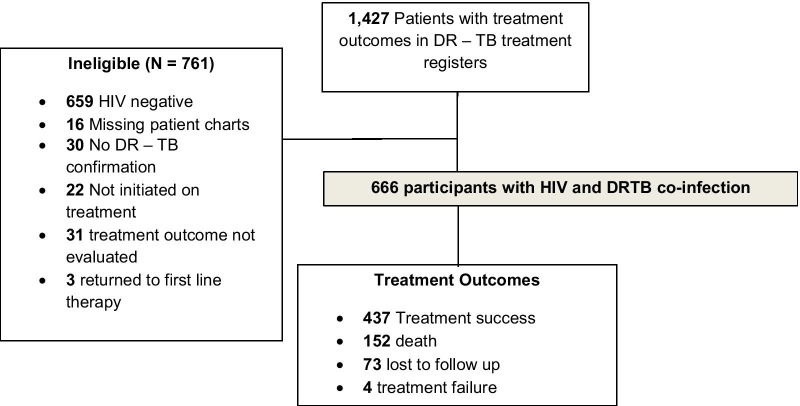
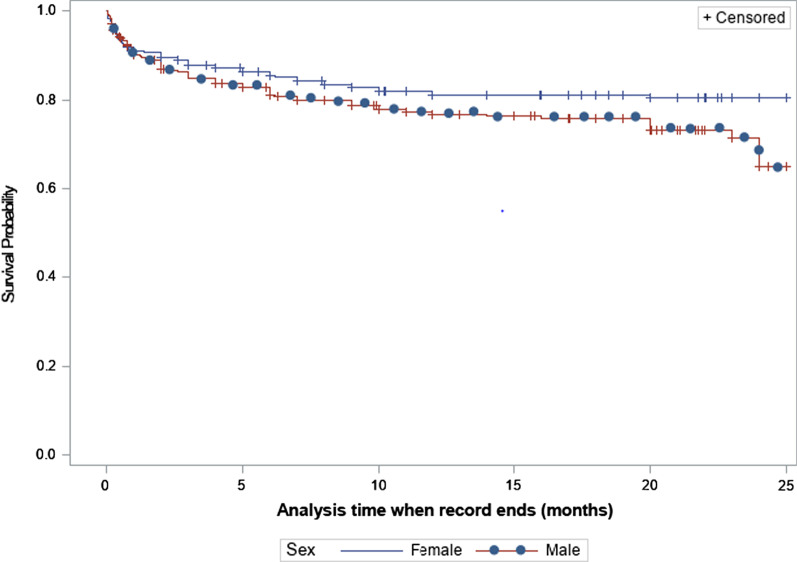
Of 666 DRTB/HIV co-infected patients, 401 (60.2%) were men. The median (IQR) age of men and women was 37.0 (13.0) and 34.0 (13.0) years respectively (p < 0.001). Men were significantly more likely to be on tenofovir-based antiretroviral therapy (ART), high-dose isoniazid-containing DRTB regimen and to have history of cigarette or alcohol use. They were also more likely to have multi-drug resistant TB, isoniazid and streptomycin resistance and had higher creatinine, aspartate and gamma-glutamyl aminotransferase and total bilirubin levels. Conversely, women were more likely to be unemployed, unmarried, receive treatment from the national referral hospital and to have anemia, a capreomycin-containing DRTB regimen and zidovudine-based ART. Treatment success was observed among 437 (65.6%) and did not differ between the genders. However, mortality was higher among men than women (25.7% vs. 18.5%, p = 0.030) and men had a shorter mean (standard error) survival time (16.8 (0.42) vs. 19.0 (0.46) months), Log Rank test (p = 0.046). Predictors of mortality, after adjusting for gender, were cigarette smoking (aHR = 4.87, 95% CI 1.28-18.58, p = 0.020), an increase in alanine aminotransferase levels (aHR = 1.05, 95% CI 1.02-1.07, p < 0.001), and history of ART default (aHR = 3.86, 95% CI 1.31-11.37, p = 0.014) while a higher baseline CD4 count was associated with lower mortality (aHR = 0.94, 95% CI 0.89-0.99, p = 0.013 for every 10 cells/mm increment).
Mortality was higher among men than women with DRTB/HIV co-infection which could be explained by several sociodemographic and clinical differences.
耐多药结核病(DRTB)和 HIV 合并感染患者的性别差异可能会影响治疗结果。我们比较了乌干达 DRTB/HIV 合并感染男性和女性患者的特征和治疗结果。
我们对来自乌干达 16 个治疗点的 DRTB 患者进行了回顾性病历审查。合格的患者年龄≥18 岁,确诊为 DRTB、HIV 合并感染,并在 2013 年至 2019 年期间登记了治疗结果。我们比较了男性和女性的社会人口统计学和临床特征以及结核病治疗结果。通过 Cox 比例风险回归分析确定了死亡率的潜在预测因素,该分析控制了性别因素。p 值<0.05 为统计学显著。
在 666 例 DRTB/HIV 合并感染患者中,401 例(60.2%)为男性。男性和女性的中位(IQR)年龄分别为 37.0(13.0)和 34.0(13.0)岁(p<0.001)。男性更有可能接受基于替诺福韦的抗逆转录病毒治疗(ART)、高剂量异烟肼含 DRTB 方案、有吸烟或饮酒史。他们也更有可能患有耐多药结核病、异烟肼和链霉素耐药,并且肌酐、天门冬氨酸和γ-谷氨酰转移酶以及总胆红素水平更高。相比之下,女性更有可能失业、未婚、接受国家转诊医院的治疗,并且更有可能贫血、接受含卷曲霉素的 DRTB 方案和齐多夫定为基础的 ART。437 例(65.6%)观察到治疗成功,但性别之间没有差异。然而,男性的死亡率高于女性(25.7%对 18.5%,p=0.030),男性的平均(标准误差)生存时间更短(16.8(0.42)对 19.0(0.46)个月),对数秩检验(p=0.046)。调整性别因素后,死亡率的预测因素包括吸烟(aHR=4.87,95%CI 1.28-18.58,p=0.020)、丙氨酸氨基转移酶水平升高(aHR=1.05,95%CI 1.02-1.07,p<0.001)和 ART 停药史(aHR=3.86,95%CI 1.31-11.37,p=0.014),而较高的基线 CD4 计数与较低的死亡率相关(aHR=0.94,95%CI 0.89-0.99,每增加 10 个细胞/mm 增量 p=0.013)。
与 DRTB/HIV 合并感染的女性相比,男性的死亡率更高,这可以用几个社会人口统计学和临床差异来解释。