Preventive Medicine Department, Ministry of Public Health, Beirut, Lebanon.
Research Center for Population Health (BPH), Institut de santé publique d'épidémiologie et de développement (ISPED), Bordeaux University, Bordeaux, France.
Hum Resour Health. 2021 Oct 24;19(1):131. doi: 10.1186/s12960-021-00673-1.
Since the focus of healthcare has shifted toward prevention, pharmacists were highly encouraged to expand their practice to include immunization services. Our study aimed to assess the knowledge, attitudes and beliefs of community-based Lebanese pharmacists, in addition to their willingness to expand their practice scope to include vaccine administration.
A cross-sectional study was conducted during the phase preceding the arrival of the COVID-19 vaccine in Lebanon between 1 and 31st December 2020. Using a stratified random sampling method, data were collected from Lebanese community pharmacists (CPs) through an online survey that included information on socio-demographic characteristics, clinical experience, willingness to administer vaccines, knowledge about vaccination, attitudes towards immunization, reasons supporting utilizing pharmacists as immunizers and the requested elements to incorporate immunization in pharmacists' practice scope. Multivariable analyses were performed to identify the factors associated with knowledge.
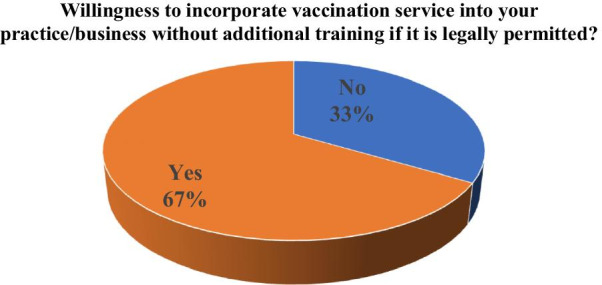
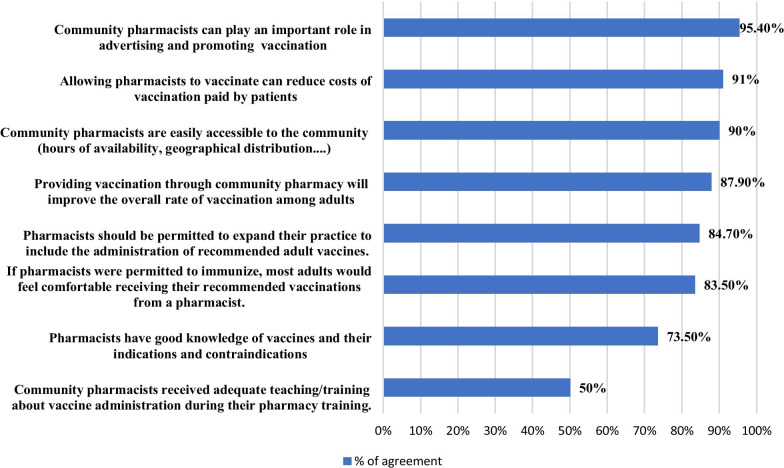
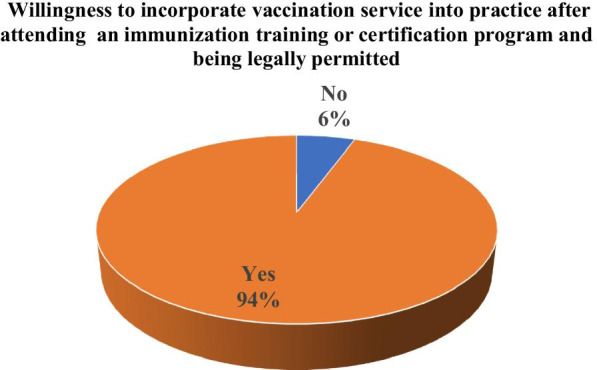
A total of 412 community pharmacists participated in this survey. Of the total, 66.5% of the surveyed CPs are willing to administer vaccines. The majority of them (89.8%) had an overall good level. Out of all, 92.7% showed a positive overall attitude score toward immunization, 95.4% agreed that community pharmacists can play an important role in advertising and promoting vaccination. The main needed elements for implementing immunization services in pharmacies listed by participants were: support of health authorities (99.3%), statutory allowance (82.8%), patient demand (95.4%), pharmacist's interest (96.1%) and continuous education and training workshops on immunization. Older CPs (50 years and above) [aOR = 0.703, CI 95% (0.598-0.812)] and those working in Bekaa and North have lower knowledge score than their counterparts. High educational level [aOR = 1.891, CI 95% (1.598-2.019)], previous experience in immunization [aOR = 3.123, CI 95% (2.652-4.161)] and working in urban areas [aOR = 3.640, CI 95% (2.544-4.717)] were positively associated with a good knowledge level.
Most of Lebanese community pharmacists are willing to offer immunizations. The expansion of the pharmacists practice scope to include provision of immunizations required a national plan that encompasses strengthening knowledge, training, certification for eligibility to administer vaccines, enhancing pharmacovigilance and statutory reform.
随着医疗保健重点转向预防,药剂师被大力鼓励扩大其执业范围,包括免疫服务。我们的研究旨在评估黎巴嫩社区药剂师的知识、态度和信念,以及他们扩大执业范围以提供疫苗接种的意愿。
在 2020 年 12 月 1 日至 31 日期间,在 COVID-19 疫苗抵达黎巴嫩之前,进行了一项横断面研究。使用分层随机抽样方法,通过在线调查从黎巴嫩社区药剂师(CPs)收集数据,调查信息包括社会人口统计学特征、临床经验、接种疫苗的意愿、疫苗接种知识、对免疫的态度、支持利用药剂师作为免疫接种者的理由以及将免疫纳入药剂师实践范围的要求。进行多变量分析以确定与知识相关的因素。
共有 412 名社区药剂师参与了这项调查。在被调查的 CPs 中,66.5%的人愿意接种疫苗。他们中的大多数(89.8%)总体上具有良好的水平。在所有参与者中,92.7%对免疫接种表现出积极的总体态度评分,95.4%同意社区药剂师可以在宣传和推广疫苗接种方面发挥重要作用。参与者列出的在药店实施免疫服务的主要要求包括:卫生当局的支持(99.3%)、法定津贴(82.8%)、患者需求(95.4%)、药剂师的兴趣(96.1%)和免疫接种继续教育和培训研讨会。50 岁及以上的老年药剂师(aOR=0.703,95%CI(0.598-0.812))和在贝卡和北部工作的药剂师得分低于同龄人。较高的教育水平[aOR=1.891,95%CI(1.598-2.019)]、免疫接种方面的先前经验[aOR=3.123,95%CI(2.652-4.161)]和在城市地区工作[aOR=3.640,95%CI(2.544-4.717)]与良好的知识水平呈正相关。
大多数黎巴嫩社区药剂师愿意提供免疫接种。扩大药剂师的执业范围,包括提供疫苗接种,需要一项涵盖加强知识、培训、接种疫苗资格认证、加强药物警戒和法定改革的国家计划。