Patil-Bhole Trupti, Wele Asmita, Gudi Ramacharya, Thakur Kapil, Nadkarni Shailesh, Panmand Rajendra, Kale Bharat
Department of Rasashastra and Bhaishajyakalpana, College of Ayurved, Bharati Vidyapeeth (Deemed to be University), Pune 411043, India.
Department of Rasashastra and Bhaishajyakalpana, College of Ayurved, Bharati Vidyapeeth (Deemed to be University), Pune 411043, India.
J Ayurveda Integr Med. 2021 Oct-Dec;12(4):640-648. doi: 10.1016/j.jaim.2021.06.017. Epub 2021 Oct 22.
Swarnabhasma (calcined gold) is a famous ancient Ayurvedic medicine. However, its detail characteristic investigations are very limited.
Herein, investigation of swarnabhasma is demonstrated using ancient and ultramodern techniques to understand the physicochemical nature of this drug, and to understand whether the mercury [Parada] used during preparation method marks its presence in swarnabhasma.
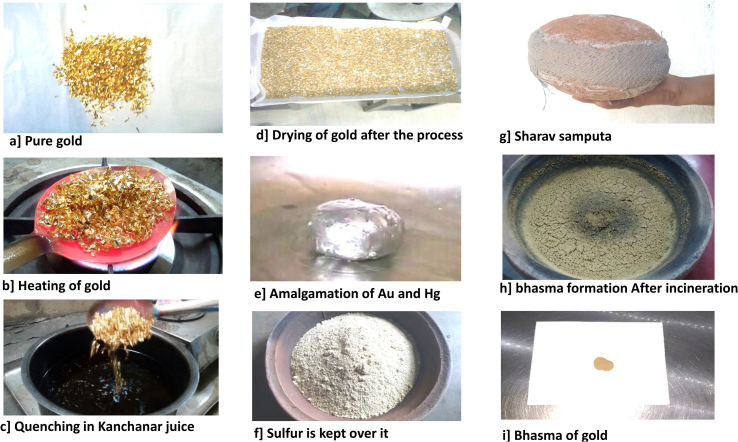
The investigated swarnabhasma was prepared by repeated incinerations of Au-Hg-Lemon juice amalgamation and sulphur. The bhasma was tested by all traditional tests of rasashastra. It was characterized by X-ray diffraction (XRD), Field Emission Scanning Electron Microscope (FE-SEM), Field Emission Transmission Electron Microscopy (FE-TEM), Inductively Coupled Plasma Atomic Emission Spectroscopy (ICP-AES), Energy Dispersive X-ray Fluorescence (EDXRF), Fourier Transform Infrared Spectroscopy (FTIR), and gravimetric analysis.
Traditional tests of rasashastra were complied by the sample. XRD confirms that swarnabhasma consists of principally pure gold at nanoscale. FE-SEM showed agglomerated particles. FE-TEM showed that swarnabhasma contains highly crystalline nanostructured gold comprised with spherical gold nanoparticles of size, 5-20 nm. ICP-AES exhibited absolute absence of Hg and presence of Au, Si, Ag, Al, Ca, Cu, Fe, K, Mg, Mn, Na, P, Sr, Ti, and Zn. EDXRF confirmed the absence of mercury and confirmed the presence of Au, Si, Zr, Nb, S, Cl, K, Ca, Fe, and Ni. FTIR confirmed presence of water molecules adsorbed over surface of bhasma. Gravimetric analysis confirmed presence of 95% gold.
Nano-structuring of gold enhances the surface area as well as activity. The present investigation shows that the entire process from rasashastra confers the unique nanostructure to gold and same is responsible for its medicinal potential. This nanomedicine is highly stable, which is specified as niruttha and apunarbhava in rasashastra.
煅金(Swarnabhasma)是一种著名的古代阿育吠陀药物。然而,对其详细特性的研究非常有限。
本文采用古代和超现代技术对煅金进行研究,以了解该药物的物理化学性质,并了解制备方法中使用的汞(Parada)是否在煅金中留下痕迹。
所研究的煅金是通过对金 - 汞 - 柠檬汁混合物和硫进行反复焚烧制备而成。该药物经所有传统的吠陀炼金术测试。通过X射线衍射(XRD)、场发射扫描电子显微镜(FE - SEM)、场发射透射电子显微镜(FE - TEM)、电感耦合等离子体原子发射光谱(ICP - AES)、能量色散X射线荧光光谱(EDXRF)、傅里叶变换红外光谱(FTIR)和重量分析对其进行表征。
该样品符合吠陀炼金术的传统测试。XRD证实煅金主要由纳米级的纯金组成。FE - SEM显示出团聚颗粒。FE - TEM表明煅金含有高度结晶的纳米结构金,由尺寸为5 - 20纳米的球形金纳米颗粒组成。ICP - AES显示绝对不含汞,存在金、硅、银、铝、钙、铜、铁、钾、镁、锰、钠、磷、锶、钛和锌。EDXRF证实不含汞,并证实存在金、硅、锆、铌、硫、氯、钾、钙、铁和镍。FTIR证实在药物表面吸附有水分子。重量分析证实金的含量为95%。
金的纳米结构化增加了表面积以及活性。本研究表明,从吠陀炼金术开始的整个过程赋予了金独特的纳米结构,这也是其药用潜力的原因。这种纳米药物非常稳定,在吠陀炼金属中被指定为niruttha和apunarbhava。