Sondej Tadeusz, Zawadzka Sylwia
Faculty of Electronics, Military University of Technology, Warsaw, Poland.
Measurement (Lond). 2022 Jan;187:110329. doi: 10.1016/j.measurement.2021.110329. Epub 2021 Oct 16.
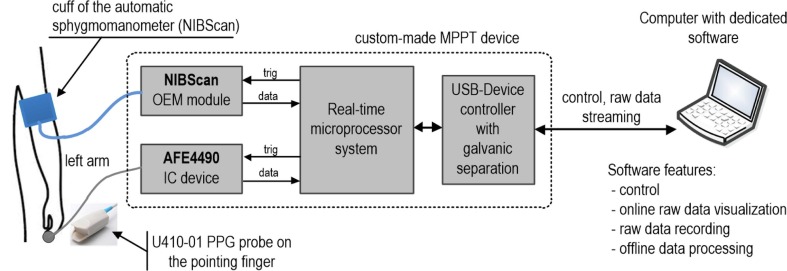
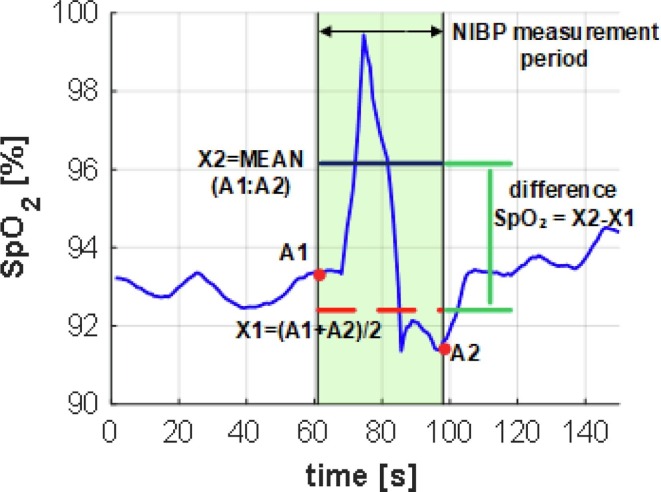
Information about blood arterial oxygen saturation (SpO) is crucial in critical care settings or home health monitoring during the COVID-19 pandemic. Also, we need to identify the factors that affect the SpO measurement. In this paper, the effect of compression of the cuff during noninvasive blood pressure (NIBP) measurement on the SpO results was investigated. A custom-made system was used for simultaneous measurement of NIBP and SpO. The study was conducted on 213 subjects aged between 21 and 93, with a systolic blood pressure of (94 to 194) mmHg, diastolic blood pressure of (52-98) mmHg, and 994 NIBP readings were used for the analysis. During the NIBP measurement, momentary changes in SpO can reach ±17% and are in most cases positive (mean 2.9%). The change was not correlated with sex, age, height, body weight, BMI, HR and blood pressure. The obtained results show that frequent NIBP measurements may lead to wrong conclusions about SpO. In our study, pressure measurements mainly caused the increase of blood oxygenation level.
在新冠疫情期间的重症监护环境或家庭健康监测中,有关动脉血氧饱和度(SpO)的信息至关重要。此外,我们需要确定影响SpO测量的因素。本文研究了无创血压(NIBP)测量过程中袖带压迫对SpO结果的影响。使用定制系统同时测量NIBP和SpO。该研究针对213名年龄在21至93岁之间的受试者进行,收缩压为(94至194)mmHg,舒张压为(52 - 98)mmHg,并使用994次NIBP读数进行分析。在NIBP测量期间,SpO的瞬间变化可达±17%,且在大多数情况下为正值(平均2.9%)。该变化与性别、年龄、身高、体重、BMI、心率和血压无关。所得结果表明,频繁进行NIBP测量可能会导致关于SpO的错误结论。在我们的研究中,压力测量主要导致血液氧合水平升高。