Jin Jing, Fang Fuquan, Gao Wei, Chen Hanjian, Wen Jiali, Wen Xuehua, Chen Junfa
Zhejiang Center for Clinical Laboratory, Zhejiang Provincial People's Hospital, Affiliated People's Hospital, Hangzhou Medical College, Hangzhou, China.
Department of Anesthesiology, The First Affiliated Hospital, Zhejiang University School of Medicine, Hangzhou, China.
Front Cell Neurosci. 2021 Oct 7;15:739699. doi: 10.3389/fncel.2021.739699. eCollection 2021.
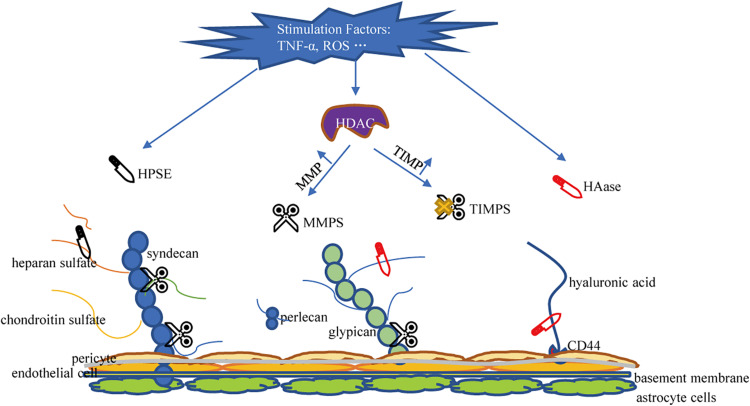
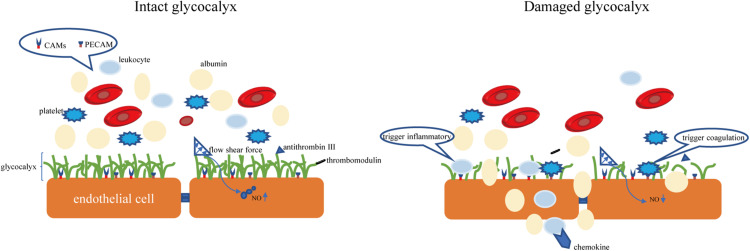
The vascular endothelial glycocalyx is a dense, bush-like structure that is synthesized and secreted by endothelial cells and evenly distributed on the surface of vascular endothelial cells. The blood-brain barrier (BBB) is mainly composed of pericytes endothelial cells, glycocalyx, basement membranes, and astrocytes. The glycocalyx in the BBB plays an indispensable role in many important physiological functions, including vascular permeability, inflammation, blood coagulation, and the synthesis of nitric oxide. Damage to the fragile glycocalyx can lead to increased permeability of the BBB, tissue edema, glial cell activation, up-regulation of inflammatory chemokines expression, and ultimately brain tissue damage, leading to increased mortality. This article reviews the important role that glycocalyx plays in the physiological function of the BBB. The review may provide some basis for the research direction of neurological diseases and a theoretical basis for the diagnosis and treatment of neurological diseases.
血管内皮糖萼是一种致密的、灌木丛状结构,由内皮细胞合成并分泌,均匀分布于血管内皮细胞表面。血脑屏障(BBB)主要由周细胞、内皮细胞、糖萼、基底膜和星形胶质细胞组成。血脑屏障中的糖萼在许多重要生理功能中发挥着不可或缺的作用,包括血管通透性、炎症、凝血以及一氧化氮的合成。脆弱的糖萼受损会导致血脑屏障通透性增加、组织水肿、神经胶质细胞活化、炎症趋化因子表达上调,最终导致脑组织损伤,增加死亡率。本文综述了糖萼在血脑屏障生理功能中所起的重要作用。该综述可能为神经疾病的研究方向提供一些依据,并为神经疾病的诊断和治疗提供理论基础。