de Pins Benoit, Mendes Tiago, Giralt Albert, Girault Jean-Antoine
Institut du Fer à Moulin, Paris, France.
Inserm UMR-S 1270, Paris, France.
Front Synaptic Neurosci. 2021 Oct 6;13:749001. doi: 10.3389/fnsyn.2021.749001. eCollection 2021.
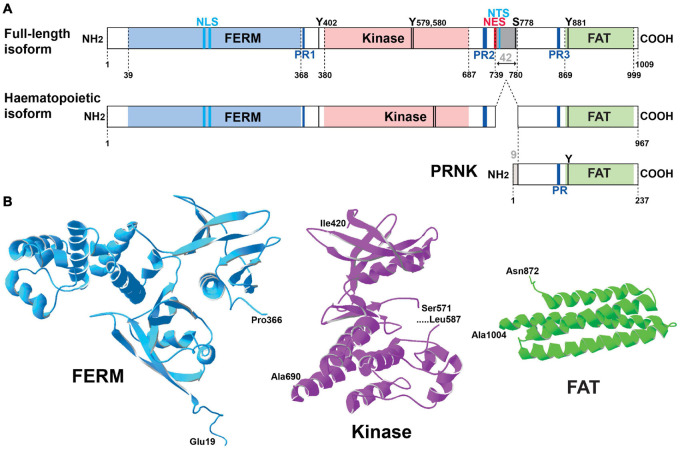
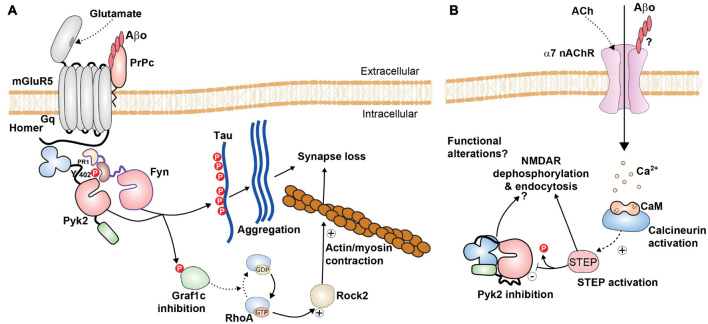
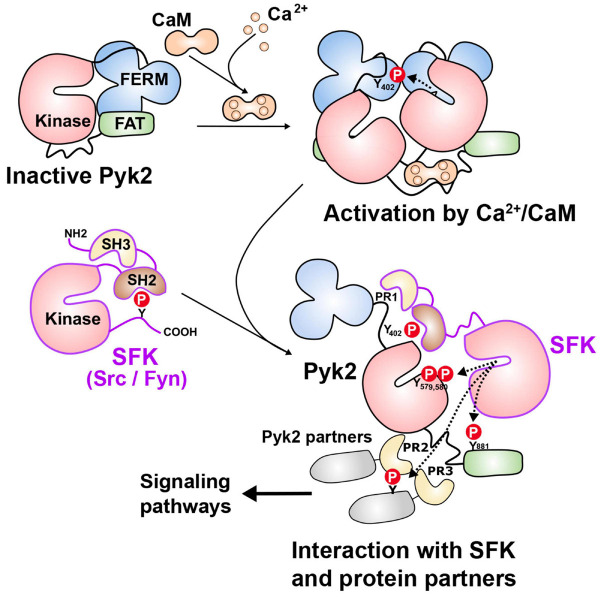
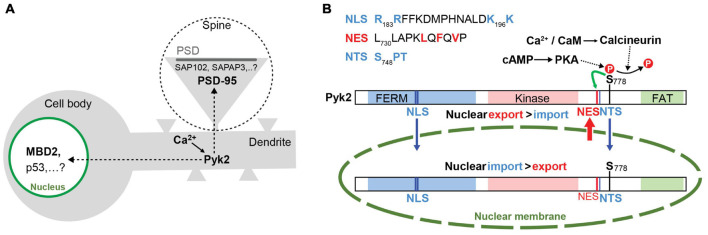
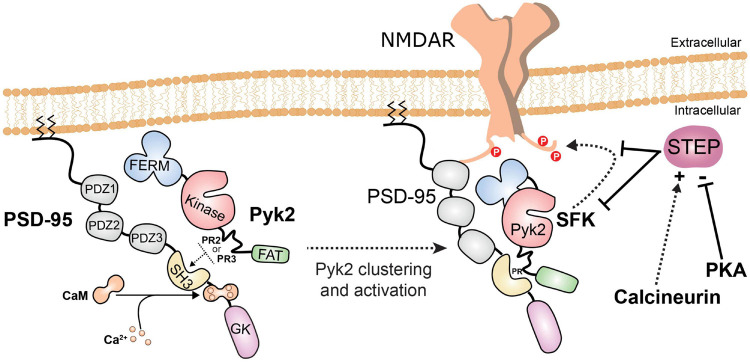
Pyk2 is a non-receptor tyrosine kinase highly enriched in forebrain neurons. Pyk2 is closely related to focal adhesion kinase (FAK), which plays an important role in sensing cell contacts with extracellular matrix and other extracellular signals controlling adhesion and survival. Pyk2 shares some of FAK's characteristics including recruitment of Src-family kinases after autophosphorylation, scaffolding by interacting with multiple partners, and activation of downstream signaling pathways. Pyk2, however, has the unique property to respond to increases in intracellular free Ca, which triggers its autophosphorylation following stimulation of various receptors including glutamate NMDA receptors. Pyk2 is dephosphorylated by the striatal-enriched phosphatase (STEP) that is highly expressed in the same neuronal populations. Pyk2 localization in neurons is dynamic, and altered following stimulation, with post-synaptic and nuclear enrichment. As a signaling protein Pyk2 is involved in multiple pathways resulting in sometimes opposing functions depending on experimental models. Thus Pyk2 has a dual role on neurites and dendritic spines. With Src family kinases Pyk2 participates in postsynaptic regulations including of NMDA receptors and is necessary for specific types of synaptic plasticity and spatial memory tasks. The diverse functions of Pyk2 are also illustrated by its role in pathology. Pyk2 is activated following epileptic seizures or ischemia-reperfusion and may contribute to the consequences of these insults whereas Pyk2 deficit may contribute to the hippocampal phenotype of Huntington's disease. Pyk2 gene, , is associated with the risk for late-onset Alzheimer's disease. Studies of underlying mechanisms indicate a complex contribution with involvement in amyloid toxicity and tauopathy, combined with possible functional deficits in neurons and contribution in microglia. A role of Pyk2 has also been proposed in stress-induced depression and cocaine addiction. Pyk2 is also important for the mobility of astrocytes and glioblastoma cells. The implication of Pyk2 in various pathological conditions supports its potential interest for therapeutic interventions. This is possible through molecules inhibiting its activity or increasing it through inhibition of STEP or other means, depending on a precise evaluation of the balance between positive and negative consequences of Pyk2 actions.
Pyk2是一种在前脑神经元中高度富集的非受体酪氨酸激酶。Pyk2与粘着斑激酶(FAK)密切相关,FAK在感知细胞与细胞外基质的接触以及控制粘附和存活的其他细胞外信号方面发挥着重要作用。Pyk2具有一些FAK的特性,包括自磷酸化后募集Src家族激酶、通过与多个伙伴相互作用进行支架搭建以及激活下游信号通路。然而,Pyk2具有独特的特性,能够对细胞内游离钙的增加做出反应,在包括谷氨酸NMDA受体在内的各种受体受到刺激后触发其自磷酸化。Pyk2被在相同神经元群体中高度表达的纹状体富集磷酸酶(STEP)去磷酸化。Pyk2在神经元中的定位是动态的,在刺激后会发生改变,在突触后和细胞核中富集。作为一种信号蛋白,Pyk2参与多种途径,根据实验模型的不同,有时会产生相反的功能。因此,Pyk2在神经突和树突棘上具有双重作用。Pyk2与Src家族激酶一起参与包括NMDA受体在内的突触后调节,并且对于特定类型的突触可塑性和空间记忆任务是必需的。Pyk2在病理学中的作用也说明了其功能的多样性。癫痫发作或缺血再灌注后Pyk2被激活,可能导致这些损伤的后果,而Pyk2缺陷可能导致亨廷顿舞蹈病的海马表型。Pyk2基因与晚发性阿尔茨海默病的风险相关。对潜在机制的研究表明,其作用复杂,涉及淀粉样蛋白毒性和tau病变,同时可能存在神经元功能缺陷以及在小胶质细胞中的作用。Pyk2在应激诱导的抑郁症和可卡因成瘾中也被认为发挥了作用。Pyk2对星形胶质细胞和胶质母细胞瘤细胞的迁移也很重要。Pyk2在各种病理状况中的作用支持了其在治疗干预方面的潜在价值。这可以通过抑制其活性的分子来实现,或者通过抑制STEP或其他方式来增强其活性,这取决于对Pyk2作用的正负后果之间平衡的精确评估。