Qian Guoying, Li Ruonan, Yang Wanqi, Li Ranran, Tian Li, Dou Gang
College of Preschool Education, Capital Normal University, Beijing, China.
School of Psychology, Capital Normal University, Beijing, China.
Front Psychiatry. 2021 Oct 8;12:729883. doi: 10.3389/fpsyt.2021.729883. eCollection 2021.
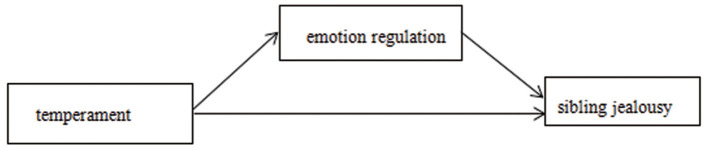
This study aimed to examine first-born children's sibling jealousy and explore the relationships among first-born children's sibling jealousy, temperament, and emotion regulation in China during COVID-19 pandemic. The research hypotheses of this study are empirically examined through online and offline surveys. A sample of 304 two-child families from China participated in the study; the first-born children were aged between 1.17 and 7 years. The results indicated the following: (1) the older the first-born children and the greater the age difference between siblings, the lower the sibling jealousy. (2) Difficult temperament of first-born children could predict sibling jealousy significantly and positively, and emotion regulation could predict sibling jealousy negatively. (3) There was a partially mediating effect of emotion regulation between temperament and sibling jealousy. Compared with intermediate temperament, first-born children with difficult temperament had weaker emotion regulation and higher sibling jealousy. Overall, findings have important implications for psychological interventions for families of first-born children with difficult temperament.
本研究旨在考察头胎子女的手足嫉妒心理,并探讨新冠疫情期间中国头胎子女的手足嫉妒心理、气质类型与情绪调节之间的关系。本研究的研究假设通过线上和线下调查进行实证检验。来自中国的304个二孩家庭的样本参与了该研究;头胎子女的年龄在1.17岁至7岁之间。结果表明:(1)头胎子女年龄越大,与兄弟姐妹的年龄差越大,手足嫉妒心理越低。(2)头胎子女的难养型气质能够显著正向预测手足嫉妒心理,而情绪调节能够负向预测手足嫉妒心理。(3)情绪调节在气质类型与手足嫉妒心理之间存在部分中介作用。与中间型气质的头胎子女相比,难养型气质的头胎子女情绪调节能力较弱,手足嫉妒心理较高。总体而言,研究结果对难养型气质头胎子女家庭的心理干预具有重要意义。