Division of Endocrinology, Tongji Hospital, Huazhong University of Science and Technology, Wuhan, China.
Branch of National Clinical Research Center for Metabolic Diseases, Hubei, China.
Front Endocrinol (Lausanne). 2021 Oct 6;12:731974. doi: 10.3389/fendo.2021.731974. eCollection 2021.
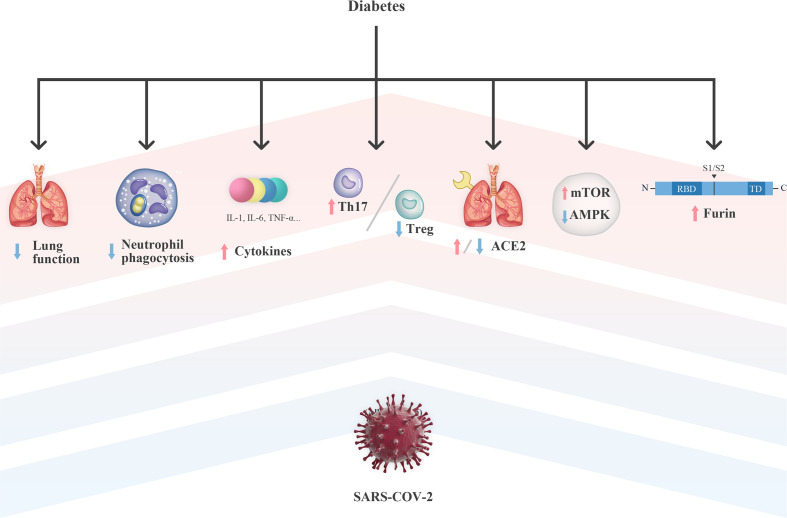
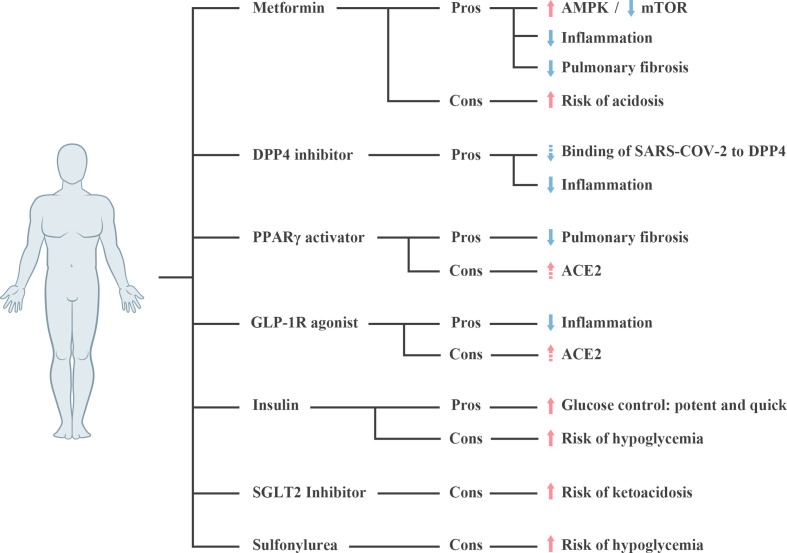
Severe acute respiratory syndrome coronavirus 2 (SARS-CoV-2) is causing a worldwide epidemic. It spreads very fast and hits people of all ages, especially patients with underlying diseases such as diabetes. In this review, we focus on the influences of diabetes on the outcome of SARS-CoV-2 infection and the involved mechanisms including lung dysfunction, immune disorder, abnormal expression of angiotensin-converting enzyme 2 (ACE2), overactivation of mechanistic target of rapamycin (mTOR) signaling pathway, and increased furin level. On the other hand, SARS-CoV-2 may trigger the development of diabetes. It causes the damage of pancreatic β cells, which is probably mediated by ACE2 protein in the islets. Furthermore, SARS-CoV-2 may aggravate insulin resistance through attacking other metabolic organs. Of note, certain anti-diabetic drugs (OADs), such as peroxisome proliferator-activated receptor (PPARγ) activator and glucagon-like peptide 1 receptor (GLP-1R) agonist, have been shown to upregulate ACE2 in animal models, which may increase the risk of SARS-CoV-2 infection. However, Metformin, as a first-line medicine for the treatment of type 2 diabetes mellitus (T2DM), may be a potential drug benefiting diabetic patients with SARS-CoV-2 infection, probably a suppression of mTOR signaling together with its anti-inflammatory and anti-fibrosis function in lung. Remarkably, another kind of OADs, dipeptidyl Peptidase 4 (DPP4) inhibitor, may also exert beneficial effects in this respect, probably a prevention of SARS-CoV-2 binding to cells. Thus, it is of significant to identify appropriate OADs for the treatment of diabetes in the context of SARS-CoV-2 infections.
严重急性呼吸综合征冠状病毒 2(SARS-CoV-2)正在引发全球大流行。它传播得非常快,影响所有年龄段的人,尤其是患有糖尿病等基础疾病的患者。在这篇综述中,我们重点关注糖尿病对 SARS-CoV-2 感染结局的影响及其涉及的机制,包括肺功能障碍、免疫紊乱、血管紧张素转换酶 2(ACE2)异常表达、机械靶标雷帕霉素(mTOR)信号通路过度激活以及 furin 水平升高。另一方面,SARS-CoV-2 可能引发糖尿病的发生。它导致胰岛β细胞受损,这可能是由 ACE2 蛋白介导的。此外,SARS-CoV-2 可能通过攻击其他代谢器官加重胰岛素抵抗。值得注意的是,某些抗糖尿病药物(OADs),如过氧化物酶体增殖物激活受体(PPARγ)激动剂和胰高血糖素样肽 1 受体(GLP-1R)激动剂,在动物模型中已被证明能上调 ACE2,这可能会增加 SARS-CoV-2 感染的风险。然而,二甲双胍作为治疗 2 型糖尿病(T2DM)的一线药物,可能是一种有益于合并 SARS-CoV-2 感染的糖尿病患者的潜在药物,可能通过抑制 mTOR 信号通路及其在肺部的抗炎和抗纤维化功能。值得注意的是,另一种 OADs,二肽基肽酶 4(DPP4)抑制剂,在这方面也可能发挥有益作用,可能通过预防 SARS-CoV-2 与细胞结合。因此,在 SARS-CoV-2 感染的背景下,确定合适的 OADs 治疗糖尿病具有重要意义。