Ford Belinda K, Angell Blake, White Andrew Jr, Duong Annita, Hiidome Saya, Keay Lisa
The George Institute for Global Health, UNSW Sydney, Newtown, NSW, Australia.
Westmead Hospital Ophthalmology Department, Westmead, NSW, Australia.
J Patient Exp. 2021 Oct 20;8:23743735211049652. doi: 10.1177/23743735211049652. eCollection 2021.
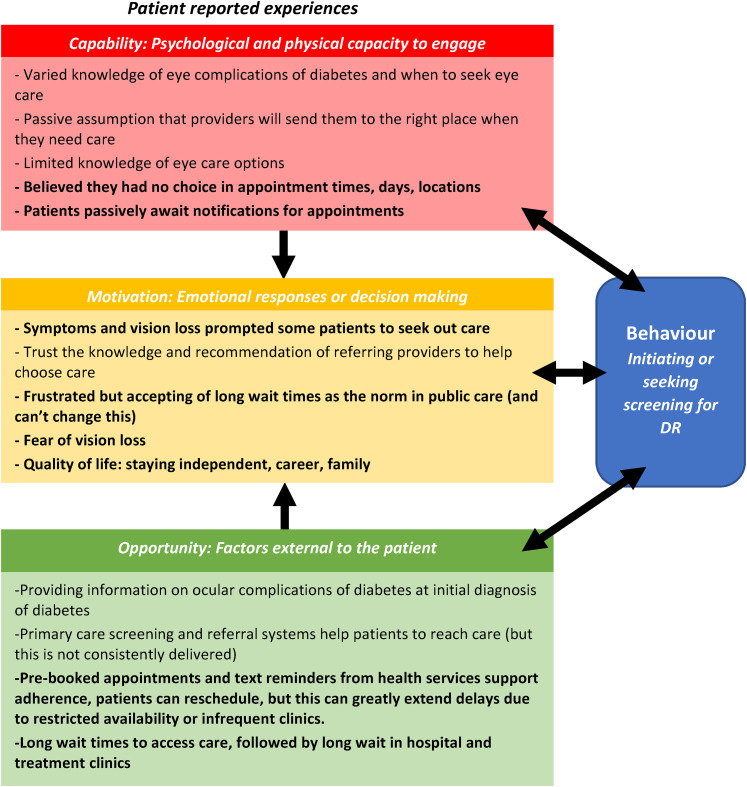
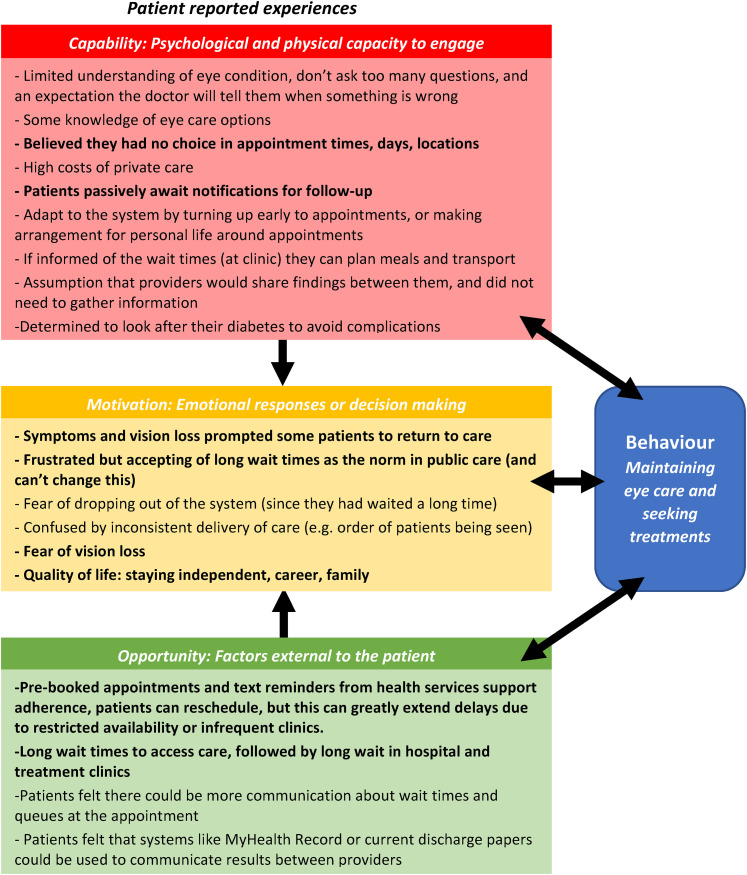
Diabetic retinopathy (DR) complications can be prevented with regular screening and timely access to an ophthalmologist for treatment. But there are patient and health system barriers that can impact access to DR services. This study aims to identify enablers and barriers for accessing public DR eye care services in a low socio-economic urban area of Australia. We conducted a qualitative study using semi-structured interviews for patients with diabetes aged 35 years and older attending public ophthalmology services. Interviews were analyzed to identify themes and subthemes; and the COM-B framework was used to interpret the complex behavioral mechanisms, including capability, opportunity, and motivation factors, to explain adherence to DR eye care. Three main themes and 7 sub-themes relating to patient experiences of DR care were derived. Patients were found to be passive actors in their DR eye care, but patients trusted clinicians and were determined to maintain their vision and quality of life. The barriers and facilitators of care related to the health system (service availability and recall-reminder systems) and patient experiences (choices, knowledge, and fear). The findings of this study will guide patient-centered initiatives to target and improve access to DR care. Strategies should focus on improving communication between eye care providers, and communication with patients to empower them to become more active players in healthcare decisions.
糖尿病视网膜病变(DR)并发症可通过定期筛查以及及时就医由眼科医生进行治疗来预防。但存在一些患者和卫生系统方面的障碍,可能会影响DR服务的可及性。本研究旨在确定澳大利亚一个社会经济水平较低的城市地区获得公共DR眼科护理服务的促进因素和障碍。我们对35岁及以上就诊于公共眼科服务机构的糖尿病患者进行了半结构化访谈的定性研究。对访谈进行分析以确定主题和子主题;并使用COM - B框架来解释复杂的行为机制,包括能力、机会和动机因素,以解释对DR眼科护理的依从性。得出了与患者DR护理体验相关的三个主要主题和7个子主题。研究发现患者在其DR眼科护理中是被动参与者,但患者信任临床医生,并决心维持其视力和生活质量。护理的障碍和促进因素与卫生系统(服务可及性和召回提醒系统)以及患者体验(选择、知识和恐惧)有关。本研究结果将指导以患者为中心的举措,以针对并改善DR护理的可及性。策略应侧重于改善眼科护理提供者之间的沟通,以及与患者的沟通,以使他们能够在医疗保健决策中成为更积极的参与者。