
英国首次因新冠疫情实施封锁期间公众对眼部症状及医院服务的认知:一项网络调查研究
Public perceptions of eye symptoms and hospital services during the first UK lockdown of the COVID-19 pandemic: a web survey study.
作者信息
Butt Gibran F, Hodson James, Wallace Graham R, Rauz Saaeha, Murray Philip I
机构信息
Academic Unit of Ophthalmology, Institute of Inflammation and Ageing, University of Birmingham, Birmingham, UK.
Medical Statistics, University Hospitals Birmingham NHS Foundation Trust, Birmingham, UK.
出版信息
BMJ Open Ophthalmol. 2021 Oct 13;6(1):e000854. doi: 10.1136/bmjophth-2021-000854. eCollection 2021.
OBJECTIVE
This study aimed to explore the British public's healthcare-seeking beliefs concerning eye symptoms, and assess how the first COVID-19 lockdown influenced these.
METHODS AND ANALYSIS
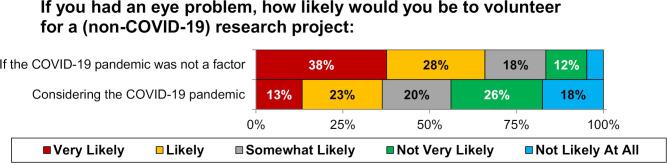
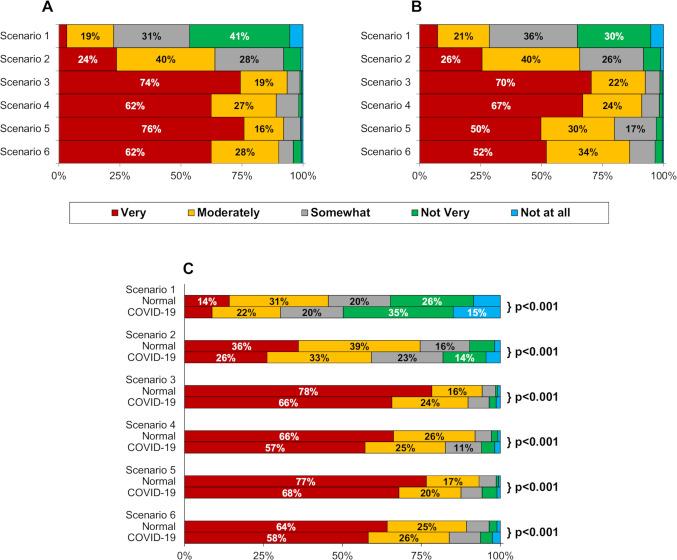
An anonymous web-based survey was disseminated through mailing lists and social media between June and August 2020. The survey sought participants' views on the severity and urgency of the need for medical review for four ophthalmic and two general medical scenarios on a five-point scale. Participants were asked to answer questions twice: once ignoring the COVID-19 pandemic, and once taking this into account, with additional questions asked to identify factors influencing the decision to seek medical attention and ward admission.
RESULTS
A total of 402 participants completed the survey (mean age 61.6 years, 63.1% female and 87.7% of white ethnicity). Scores for symptom severity and urgency of medical review increased significantly with the severity of the clinical scenario (both p<0.001). However, participants gave significantly lower scores for the urgency of medical attention when accounting for the COVID-19 pandemic (compared with no pandemic) for all scenarios (all p<0.001). Younger age, greater deprivation and non-white ethnicity were correlated with a lower perception of seriousness and urgency of medical attention.
CONCLUSIONS
During the first UK lockdown of the COVID-19 pandemic, reduced urgency of medical review for ocular and systemic pathologies was reported in response to the pandemic, which represents a barrier to healthcare-seeking behaviour. This has the potential to critically delay medical review and timely management, negatively impacting patient outcomes.
目的
本研究旨在探讨英国公众对眼部症状寻求医疗护理的信念,并评估首次新冠疫情封锁措施对此有何影响。
方法与分析
2020年6月至8月期间,通过邮件列表和社交媒体开展了一项基于网络的匿名调查。该调查要求参与者对四种眼科和两种普通医疗情况进行医疗检查的必要性的严重程度和紧迫性,按照五分制进行评分。参与者被要求回答两次问题:一次忽略新冠疫情,一次考虑新冠疫情,并额外提出问题以确定影响寻求医疗护理和住院决策的因素。
结果
共有402名参与者完成了调查(平均年龄61.6岁,女性占63.1%,白人占87.7%)。随着临床情况严重程度的增加,症状严重程度和医疗检查紧迫性的评分显著升高(均p<0.001)。然而,在考虑新冠疫情时,所有情况下参与者对医疗护理紧迫性的评分均显著低于不考虑疫情时(均p<0.001)。年龄较小、贫困程度较高和非白人种族与对医疗护理严重性和紧迫性的较低认知相关。
结论
在英国首次新冠疫情封锁期间,由于疫情,眼部和全身性疾病的医疗检查紧迫性降低,这对寻求医疗护理行为构成了障碍。这有可能严重延迟医疗检查和及时治疗,对患者预后产生负面影响。

 Zotero 插件