• 文献检索
  • 文档翻译
  • 深度研究
  • 学术资讯
  • Suppr Zotero 插件Zotero 插件
  • 邀请有礼
  • 套餐&价格
  • 历史记录
应用&插件
Suppr Zotero 插件Zotero 插件浏览器插件Mac 客户端Windows 客户端微信小程序
定价
高级版会员购买积分包购买API积分包
服务
文献检索文档翻译深度研究API 文档MCP 服务
关于我们
关于 Suppr公司介绍联系我们用户协议隐私条款
关注我们

Suppr 超能文献

核心技术专利:CN118964589B侵权必究
粤ICP备2023148730 号-1Suppr @ 2026

文献检索

告别复杂PubMed语法,用中文像聊天一样搜索,搜遍4000万医学文献。AI智能推荐,让科研检索更轻松。

立即免费搜索

文件翻译

保留排版,准确专业,支持PDF/Word/PPT等文件格式,支持 12+语言互译。

免费翻译文档

深度研究

AI帮你快速写综述,25分钟生成高质量综述,智能提取关键信息,辅助科研写作。

立即免费体验

基于可解释机器学习算法的简化儿科死亡率指数3评分

Simplified Pediatric Index of Mortality 3 Score by Explainable Machine Learning Algorithm.

作者信息

Baloglu Orkun, Nagy Matthew, Ezetendu Chidiebere, Latifi Samir Q, Nazha Aziz

机构信息

Pediatric Critical Care Medicine, Cleveland Clinic Children's, Cleveland, OH.

Cleveland Clinic Children`s Center for Artificial Intelligence (C4AI), Cleveland, OH.

出版信息

Crit Care Explor. 2021 Oct 19;3(10):e0561. doi: 10.1097/CCE.0000000000000561. eCollection 2021 Oct.

DOI:10.1097/CCE.0000000000000561
PMID:34693292
原文链接:https://pmc.ncbi.nlm.nih.gov/articles/PMC8528230/
Abstract

UNLABELLED

Pediatric Index of Mortality 3 is a validated tool including 11 variables for the assessment of mortality risk in PICU patients. With the recent advances in explainable machine learning algorithms, we aimed to assess feasibility of application of these machine learning models to simplify the Pediatric Index of Mortality 3 scoring system in order to decrease time and labor required for data collection and entry for Pediatric Index of Mortality 3.

DESIGN

Single-center, retrospective cohort study. Data from the Virtual Pediatric Systems for patients admitted to Cleveland Clinic Children`s PICU between January 2008 and December 2019 was obtained. Light Gradient Boosting Machine Regressor (a gradient boosting decision tree algorithm) was used for building the machine learning models. Variable importance was analyzed by SHapley Additive exPlanations. All of the 11 Pediatric Index of Mortality 3 variables were used as input variables in the machine learning models to predict Pediatric Index of Mortality 3 risk of mortality as the outcome variable. Mean absolute error, root mean squared error, and R-squared were calculated for each of the 11 machine learning models as model performance parameters.

SETTING

Quaternary children's hospital.

PATIENTS

PICU patients.

INTERVENTIONS

None.

MEASUREMENTS AND MAIN RESULTS

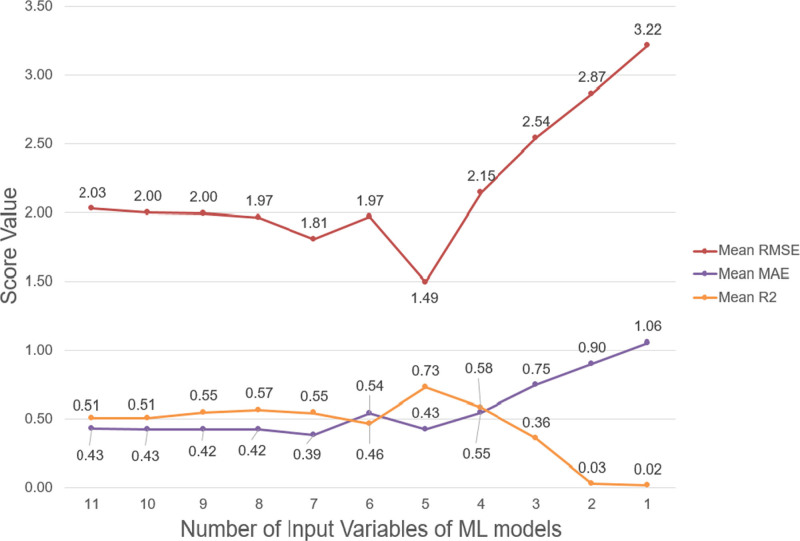
Five-thousand sixty-eight patients were analyzed. The machine learning models were able to maintain similar predictive error until the number of input variables decreased to four. The machine learning model with five input variables (mechanical ventilation in the first hour of PICU admission, very-high-risk diagnosis, surgical recovery from a noncardiac procedure, low-risk diagnosis, and base excess) produced lowest mean root mean squared error of 1.49 (95% CI, 1.05-1.93) and highest R-squared of 0.73 (95% CI, 0.6-0.86) with mean absolute error of 0.43 (95% CI, 0.35-0.5) among all the 11 machine learning models.

CONCLUSIONS

Explainable machine learning methods were feasible in simplifying the Pediatric Index of Mortality 3 scoring system with similar risk of mortality predictions compared to the original Pediatric Index of Mortality 3 model tested in a single-center dataset.

摘要

未标注

儿童死亡率指数3是一种经过验证的工具,包含11个变量,用于评估儿科重症监护病房(PICU)患者的死亡风险。随着可解释机器学习算法的最新进展,我们旨在评估应用这些机器学习模型简化儿童死亡率指数3评分系统的可行性,以减少儿童死亡率指数3数据收集和录入所需的时间和人力。

设计

单中心回顾性队列研究。获取了2008年1月至2019年12月期间入住克利夫兰诊所儿童医院PICU的患者的虚拟儿科系统数据。使用轻梯度提升机回归器(一种梯度提升决策树算法)构建机器学习模型。通过夏普利值加法解释(SHapley Additive exPlanations)分析变量重要性。将所有11个儿童死亡率指数3变量用作机器学习模型的输入变量,以预测儿童死亡率指数3的死亡风险作为结果变量。计算11个机器学习模型中每个模型的平均绝对误差、均方根误差和决定系数R²作为模型性能参数。

地点

四级儿童医院。

患者

PICU患者。

干预措施

无。

测量和主要结果

分析了5068例患者。直到输入变量数量减少到4个,机器学习模型都能够保持相似的预测误差。在所有11个机器学习模型中,具有5个输入变量(PICU入院后第一小时的机械通气、极高风险诊断、非心脏手术的手术恢复、低风险诊断和碱剩余)的机器学习模型产生的最低均方根误差为1.49(95%CI,1.05 - 1.93),最高决定系数R²为0.73(95%CI,0.6 - 0.86),平均绝对误差为0.43(95%CI,0.35 - 0.5)。

结论

与在单中心数据集中测试的原始儿童死亡率指数3模型相比,可解释机器学习方法在简化儿童死亡率指数3评分系统方面是可行的,且具有相似的死亡风险预测能力。
https://cdn.ncbi.nlm.nih.gov/pmc/blobs/8d26/8528230/614e8e35467e/cc9-3-e0561-g001.jpg

相似文献

1
Simplified Pediatric Index of Mortality 3 Score by Explainable Machine Learning Algorithm.基于可解释机器学习算法的简化儿科死亡率指数3评分
Crit Care Explor. 2021 Oct 19;3(10):e0561. doi: 10.1097/CCE.0000000000000561. eCollection 2021 Oct.
2
Interoperable and explainable machine learning models to predict morbidity and mortality in acute neurological injury in the pediatric intensive care unit: secondary analysis of the TOPICC study.用于预测儿科重症监护病房急性神经损伤发病率和死亡率的可互操作且可解释的机器学习模型:TOPICC研究的二次分析
Front Pediatr. 2023 Jun 28;11:1177470. doi: 10.3389/fped.2023.1177470. eCollection 2023.
3
Dynamic and explainable machine learning prediction of mortality in patients in the intensive care unit: a retrospective study of high-frequency data in electronic patient records.动态可解释机器学习预测 ICU 患者死亡率:电子患者记录中高频数据的回顾性研究。
Lancet Digit Health. 2020 Apr;2(4):e179-e191. doi: 10.1016/S2589-7500(20)30018-2. Epub 2020 Mar 12.
4
Intensive Care Mortality Prognostic Model for Pediatric Pulmonary Hypertension.儿童肺动脉高压重症监护病死率预测模型。
Pediatr Crit Care Med. 2018 Aug;19(8):733-740. doi: 10.1097/PCC.0000000000001636.
5
Comparison of three different timeframes for pediatric index of mortality data collection in transported intensive care admissions*.三种不同时间框架用于转运重症监护入院儿童死亡率数据收集的比较*
Pediatr Crit Care Med. 2014 Mar;15(3):e120-7. doi: 10.1097/PCC.0000000000000058.
6
A Machine Learning Classifier Improves Mortality Prediction Compared With Pediatric Logistic Organ Dysfunction-2 Score: Model Development and Validation.与小儿逻辑器官功能障碍-2评分相比,机器学习分类器可改善死亡率预测:模型开发与验证
Crit Care Explor. 2021 May 17;3(5):e0426. doi: 10.1097/CCE.0000000000000426. eCollection 2021 May.
7
A qualitative research framework for the design of user-centered displays of explanations for machine learning model predictions in healthcare.面向医疗保健中机器学习模型预测解释的以用户为中心的显示设计的定性研究框架。
BMC Med Inform Decis Mak. 2020 Oct 8;20(1):257. doi: 10.1186/s12911-020-01276-x.
8
Explainable Machine Learning on AmsterdamUMCdb for ICU Discharge Decision Support: Uniting Intensivists and Data Scientists.用于重症监护病房出院决策支持的阿姆斯特丹大学医学中心数据库可解释机器学习:重症医学专家与数据科学家的联合
Crit Care Explor. 2021 Sep 10;3(9):e0529. doi: 10.1097/CCE.0000000000000529. eCollection 2021 Sep.
9
Explainable machine learning model to predict refeeding hypophosphatemia.解释性机器学习模型预测再喂养性低磷血症。
Clin Nutr ESPEN. 2021 Oct;45:213-219. doi: 10.1016/j.clnesp.2021.08.022. Epub 2021 Sep 10.
10
Development and Performance of Electronic Pediatric Risk of Mortality and Pediatric Logistic Organ Dysfunction-2 Automated Acuity Scores.电子儿童死亡风险和儿科逻辑器官功能障碍-2 自动评估分数的制定和性能。
Pediatr Crit Care Med. 2019 Aug;20(8):e372-e379. doi: 10.1097/PCC.0000000000001998.

引用本文的文献

1
Development and Validation of a Neurological Outcome Prediction Score for Children Requiring Mechanical Ventilation: The NOPS-VC Score.需要机械通气儿童的神经学预后预测评分的开发与验证:NOPS-VC评分
Indian J Crit Care Med. 2025 Jul;29(7):578-585. doi: 10.5005/jp-journals-10071-25013. Epub 2025 Jul 7.
2
Pediatric Critical Care Illness Severity Toolkit: Stata Commands for Calculation of Pediatric Index of Mortality and Pediatric Logistic Organ Dysfunction Scores.儿科重症疾病严重程度工具包:用于计算儿科死亡率指数和儿科逻辑器官功能障碍评分的Stata命令。
J Crit Care Med (Targu Mures). 2024 Jan 30;10(1):16-18. doi: 10.2478/jccm-2023-0033. eCollection 2024 Jan.
3

本文引用的文献

1
Pediatric Index of Mortality 3-An Evaluation of Function Among ICUs In South Africa.儿科死亡率 3 指数-南非 ICU 功能评估。
Pediatr Crit Care Med. 2021 Sep 1;22(9):813-821. doi: 10.1097/PCC.0000000000002693.
2
Interpretation of machine learning models using shapley values: application to compound potency and multi-target activity predictions.使用 Shapley 值解释机器学习模型:在化合物效力和多靶点活性预测中的应用。
J Comput Aided Mol Des. 2020 Oct;34(10):1013-1026. doi: 10.1007/s10822-020-00314-0. Epub 2020 May 2.
3
Validation of Pediatric Index of Mortality 3 for Predicting Mortality among Patients Admitted to a Pediatric Intensive Care Unit.
Clinical Prediction Scoring Scheme for 24 h Mortality in Major Traumatic Adult Patients.
成年严重创伤患者24小时死亡率的临床预测评分方案
Healthcare (Basel). 2022 Mar 20;10(3):577. doi: 10.3390/healthcare10030577.
用于预测儿科重症监护病房收治患者死亡率的儿童死亡率指数3的验证
Acute Crit Care. 2018 Aug;33(3):170-177. doi: 10.4266/acc.2018.00150. Epub 2018 Aug 31.
4
Retrospective cohort study on factors associated with mortality in high-risk pediatric critical care patients in the Netherlands.荷兰高危儿科重症监护患者死亡相关因素的回顾性队列研究。
BMC Pediatr. 2019 Aug 6;19(1):274. doi: 10.1186/s12887-019-1646-9.
5
Performance of the Pediatric Index of Mortality 3 Score in PICUs in Argentina: A Prospective, National Multicenter Study.儿科死亡率 3 评分在阿根廷 PICUs 中的表现:一项前瞻性、全国多中心研究。
Pediatr Crit Care Med. 2018 Dec;19(12):e653-e661. doi: 10.1097/PCC.0000000000001741.
6
Evaluation of variable selection methods for random forests and omics data sets.随机森林和组学数据集变量选择方法的评估。
Brief Bioinform. 2019 Mar 22;20(2):492-503. doi: 10.1093/bib/bbx124.
7
The Importance of Mortality Risk Assessment: Validation of the Pediatric Index of Mortality 3 Score.死亡率风险评估的重要性:儿童死亡率指数3评分的验证
Pediatr Crit Care Med. 2016 Mar;17(3):251-6. doi: 10.1097/PCC.0000000000000657.
8
Transparent Reporting of a multivariable prediction model for Individual Prognosis or Diagnosis (TRIPOD): the TRIPOD statement.透明报告个体预后或诊断的多变量预测模型(TRIPOD):TRIPOD 声明。
Ann Intern Med. 2015 Jan 6;162(1):55-63. doi: 10.7326/M14-0697.
9
Paediatric index of mortality 3: an updated model for predicting mortality in pediatric intensive care*.儿科死亡率 3 指数:一种预测儿科重症监护死亡率的更新模型*。
Pediatr Crit Care Med. 2013 Sep;14(7):673-81. doi: 10.1097/PCC.0b013e31829760cf.