Department of NanoEngineering, Chemical Engineering Program, Moores Cancer Center, University of California San Diego, La Jolla, CA, 92093, USA.
Angew Chem Int Ed Engl. 2022 Jan 10;61(2):e202113671. doi: 10.1002/anie.202113671. Epub 2021 Nov 29.
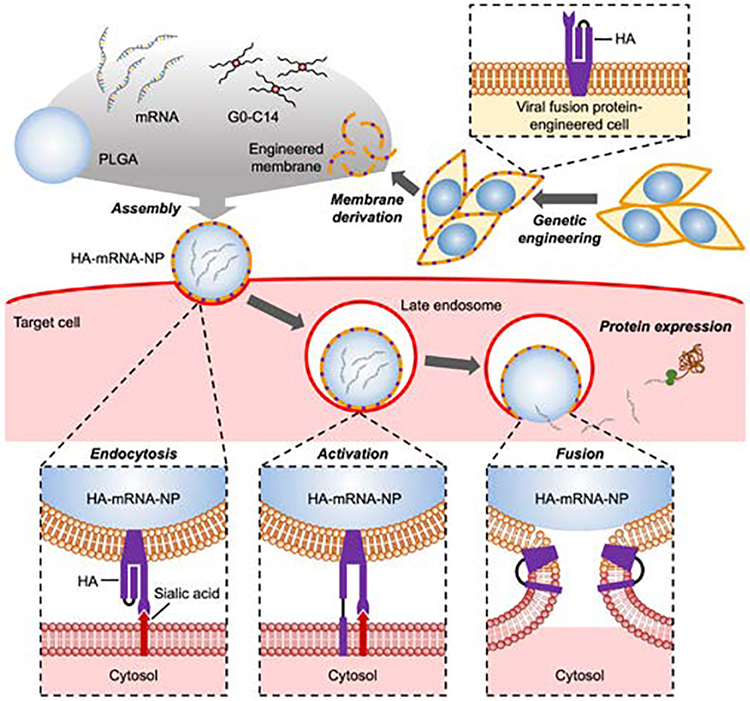
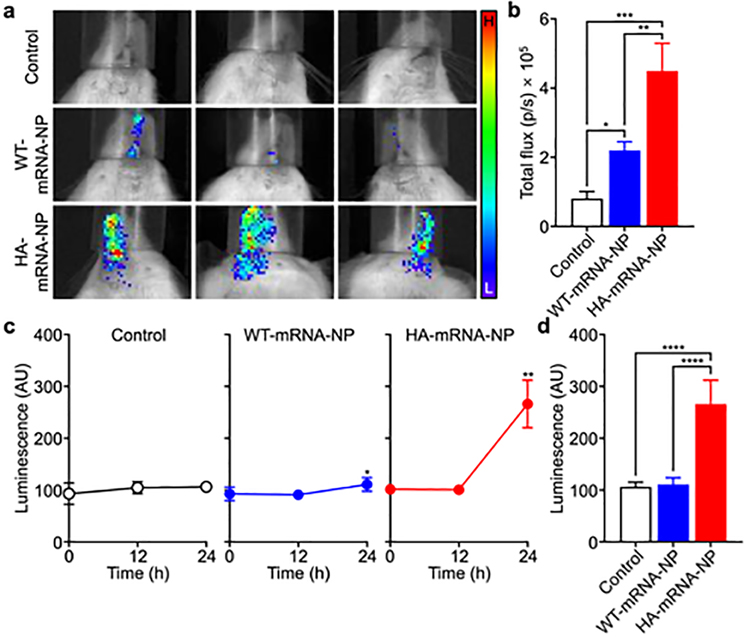
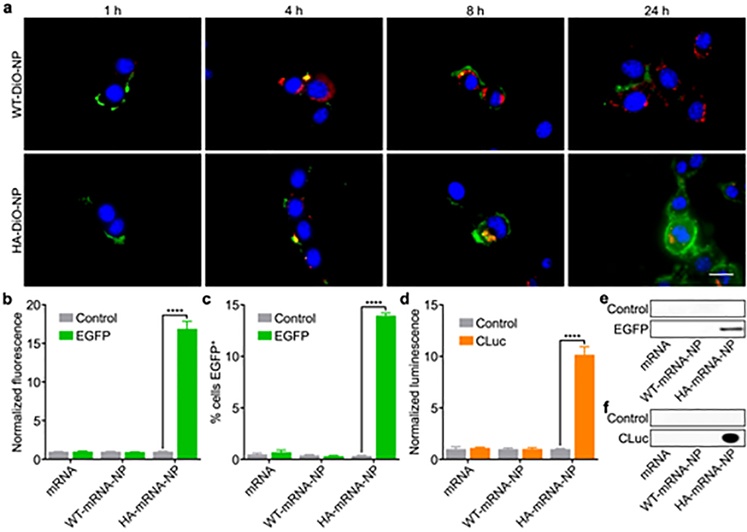
Effective endosomal escape after cellular uptake represents a major challenge in the field of nanodelivery, as the majority of drug payloads must localize to subcellular compartments other than the endosomes in order to exert activity. In nature, viruses can readily deliver their genetic material to the cytosol of host cells by triggering membrane fusion after endocytosis. For the influenza A virus, the hemagglutinin (HA) protein found on its surface fuses the viral envelope with the surrounding membrane at endosomal pH values. Biomimetic nanoparticles capable of endosomal escape were fabricated using a membrane coating derived from cells engineered to express HA on their surface. When evaluated in vitro, these virus-mimicking nanoparticles were able to deliver an mRNA payload to the cytosolic compartment of target cells, resulting in the successful expression of the encoded protein. When the mRNA-loaded nanoparticles were administered in vivo, protein expression levels were significantly increased in both local and systemic delivery scenarios. We therefore conclude that utilizing genetic engineering approaches to express viral fusion proteins on the surface of cell membrane-coated nanoparticles is a viable strategy for modulating the intracellular localization of encapsulated cargoes.
细胞摄取后的有效内涵体逃逸是纳米递药领域的一个主要挑战,因为大多数药物有效负载必须定位于除内涵体以外的亚细胞隔室,才能发挥作用。在自然界中,病毒可以通过内吞作用后触发膜融合,将其遗传物质轻易递送到宿主细胞的细胞质中。对于甲型流感病毒,其表面上的血凝素 (HA) 蛋白在内涵体 pH 值下使病毒包膜与周围膜融合。使用源自表面表达 HA 的工程细胞衍生的膜涂层来制备能够实现内涵体逃逸的仿生纳米颗粒。在体外评估时,这些模拟病毒的纳米颗粒能够将 mRNA 有效负载递送到靶细胞的细胞质隔室,从而成功表达编码蛋白。当将负载 mRNA 的纳米颗粒在体内给药时,在局部和全身递送情况下,蛋白质表达水平均显著增加。因此,我们得出结论,利用基因工程方法在细胞膜涂层纳米颗粒的表面表达病毒融合蛋白是一种可行的策略,可用于调节封装货物的细胞内定位。