Trent/Fleming School of Nursing, Trent University, Peterborough, Ontario, Canada
Toronto Rehabilitation Institute, University Health Network, Toronto, Ontario, Canada.
BMJ Open. 2021 Oct 25;11(10):e053992. doi: 10.1136/bmjopen-2021-053992.
Despite inpatient rehabilitation, many older adults post-hip fracture have difficulty returning to their prefracture levels of function and activity. This scoping review aims to identify interventions for community-dwelling older adults discharged from inpatient rehabilitation and examine the function and activity outcomes associated with these interventions.
This scoping review followed Arksey and O'Malley's five-stage framework.
We searched MEDLINE, CINAHL, PsycINFO, EMBASE and Ageline electronic databases for English-language articles published between January 1946 and January 2020.
We included studies with health and social interventions involving community-dwelling older adults and their caregivers after hip fracture and inpatient rehabilitation. The interventions were selected if initiated within 60 days post-hip fracture surgery.
Two independent reviewers screened abstracts and full texts and extracted the data based on the inclusion criteria. A third reviewer adjudicated any disagreement and collated the extracted data.
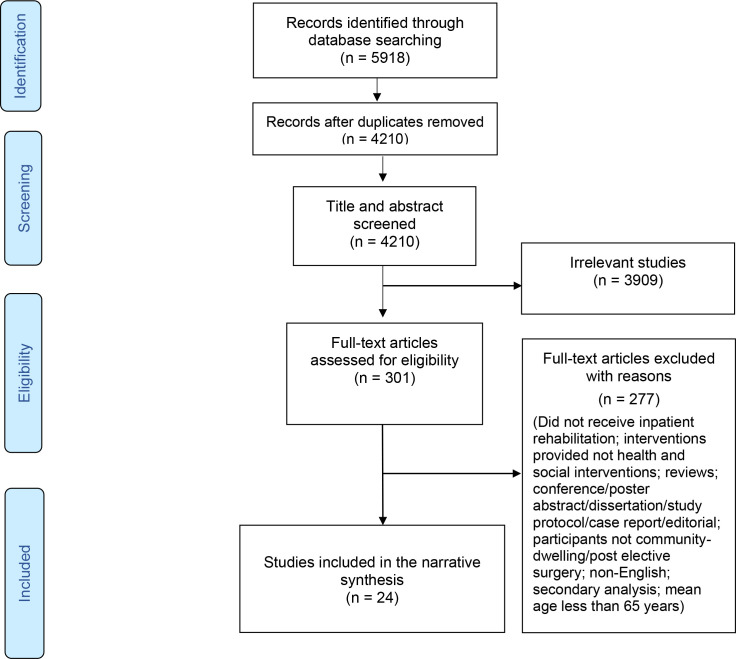
Of the 24 studies included in the review, most studies (79%) used exercise-based interventions, over half (63%) included activities of daily living training and/or home assessment and environment modification as intervention components, and three studies used social intervention components. Over half of the interventions (58%) were initiated in the inpatient setting and physiotherapists provided 83% of the interventions. Only seven studies (29%) involved tailored interventions based on the older adults' unique needs and progress in exercise training. Six studies (25%) enrolled patients with cognitive impairment, and only one study examined caregiver-related outcomes. Exercise-based interventions led to improved function and activity outcomes. 29 different outcome measures were reported.
While exercise-based multicomponent interventions have evidence for improving outcomes in this population, there is a paucity of studies, including social interventions. Further, studies with standardised outcome measures are needed, particularly focusing on supporting caregivers and the recovery of older adults with cognitive impairment.
尽管进行了住院康复治疗,但许多髋部骨折后的老年人在恢复到骨折前的功能和活动水平方面仍存在困难。本范围综述旨在确定对出院后进行社区居住的老年髋部骨折患者的干预措施,并研究这些干预措施与功能和活动结果之间的关系。
本范围综述遵循阿特赛和奥马利的五个阶段框架。
我们检索了 MEDLINE、CINAHL、PsycINFO、EMBASE 和 Ageline 电子数据库,以获取 1946 年 1 月至 2020 年 1 月期间发表的英文文章。
纳入研究对象为髋部骨折和住院康复治疗后进行社区居住的老年患者及其护理人员,涉及健康和社会干预措施。如果干预措施是在髋部骨折手术后 60 天内开始实施,则将其纳入研究。
两位独立的综述员对摘要和全文进行筛选,并根据纳入标准提取数据。第三位综述员对任何分歧进行裁决,并整理提取的数据。
在纳入本综述的 24 项研究中,大多数研究(79%)采用运动为基础的干预措施,超过一半(63%)的研究包含日常生活活动训练和/或家庭评估及环境改造作为干预组成部分,三项研究采用社会干预组成部分。超过一半的干预措施(58%)是在住院环境中开始实施的,其中 83%的干预措施由物理治疗师提供。只有 7 项研究(29%)根据老年人在运动训练中的独特需求和进展情况实施了针对性干预措施。6 项研究(25%)纳入了认知障碍患者,仅有一项研究考察了与护理人员相关的结果。以运动为基础的干预措施可改善功能和活动结果。报告了 29 种不同的结果测量方法。
尽管基于运动的多组分干预措施在改善该人群的结局方面具有证据,但研究仍较少,包括社会干预措施。此外,需要开展具有标准化结局测量方法的研究,特别是要关注对护理人员的支持和认知障碍老年患者的康复。