Institute for Translational Psychiatry, University of Münster, Münster, Germany.
Institute for Translational Neuroscience, University of Münster, Münster, Germany.
Mol Psychiatry. 2022 Feb;27(2):1103-1110. doi: 10.1038/s41380-021-01330-8. Epub 2021 Oct 25.
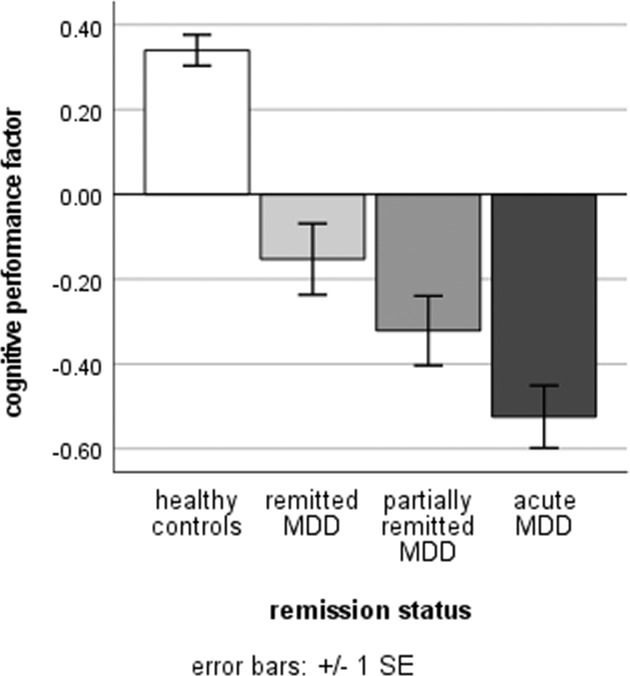
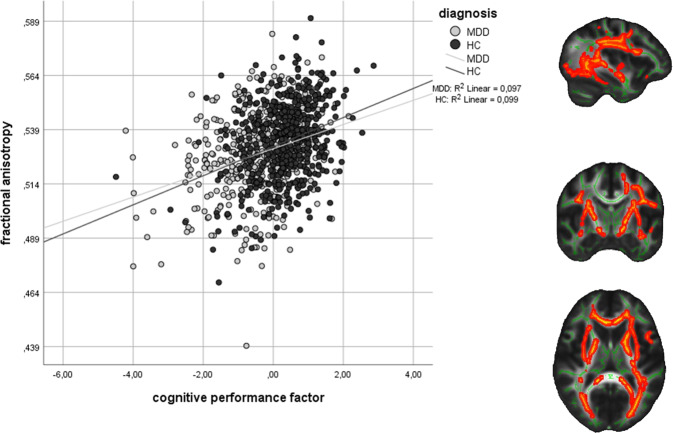
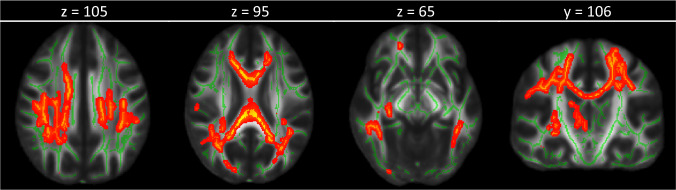
Cognitive deficits are central attendant symptoms of major depressive disorder (MDD) with a crucial impact in patients' everyday life. Thus, it is of particular clinical importance to understand their pathophysiology. The aim of this study was to investigate a possible relationship between brain structure and cognitive performance in MDD patients in a well-characterized sample. N = 1007 participants (N = 482, healthy controls (HC): N = 525) were selected from the FOR2107 cohort for this diffusion-tensor imaging study employing tract-based spatial statistics. We conducted a principal component analysis (PCA) to reduce neuropsychological test results, and to discover underlying factors of cognitive performance in MDD patients. We tested the association between fractional anisotropy (FA) and diagnosis (MDD vs. HC) and cognitive performance factors. The PCA yielded a single general cognitive performance factor that differed significantly between MDD patients and HC (P < 0.001). We found a significant main effect of the general cognitive performance factor in FA (P = 0.002) in a large bilateral cluster consisting of widespread frontotemporal-association fibers. In MDD patients this effect was independent of medication intake, the presence of comorbid diagnoses, the number of previous hospitalizations, and depressive symptomatology. This study provides robust evidence that white matter disturbances and cognitive performance seem to be associated. This association was independent of diagnosis, though MDD patients show more pronounced deficits and lower FA values in the global white matter fiber structure. This suggests a more general, rather than the depression-specific neurological basis for cognitive deficits.
认知缺陷是重性抑郁障碍(MDD)的核心伴随症状,对患者的日常生活有重大影响。因此,了解其病理生理学具有特殊的临床意义。本研究的目的是在一个特征明确的样本中研究 MDD 患者的大脑结构与认知表现之间的可能关系。本研究从 FOR2107 队列中选择了 1007 名参与者(N=482,健康对照组(HC):N=525)进行弥散张量成像研究,采用基于束的空间统计学方法。我们进行了主成分分析(PCA),以减少认知测试结果,并发现 MDD 患者认知表现的潜在因素。我们测试了各向异性分数(FA)与诊断(MDD 与 HC)和认知表现因素之间的相关性。PCA 得出了一个单一的总体认知表现因素,在 MDD 患者和 HC 之间存在显著差异(P<0.001)。我们发现,在一个由广泛的额颞联合纤维组成的大双侧簇中,一般认知表现因素的 FA 存在显著的主效应(P=0.002)。在 MDD 患者中,这种效应独立于药物摄入、合并诊断的存在、既往住院次数和抑郁症状。这项研究提供了有力的证据,表明白质紊乱和认知表现似乎相关。这种相关性独立于诊断,尽管 MDD 患者在整个白质纤维结构中表现出更明显的缺陷和更低的 FA 值。这表明认知缺陷的神经基础更具有普遍性,而不是抑郁症特异性的。