BACKGROUND
Studies have shown that the skeletal muscle index at the third lumbar vertebra (L3 SMI) had reasonable specificity and sensitivity in nutritional assessment and prognostic prediction in digestive system cancers, but its performance in lung cancer needs further investigation.
METHODS
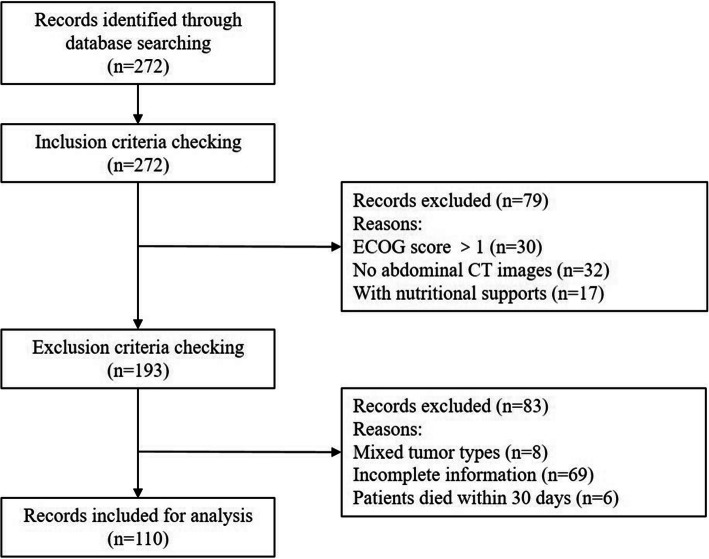
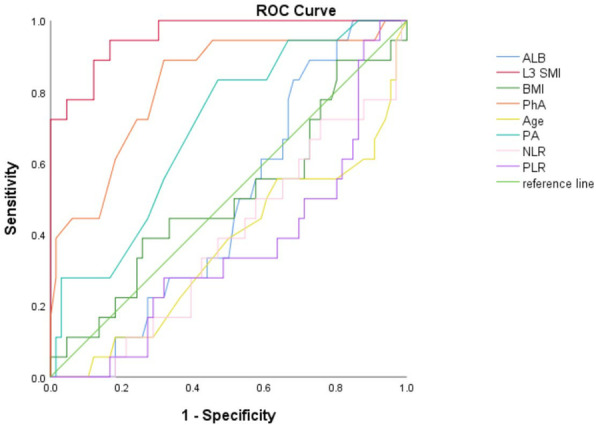
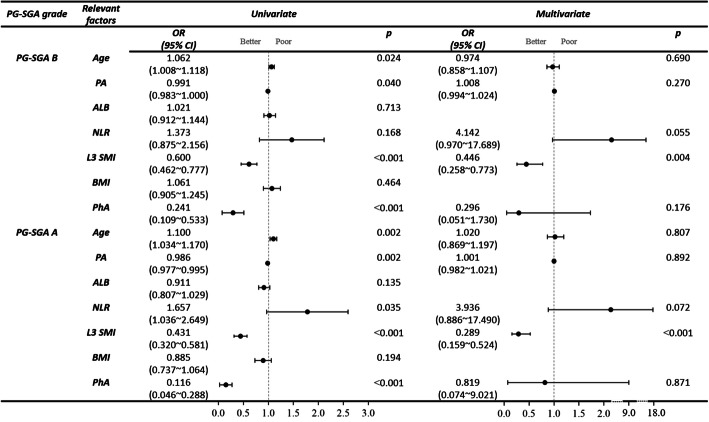
A retrospective study was performed on 110 patients with advanced lung cancer. The L3 SMI, the Patient-Generated Subjective Global Assessment score (PG-SGA score), body mass index (BMI), and serological indicators were analyzed. According to PG-SGA scores, patients were divided into severe malnutrition (≥9 points), mild to moderate malnutrition (≥3 points and ≤ 8 points), and no malnutrition (≤2 points) groups. Pearson correlation and logistic regression analysis were adopted to find factors related to malnutrition, and a forest plot was drawn. The receiver operating characteristic (ROC) curve was performed to compare the diagnostic values of malnutrition among factors, which were expressed by the area under curve (AUC).
RESULTS
- The age of patients in the severe malnutrition group, the mild to moderate malnutrition group, and the no malnutrition group significantly differed, with mean ages of 63.46 ± 10.01 years, 60.42 ± 8.76 years, and 55.03 ± 10.40 years, respectively (OR = 1.062, 95%CI: 1.008 ~ 1.118, P = 0.024; OR = 1.100, 95%CI: 1.034 ~ 1.170, P = 0.002). Furthermore, the neutrophil to lymphocyte ratio (NLR) of the severe malnutrition group was significantly higher than that of the no malnutrition group, with statistical significance. The difference between the mild to moderate malnutrition group and the no malnutrition group were not statistically significant, with NLR of 4.07 ± 3.34 and 2.47 ± 0.92, respectively (OR = 1.657,95%CI: 1.036 ~ 2.649, P = 0.035). The L3 SMI of patients in the severe malnutrition and mild to moderate malnutrition groups were significantly lower than that of the patients in the no malnutrition group, with statistical significance. The L3 SMI of patients in the severe malnutrition group, mild to moderate malnutrition group, and no malnutrition group were 27.40 ± 4.25 cm/m, 38.19 ± 6.17 cm/m, and 47.96 ± 5.02 cm/m, respectively (OR = 0.600, 95%CI: 0.462 ~ 0.777, P < 0.001; OR = 0.431, 95%CI: 0.320 ~ 0.581, P < 0.001). 2. The Pearson correlation analysis showed that the PG-SGA score positively correlated with age (r = 0.296, P < 0.05) but negatively correlated with L3 SMI (r = - 0.857, P < 0.05). The L3 SMI was also negatively correlated with age (r = - 0.240, P < 0.05). 3. The multivariate analysis showed that the L3 SMI was an independent risk factor for malnutrition (OR = 0.446, 95%CI: 0.258 ~ 0.773, P = 0.004; OR = 0.289, 95%CI: 0.159 ~ 0.524, P < 0.001).
CONCLUSION
- The differences in the L3 SMI was statistically significant among advanced lung cancer patients with different nutritional statuses. 2. In the nutritional assessment of patients with lung cancer, the L3 SMI was consistent with the PG-SGA. 3. The L3 SMI is an independent predictor of malnutrition in patients with advanced lung cancer.