Department of Gastric Surgery, Fujian Medical University Union Hospital, Fuzhou, China.
Department of General Surgery, Fujian Medical University Union Hospital, Fuzhou, China.
Cancer Med. 2018 Aug;7(8):3537-3547. doi: 10.1002/cam4.1548. Epub 2018 Jun 28.
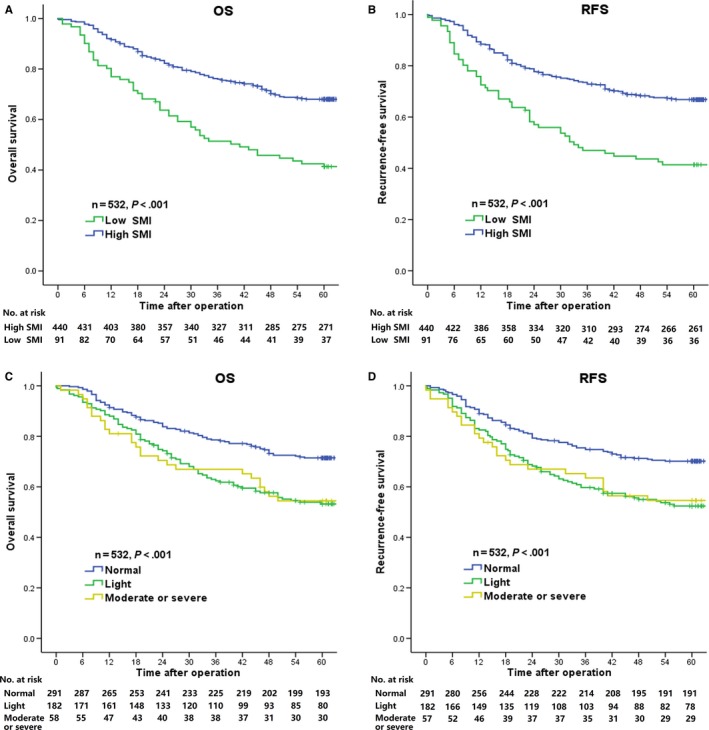
Skeletal muscle index (SMI) and the controlling nutritional status (CONUT) score are useful for evaluating nutritional status, which is closely associated with cancer prognosis. This study compared the prognostic value of these indicators in patients with gastric cancer (GC) after radical gastrectomy (RG). We retrospectively enrolled 532 patients between 2010 and 2011. SMI was measured via CT images to determine low SMI. The CONUT score was calculated based on serum albumin, total lymphocyte count, and cholesterol. Patients were grouped according to SMI and the CONUT score based on previous research. Spearman's correlation coefficient, the Kaplan-Meier method, and Cox regression were used. There was no significant correlation between SMI and the CONUT score. Five-year overall survival (OS) and recurrence-free survival (RFS) in patients with low SMI were significantly worse than those in patients with high SMI (P < .001). The normal nutrition group had better OS and RFS than did the light and moderate or severe malnutrition groups (P < .05), but the OS and RFS were not significantly different between the light and moderate or severe malnutrition groups (P = .726). Univariate analysis showed that SMI and the CONUT score were associated with OS and RFS, but only SMI remained prognostic in multivariate analysis. Preoperative SMI based on CT images is a more objective predictor than the CONUT score of long-term survival in GC after RG, but this finding must be confirmed by prospective trials.
骨骼肌指数(SMI)和控制营养状态(CONUT)评分可用于评估与癌症预后密切相关的营养状况。本研究比较了这些指标在根治性胃切除术后(RG)胃癌(GC)患者中的预后价值。我们回顾性纳入了 2010 年至 2011 年的 532 例患者。通过 CT 图像测量 SMI 以确定低 SMI。根据血清白蛋白、总淋巴细胞计数和胆固醇计算 CONUT 评分。根据既往研究,根据 SMI 和 CONUT 评分将患者分组。采用 Spearman 相关系数、Kaplan-Meier 方法和 Cox 回归进行分析。SMI 与 CONUT 评分之间无显著相关性。低 SMI 患者的 5 年总生存(OS)和无复发生存(RFS)明显差于高 SMI 患者(P<.001)。正常营养组的 OS 和 RFS 明显优于轻中度或重度营养不良组(P<.05),但轻中度或重度营养不良组之间的 OS 和 RFS 无显著差异(P=.726)。单因素分析显示,SMI 和 CONUT 评分与 OS 和 RFS 相关,但仅 SMI 在多因素分析中具有预后意义。基于 CT 图像的术前 SMI 是预测 RG 后 GC 患者长期生存的更客观指标,但这一发现需要前瞻性试验证实。