Cancer Center, The First Hospital of Jilin University, Xinmin St No 126, Changchun, 130021, Jilin, China.
College of Instrumentation and Electrical Engineering, Jilin University, Changchun, Jilin, China.
Sci Rep. 2024 Jun 6;14(1):13036. doi: 10.1038/s41598-024-63806-1.
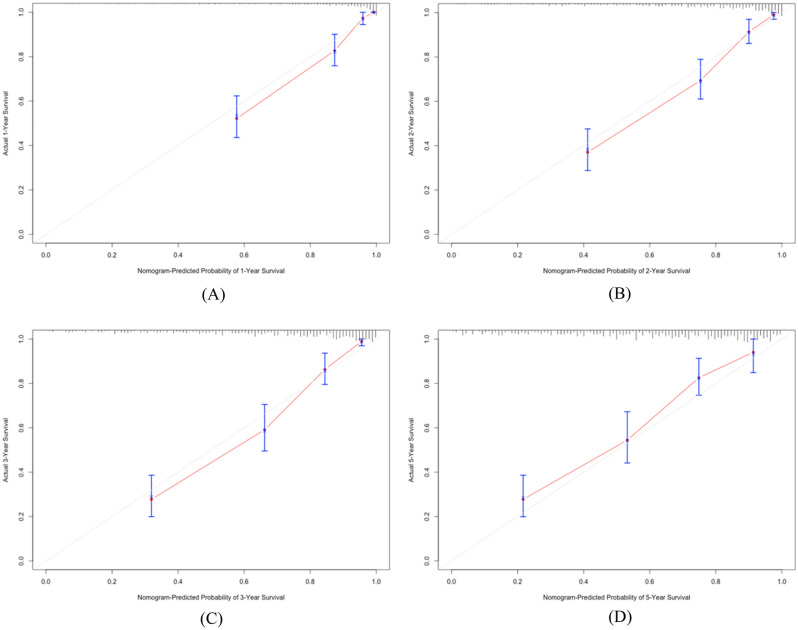
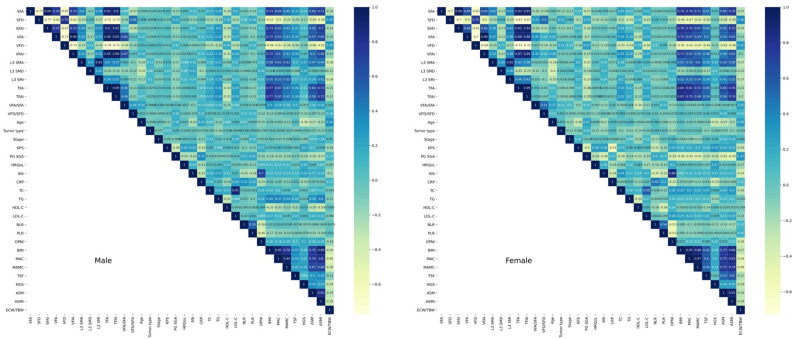
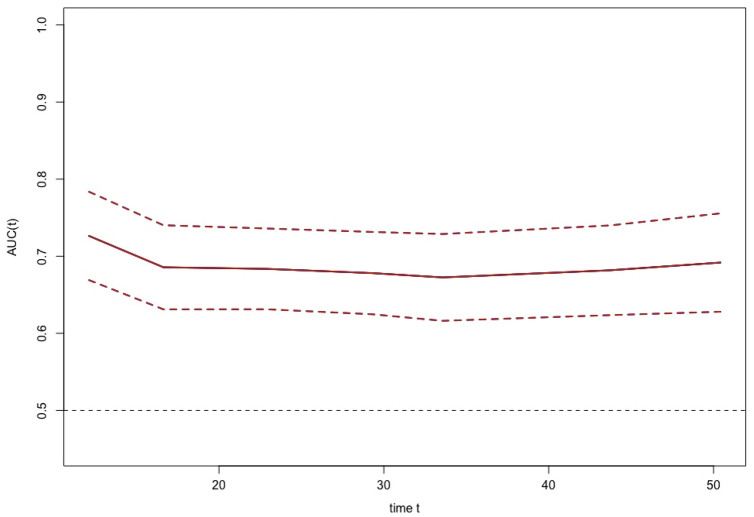
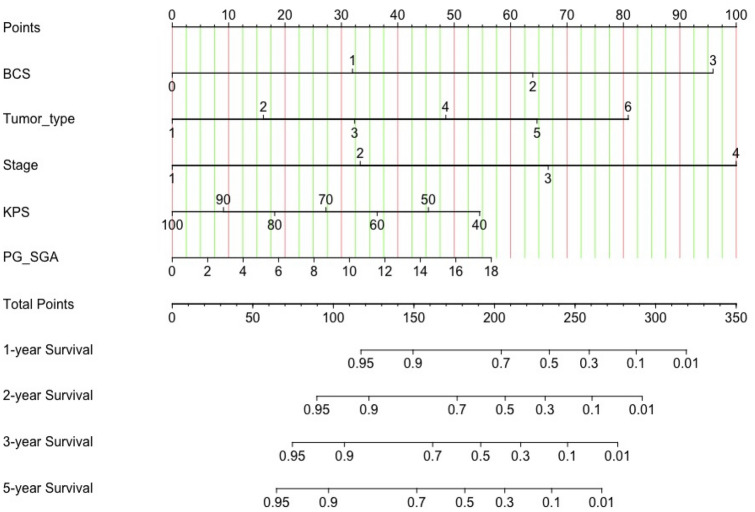
The role of skeletal muscle and adipose tissue in the progression of cancer has been gradually discussed, but it needs further exploration. The objective of this study was to provide an in-depth analysis of skeletal muscle and fat in digestive malignancies and to construct novel predictors for clinical management. This is a retrospective study that includes data from Cancer Center, the First Hospital of Jilin University. Basic characteristic information was analyzed by T tests. Correlation matrices were drawn to explore the relationship between CT-related indicators and other indicators. Cox risk regression analyses were performed to analyze the association between the overall survivals (OS) and various types of indicators. A new indicator body composition score (BCS) was then created and a time-dependent receiver operating characteristic curve was plotted to analyze the efficacy of the BCS. Finally, a nomogram was produced to develop a scored-CT system based on BCS and other indicators. C-index and calibration curve analyses were performed to validate the predictive accuracy of the scored-CT system. A total of 575 participants were enrolled in the study. Cox risk regression model revealed that VFD, L3 SMI and VFA/SFA were associated with prognosis of cancer patients. After adjustment, BCS index based on CT was significantly associated with prognosis, both in all study population and in subgroup analysis according to tumor types (all study population: HR 2.036, P < 0.001; colorectal cancer: HR 2.693, P < 0.001; hepatocellular carcinoma: HR 4.863, P < 0.001; esophageal cancer: HR 4.431, P = 0.008; pancreatic cancer: HR 1.905, P = 0.016; biliary system malignancies: HR 23.829, P = 0.035). The scored-CT system was constructed according to tumor type, stage, KPS, PG-SGA and BCS index, and it was of great predictive validity. This study identified VFD, L3 SMI and VFA/SFA associated with digestive malignancies outcomes. BCS was created and the scored-CT system was established to predict the OS of cancer patients.
骨骼肌和脂肪组织在癌症进展中的作用逐渐被讨论,但仍需要进一步探索。本研究旨在深入分析消化系统恶性肿瘤中的骨骼肌和脂肪,并构建新的预测因子以用于临床管理。这是一项回顾性研究,纳入了来自吉林大学第一医院癌症中心的数据。采用 T 检验分析基本特征信息。绘制相关矩阵以探索 CT 相关指标与其他指标之间的关系。采用 Cox 风险回归分析来分析总生存(OS)与各种类型指标之间的关联。然后创建了一个新的指标——身体成分评分(BCS),并绘制了时间依赖性接收者操作特征曲线以分析 BCS 的疗效。最后,根据 BCS 和其他指标制定了一个列线图,以开发基于 BCS 和其他指标的评分 CT 系统。进行 C-指数和校准曲线分析以验证评分 CT 系统的预测准确性。共纳入 575 名参与者进行研究。Cox 风险回归模型显示,VFD、L3 SMI 和 VFA/SFA 与癌症患者的预后相关。调整后,基于 CT 的 BCS 指数与预后显著相关,在所有研究人群以及根据肿瘤类型的亚组分析中均如此(所有研究人群:HR 2.036,P<0.001;结直肠癌:HR 2.693,P<0.001;肝细胞癌:HR 4.863,P<0.001;食管癌:HR 4.431,P=0.008;胰腺癌:HR 1.905,P=0.016;胆道系统恶性肿瘤:HR 23.829,P=0.035)。根据肿瘤类型、分期、KPS、PG-SGA 和 BCS 指数构建了评分 CT 系统,具有很好的预测有效性。本研究确定了与消化系统恶性肿瘤结局相关的 VFD、L3 SMI 和 VFA/SFA。创建了 BCS 并建立了评分 CT 系统,以预测癌症患者的 OS。