IFT Institut für Therapieforschung, Leopoldstrasse 175, 80804, Munich, Germany.
Institute of Health Economics and Health Care Management, Helmholtz Zentrum München GmbH, German Research Center for Environmental Health, Ingolstaedter Landstrasse 1, 85764, Neuherberg, Germany.
BMC Health Serv Res. 2021 Oct 26;21(1):1162. doi: 10.1186/s12913-021-07153-1.
Bouldering-Psychotherapy (BPT) has proven to effectively reduce depressive symptoms, but evidence on its cost-effectiveness is lacking. Corresponding information is paramount to support health policy decision making on a potential implementation of BPT in routine care.
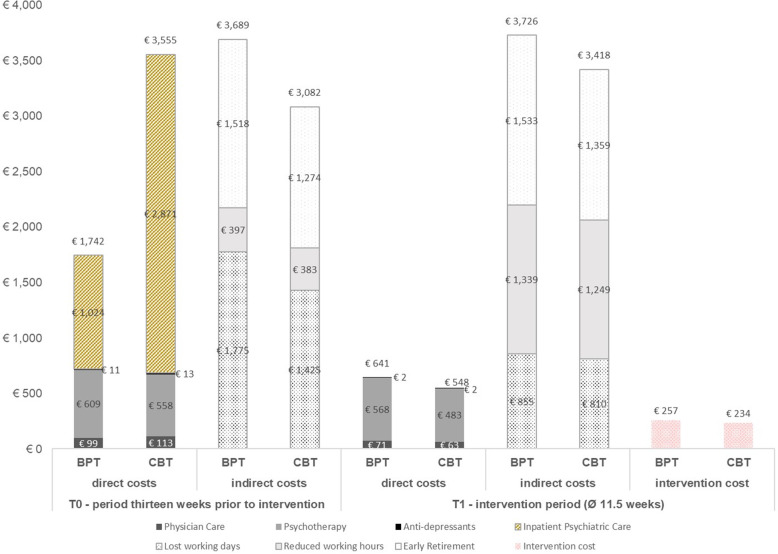
Using data from the German KuS trial BPT was compared with group Cognitive Behavioral Therapy (CBT). Severity of depression symptoms at end of the intervention was operationalized via Montgomery-Asberg Depression Rating Scale (MADRS) and Patient Health Questionnaire (PHQ-9). Adopting a societal perspective, direct medical costs and productivity loss were calculated based on standardized unit costs. To determine incremental cost-effectiveness ratios (ICER) and cost-effectiveness-acceptance curves (CEAC), adjusted mean differences (AMD) in costs (gamma-distributed model) and both effect parameters (Gaussian-distributed model) were obtained from 1000 simultaneous bootstrap replications.
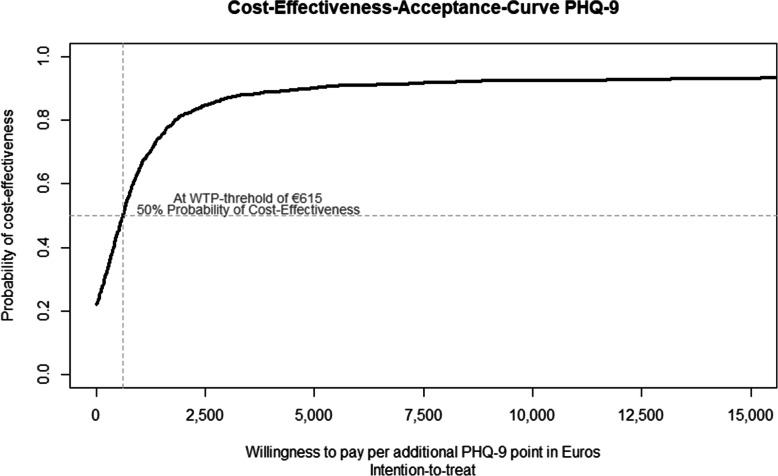
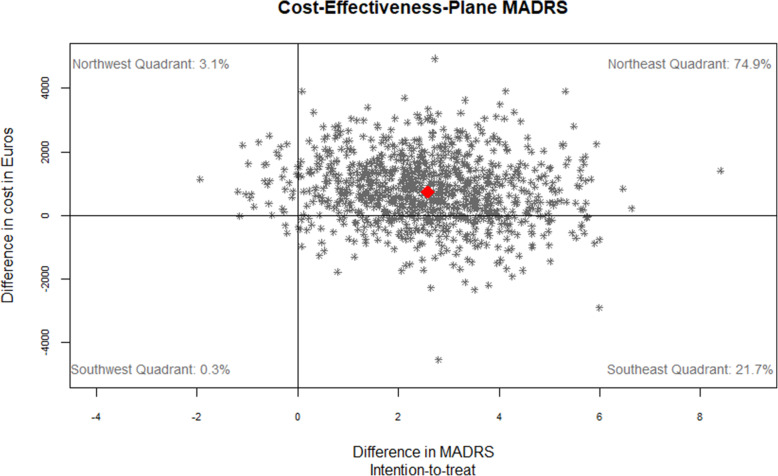
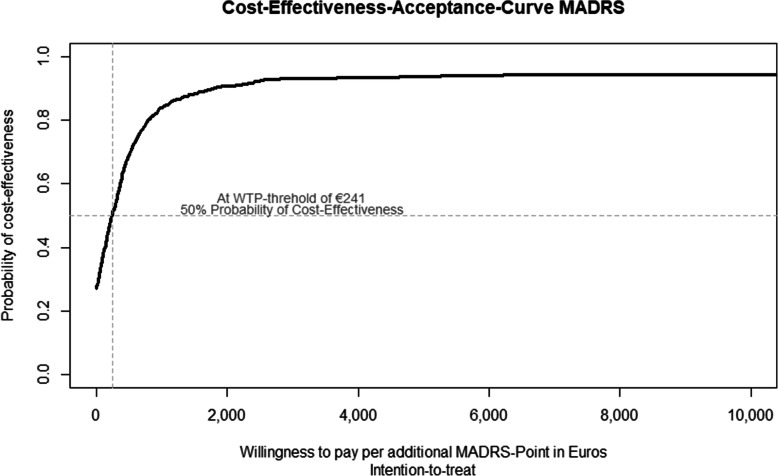
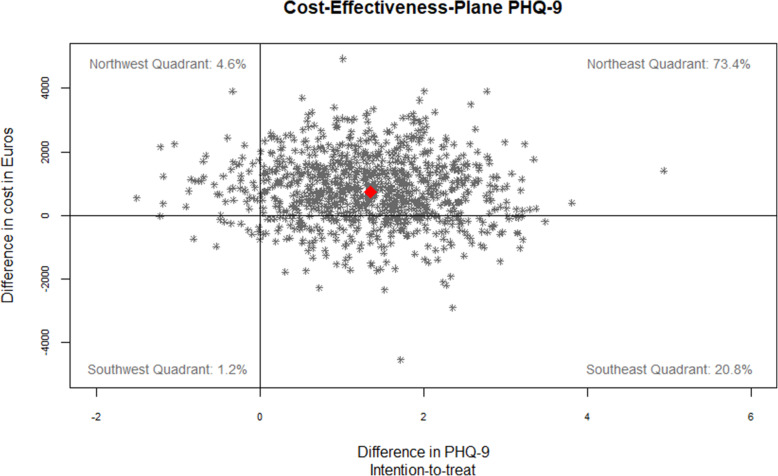
BPT was related to improved effects (AMDs: MADRS -2.58; PHQ-9: - 1.35) at higher costs (AMD: +€ 754). No AMD was significant. ICERs amounted to €288 per MADRS-point and €550 per PHQ-9-point. For both effect parameters about 20% of bootstrap replications indicated dominance of BPT, and about 75% larger effects at higher costs. At hypothetical willingness to pay (WTP) thresholds of €241 (MADRS) and €615 (PHQ-9) per unit of change BPT had a 50% probability of being cost-effective.
BPT is a promising alternate treatment strategy which - in absence of established WTP thresholds for improving symptoms of depression - cannot unambiguously be claimed cost-effective. Further studies defining subgroups that particularly benefit from BPT appear paramount to delineate recommendations for an efficient prospective roll-out to routine care.
抱石心理疗法(BPT)已被证明能有效减轻抑郁症状,但缺乏其成本效益的证据。相应的信息对于支持在常规护理中实施 BPT 的卫生政策决策至关重要。
利用德国 KuS 试验的数据,将 BPT 与团体认知行为疗法(CBT)进行了比较。干预结束时抑郁症状的严重程度通过蒙哥马利-阿斯伯格抑郁评定量表(MADRS)和患者健康问卷(PHQ-9)进行了量化。采用社会视角,根据标准化单位成本计算了直接医疗费用和生产力损失。为了确定增量成本效益比(ICER)和成本效益接受曲线(CEAC),从 1000 次同步自举复制中获得了成本(伽马分布模型)和两个效果参数(高斯分布模型)的调整均值差异(AMD)。
BPT 与改善的效果相关(AMD:MADRS -2.58;PHQ-9:-1.35),但成本更高(AMD:+754 欧元)。没有 AMD 是显著的。ICER 分别为每 MADRS 点 288 欧元和每 PHQ-9 点 550 欧元。对于这两个效果参数,大约 20%的自举复制表明 BPT 具有优势,而在更高的成本下效果更大。在假设的支付意愿(WTP)阈值为每单位变化 241 欧元(MADRS)和 615 欧元(PHQ-9)时,BPT 有 50%的可能性具有成本效益。
BPT 是一种有前途的替代治疗策略,如果没有确定的 WTP 阈值来改善抑郁症状,就不能明确地声称它具有成本效益。进一步研究确定特别受益于 BPT 的亚组,对于制定有效的前瞻性推广到常规护理的建议至关重要。