Naganathan Athi N, Kannan Adithi
Department of Biotechnology, Bhupat & Jyoti Mehta School of Biosciences, Indian Institute of Technology Madras, Chennai, 600036, India.
Curr Res Struct Biol. 2021 Oct 8;3:257-267. doi: 10.1016/j.crstbi.2021.09.003. eCollection 2021.
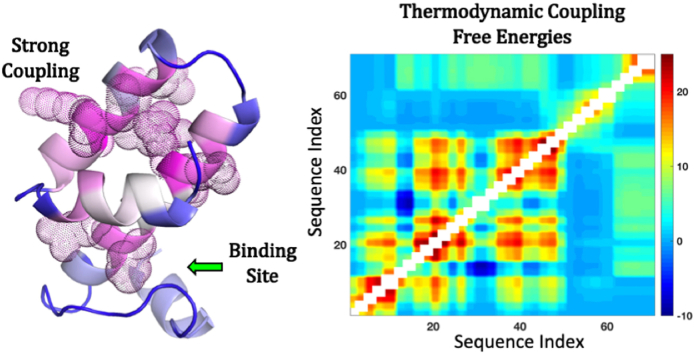
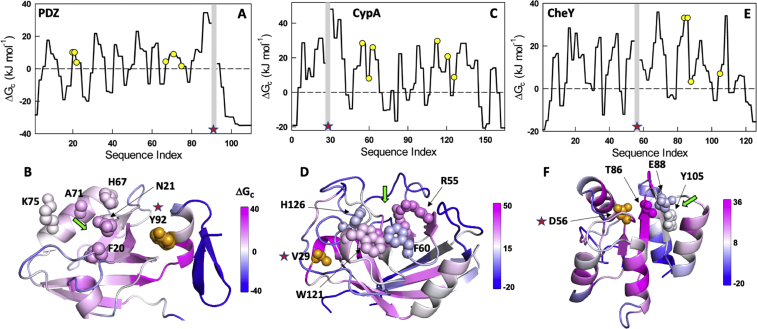
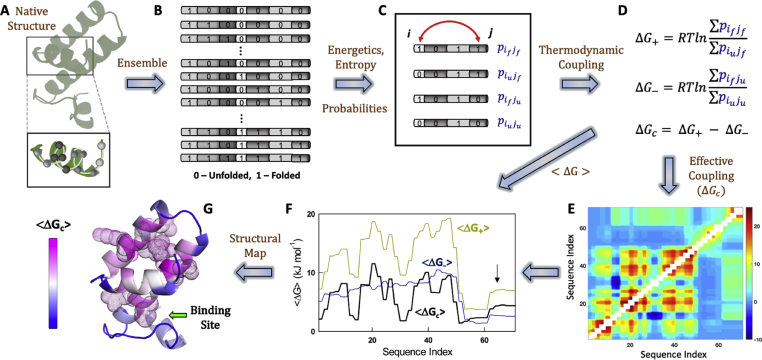
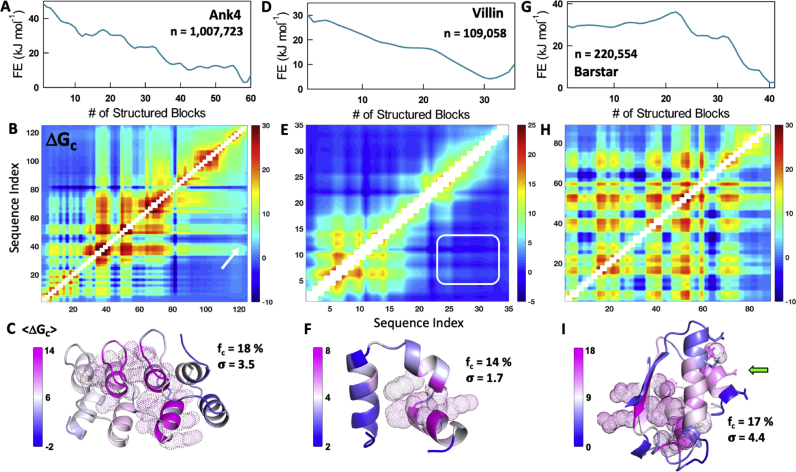
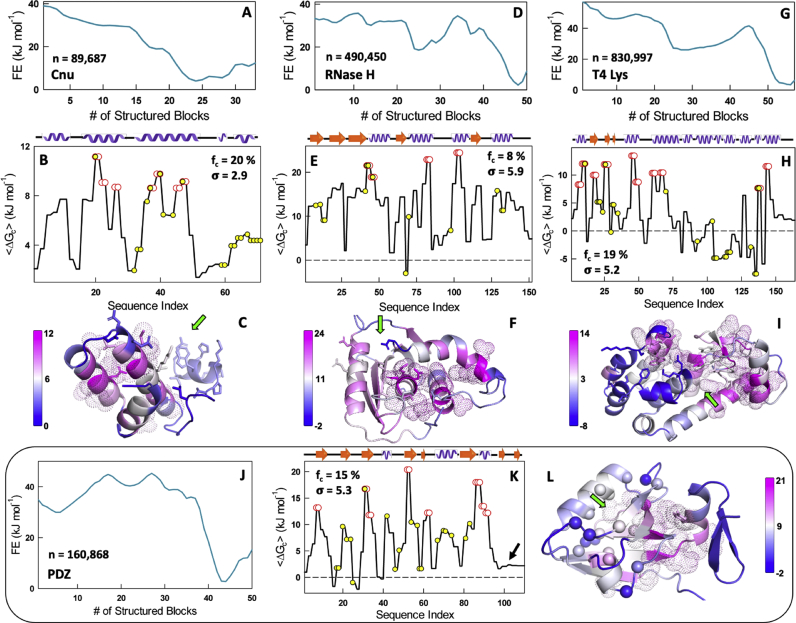
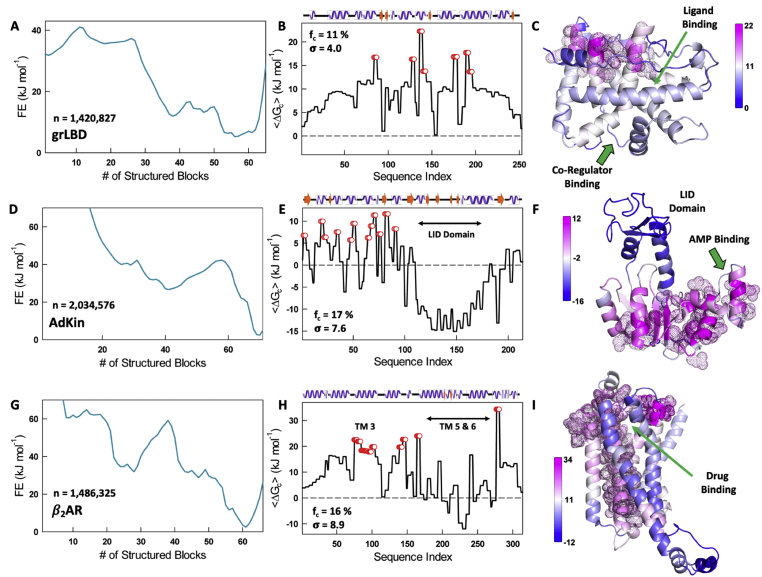
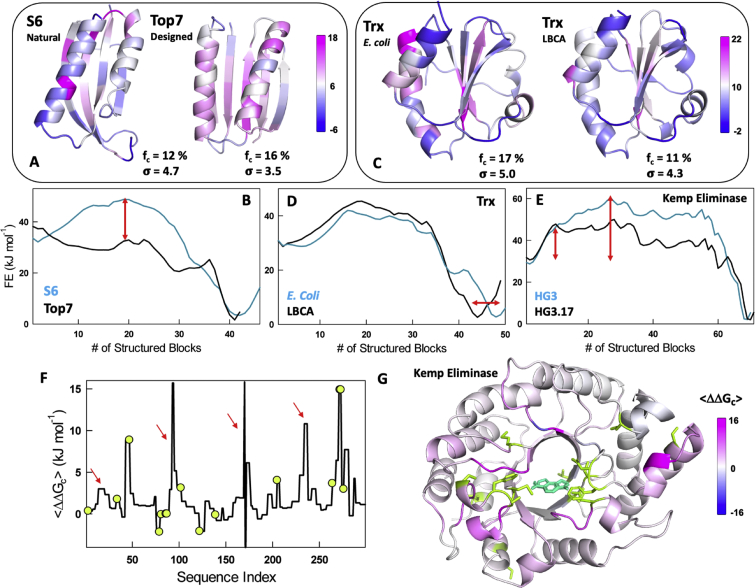
Protein sequences and structures evolve by satisfying varied physical and biochemical constraints. This multi-level selection is enabled not just by the patterning of amino acids on the sequence, but also via coupling between residues in the native structure. Here, we employ an energetically detailed statistical mechanical model with millions of microstates to extract such long-range structural correlations, thermodynamic coupling free energies, from a diverse family of protein structures. We find that despite the intricate and anisotropic distribution of coupling patterns, the majority of residues (>70%) are only marginally coupled contributing to functional motions and catalysis. Physical origins of 'sectors', determinants of native ensemble heterogeneity in extant, ancient and designed proteins, and the basis for allostery emerge naturally from coupling free energies. The statistical framework highlights how evolutionary selection and optimization occur at the level of global interaction network for a given protein fold impacting folding, function, and allosteric outputs.
蛋白质序列和结构通过满足各种物理和生化限制而进化。这种多层次选择不仅通过序列上氨基酸的模式实现,还通过天然结构中残基之间的耦合实现。在这里,我们采用一个具有数百万个微观状态的能量详细统计力学模型,从不同的蛋白质结构家族中提取这种长程结构相关性,即热力学耦合自由能。我们发现,尽管耦合模式的分布复杂且各向异性,但大多数残基(>70%)仅存在微弱耦合,对功能运动和催化作用贡献不大。“扇区”的物理起源、现存、古老和设计蛋白质中天然整体异质性的决定因素以及变构的基础都自然地从耦合自由能中显现出来。该统计框架突出了进化选择和优化如何在给定蛋白质折叠的全局相互作用网络层面发生,从而影响折叠、功能和变构输出。