Humanistic Nursing Department, School of Nursing, Xinxiang Medical University, Xinxiang, China.
Xiangya Nursing School of Central South University, Changsha, China.
Psychogeriatrics. 2022 Jan;22(1):11-21. doi: 10.1111/psyg.12774. Epub 2021 Oct 27.
Self-perceptions of ageing (SPA) is an important predictor for physical and mental health of older adults in successful ageing. SPA is mainly studied from negative or positive perspectives using variable-centred methodologies. The aim of the current study was to explore distinct profiles of SPA among Chinese community-dwelling older adults using a person-centred method and validate the SPA profiles by examining associations with psychological outcomes.
Participants aged 65 and over were randomly divided into test and validation samples (n = 451, respectively). SPA was measured by the Brief Ageing Perceptions Questionnaire using latent profile analysis.
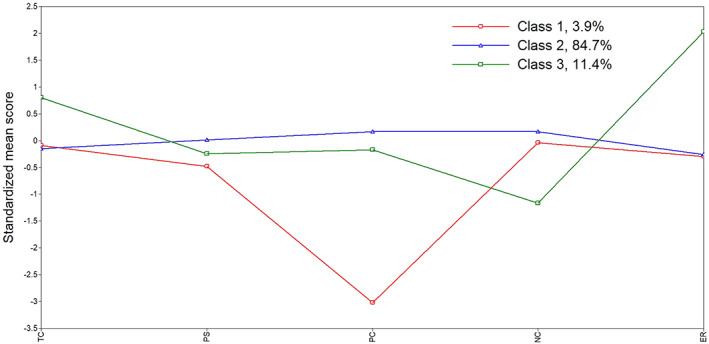
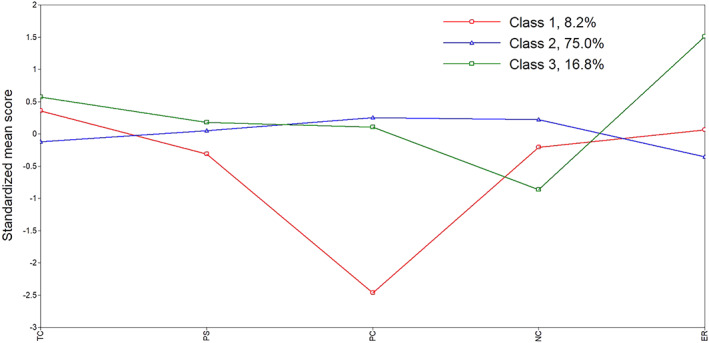
Three SPA profiles were identified. One adaptive subgroup was designated as 'Low ageing awareness and high positive control' (LAPC, 84.7% and 75% in both samples, respectively). Two maladaptive SPA subgroups were designated as 'Low positive consequences and control' (LPCC, 3.9% and 8.2% in both samples, respectively), and 'High ageing awareness and negative control' (HANC, 11.4% and 16.8% in both samples, respectively). Similar to negative/positive SPA, the HANC and LAPC subgroups showed the highest and lowest levels of depressive symptoms and cognitive decline. Low cognitive function was found in the LPCC subgroup.
These findings highlight the heterogeneity of older adults' SPA. SPA profiles may aid community healthcare providers in China to identify individuals with high risk of maladaptive SPA and to tailor targeted interventions for psychological health in later life. Distinct SPA profiles require different interventions targeting negative or positive control or both aspects. More positive control strategies might be beneficial for cognitive functioning in older adults from the LPCC subgroup.
自我年龄认知(SPA)是成功老龄化中老年个体身心健康的重要预测指标。SPA 主要从消极或积极的角度进行研究,采用变量为中心的方法。本研究旨在采用以个体为中心的方法探索中国社区居住的老年人 SPA 的不同特征,并通过考察与心理结果的关联来验证 SPA 特征。
65 岁及以上的参与者被随机分为测试和验证样本(分别为 n=451)。使用潜在剖面分析来衡量 SPA 采用简短老化认知问卷。
确定了三种 SPA 特征。一个适应性亚组被指定为“低老化意识和高积极控制”(LAPC,两个样本中分别为 84.7%和 75%)。两个适应不良 SPA 亚组分别被指定为“低积极后果和控制”(LPCC,两个样本中分别为 3.9%和 8.2%)和“高老化意识和消极控制”(HANC,两个样本中分别为 11.4%和 16.8%)。与消极/积极 SPA 相似,HANC 和 LAPC 亚组的抑郁症状和认知下降水平最高和最低。在 LPCC 亚组中发现认知功能较低。
这些发现强调了老年人 SPA 的异质性。SPA 特征可能有助于中国社区医疗保健提供者识别适应不良 SPA 风险较高的个体,并针对晚年心理健康制定有针对性的干预措施。不同的 SPA 特征需要针对消极或积极控制或两者都有不同的干预措施。对于来自 LPCC 亚组的老年人,更多的积极控制策略可能对认知功能有益。