Gras Airy, Parada Montse, Vallès Joan, Garnatje Teresa
Institut Botànic de Barcelona (IBB, CSIC-Ajuntament de Barcelona), Barcelona, Spain.
Laboratori de Botànica-Unitat Associada CSIC, Facultat de Farmàcia i Ciències de l'Alimentació-Institut de Recerca de la Biodiversitat IRBio, Universitat de Barcelona, Barcelona, Spain.
Front Pharmacol. 2021 Oct 11;12:744616. doi: 10.3389/fphar.2021.744616. eCollection 2021.
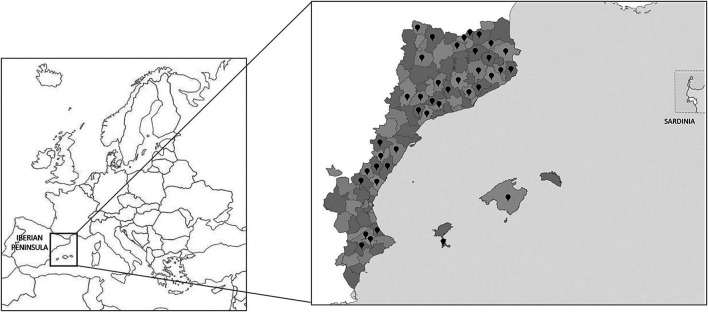
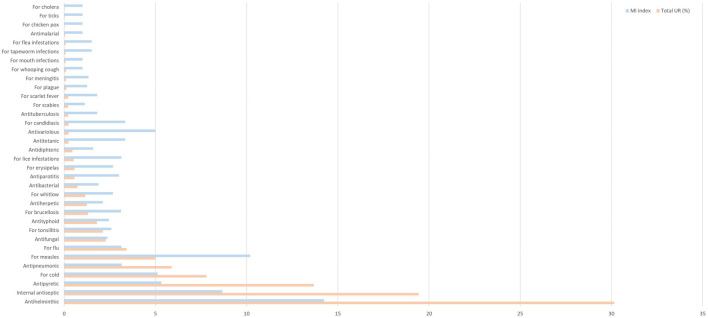
Infectious diseases represent, as a group, the main cause of mortality in the world. The most important reasons are multidrug-resistant pathogens, the rapid spread of emerging diseases aggravated by globalization, and the extended reach of tropical and vector-borne diseases resulting from continued climate change. Given the increase in these diseases and the limited effectiveness of antibiotics, traditional knowledge can constitute a useful tool to address these new health challenges. The aim of this work is to analyze extensively the available ethnobotanical data linked to infections and infestations in the Catalan linguistic area, with the intention of depicting the panorama of the folk use of herbal products to address the quoted ailments, preserving the popular plant knowledge and management data. The meta-analytic work performed in the present study covers 29 research studies belonging to different regions throughout the Catalan linguistic area. The medicinal ethnoflora to treat infections and infestations in the Catalan linguistic area includes 326 taxa belonging to 78 botanical families of vascular plants. The informant consensus factor (F) was 0.92, and the ethnobotanicity index (EI) was 7.26%. (10.98%; 0.37) and (8.06%; 0.27) are the most quoted taxa and have the highest values of the cultural importance index. The most reported use was antihelminthic (30.15%), followed by internal antiseptic (19.43%) and antipyretic (13.69%). The medicinal importance index shows the relevance of the antihelminthic use (14.23) and also the use against measles (10.19). The information is coincidental with at least one of the comprehensive pharmacological literature sources checked for 47.42% of ethnobotanical uses. These results, centered on the plants used to treat infection and infestation diseases, are the first step toward selecting some of the most interesting species to develop phytochemical and pharmacological studies and suggesting an alternative regarding how to face the health emergency involving the expansion of infectious diseases, based on local and traditional knowledge.
作为一个整体,传染病是全球主要的死亡原因。最重要的原因是多重耐药病原体、全球化加剧了新发疾病的迅速传播,以及持续的气候变化导致热带和媒介传播疾病的传播范围扩大。鉴于这些疾病的增加以及抗生素有效性的有限,传统知识可以成为应对这些新的健康挑战的有用工具。这项工作的目的是广泛分析加泰罗尼亚语地区与感染和寄生虫侵扰相关的现有民族植物学数据,旨在描绘民间使用草药产品治疗上述疾病的全景,保存民间植物知识和管理数据。本研究中进行的荟萃分析工作涵盖了加泰罗尼亚语地区不同区域的29项研究。加泰罗尼亚语地区用于治疗感染和寄生虫侵扰的药用民族植物区系包括属于78个维管束植物科的326个分类单元。信息提供者共识因子(F)为0.92,民族植物学指数(EI)为7.26%。(10.98%;0.37)和(8.06%;0.27)是被引用最多的分类单元,并且具有最高的文化重要性指数值。报告最多的用途是抗蠕虫(30.15%),其次是内部防腐(19.43%)和解热(13.69%)。药用重要性指数显示了抗蠕虫用途(14.23)以及抗麻疹用途(10.19)的相关性。47.42%的民族植物学用途信息与至少一份综合药理学文献来源相符。这些以用于治疗感染和寄生虫侵扰疾病的植物为中心的结果,是朝着选择一些最有趣的物种开展植物化学和药理学研究迈出的第一步,并基于当地和传统知识,就如何应对涉及传染病传播的健康紧急情况提出一种替代方案。