Department of Hematology, Clinical Hospital Center "Dr. Dragisa Misovic-Dedinje", University of Belgrade, Serbia.
Molecular Oncology Group, Institute for Medical Research, National Institute of Republic of Serbia, University of Belgrade, Belgrade, Serbia.
Oxid Med Cell Longev. 2021 Oct 18;2021:7753857. doi: 10.1155/2021/7753857. eCollection 2021.
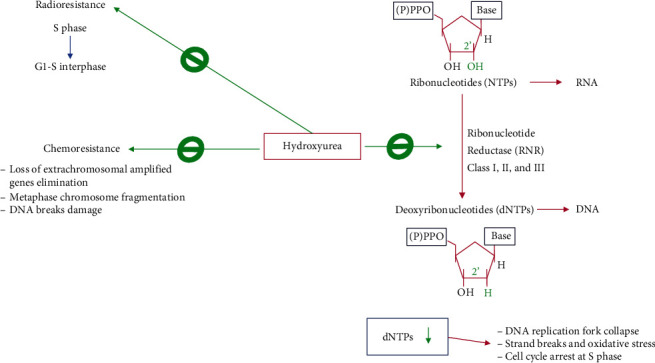
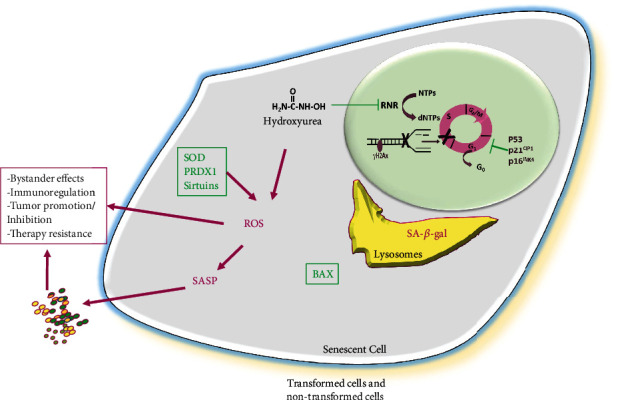
Hydroxyurea (HU) is a water-soluble antiproliferative agent used for decades in neoplastic and nonneoplastic conditions. HU is considered an essential medicine because of its cytoreduction functions. HU is an antimetabolite that inhibits ribonucleotide reductase, which causes a depletion of the deoxyribonucleotide pool and dramatically reduces cell proliferation. The proliferation arrest, depending on drug concentration and exposure, may promote a cellular senescence phenotype associated with cancer cell therapy resistance and inflammation, influencing neighboring cell functions, immunosuppression, and potential cancer relapse. HU can induce cellular senescence in both healthy and transformed cells in vitro, in part, because of increased reactive oxygen species (ROS). Here, we analyze the main molecular mechanisms involved in cytotoxic/genotoxic HU function, the potential to increase intracellular ROS levels, and the principal features of cellular senescence induction. Understanding the mechanisms involved in HU's ability to induce cellular senescence may help to improve current chemotherapy strategies and control undesirable treatment effects in cancer patients and other diseases.
羟脲(HU)是一种水溶性抗增殖剂,已在肿瘤和非肿瘤疾病中使用了数十年。由于其细胞减少功能,HU 被认为是一种基本药物。HU 是一种抗代谢物,可抑制核糖核苷酸还原酶,导致脱氧核苷酸池耗竭,并显著降低细胞增殖。增殖停滞取决于药物浓度和暴露时间,可能会促进与癌症细胞治疗耐药性和炎症相关的细胞衰老表型,影响邻近细胞的功能、免疫抑制和潜在的癌症复发。HU 可以在体外诱导健康和转化细胞的细胞衰老,部分原因是活性氧物种(ROS)增加。在这里,我们分析了参与 HU 的细胞毒性/遗传毒性功能的主要分子机制、增加细胞内 ROS 水平的潜力以及诱导细胞衰老的主要特征。了解 HU 诱导细胞衰老的能力所涉及的机制可能有助于改善当前的化疗策略,并控制癌症患者和其他疾病中不良治疗效果。