Division of Performance Physiology & Prevention, Department of Sport Science, University Innsbruck, Innsbruck, Austria.
Health Physical Activity Lifestyle Sport Research Centre (HPALS), University of Cape Town, Cape Town, South Africa.
Eur J Appl Physiol. 2022 Feb;122(2):301-316. doi: 10.1007/s00421-021-04833-y. Epub 2021 Oct 27.
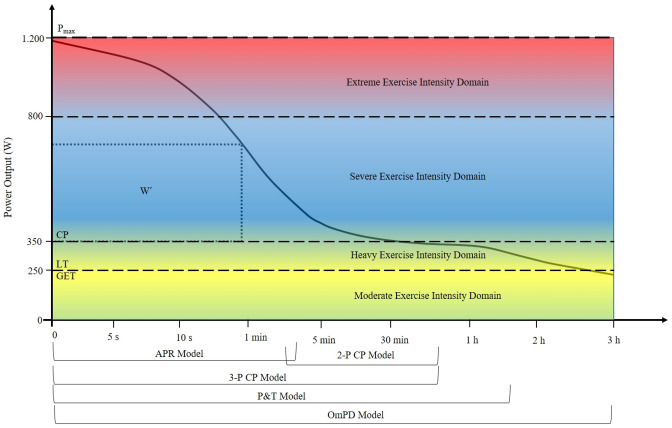
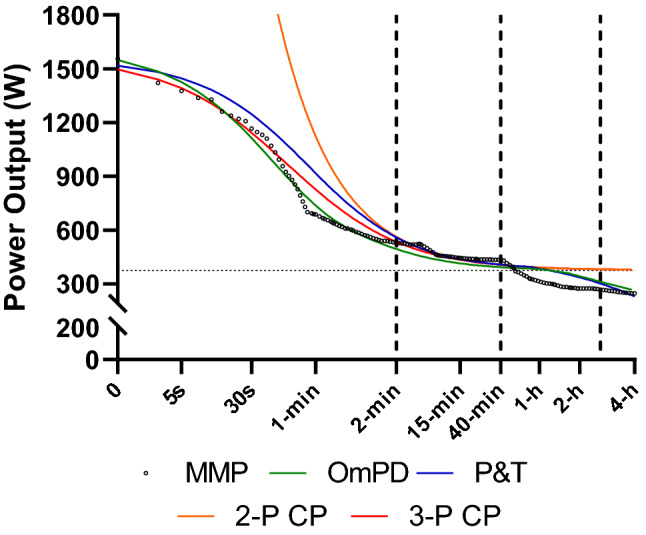
Emerging trends in technological innovations, data analysis and practical applications have facilitated the measurement of cycling power output in the field, leading to improvements in training prescription, performance testing and race analysis. This review aimed to critically reflect on power profiling strategies in association with the power-duration relationship in cycling, to provide an updated view for applied researchers and practitioners. The authors elaborate on measuring power output followed by an outline of the methodological approaches to power profiling. Moreover, the deriving a power-duration relationship section presents existing concepts of power-duration models alongside exercise intensity domains. Combining laboratory and field testing discusses how traditional laboratory and field testing can be combined to inform and individualize the power profiling approach. Deriving the parameters of power-duration modelling suggests how these measures can be obtained from laboratory and field testing, including criteria for ensuring a high ecological validity (e.g. rider specialization, race demands). It is recommended that field testing should always be conducted in accordance with pre-established guidelines from the existing literature (e.g. set number of prediction trials, inter-trial recovery, road gradient and data analysis). It is also recommended to avoid single effort prediction trials, such as functional threshold power. Power-duration parameter estimates can be derived from the 2 parameter linear or non-linear critical power model: P(t) = W'/t + CP (W'-work capacity above CP; t-time). Structured field testing should be included to obtain an accurate fingerprint of a cyclist's power profile.
新兴技术创新、数据分析和实际应用的趋势促进了现场骑行功率输出的测量,从而改进了训练方案、性能测试和比赛分析。本综述旨在批判性地反思与骑行功率-时间关系相关的功率特征分析策略,为应用研究人员和从业者提供最新观点。作者详细介绍了功率输出的测量方法,然后概述了功率特征分析的方法学方法。此外,在推导功率-时间关系部分,提出了现有的功率-时间模型概念以及运动强度域。结合实验室和现场测试讨论了如何将传统的实验室和现场测试相结合,为功率特征分析方法提供信息并实现个体化。推导功率-时间建模的参数表明如何从实验室和现场测试中获得这些测量值,包括确保高生态有效性的标准(例如,骑手专业化、比赛需求)。建议现场测试应始终按照现有文献中的既定指南进行(例如,预测试验的固定次数、试验间恢复、道路坡度和数据分析)。还建议避免单次用力预测试验,如功能阈功率。功率-时间参数估计可以从 2 参数线性或非线性临界功率模型中得出:P(t)=W'/t+CP(W'-CP 以上的工作能力;t-时间)。应包括结构化的现场测试,以获得自行车运动员功率特征的准确指纹。