Department of Ophthalmology, Amrita Institute of Medical Sciences, Kochi, Kerala, India.
Department of Endocrinology and Diabetes, Amrita Institute of Medical Sciences, Kochi, Kerala, India.
Indian J Ophthalmol. 2021 Nov;69(11):3370-3375. doi: 10.4103/ijo.IJO_1279_21.
To determine the relationship between diabetic retinopathy (DR) and diabetic peripheral neuropathy (DPN), and their associated risk factors.
We conducted a cross-sectional analysis on 500 patients who attended the Endocrinology department at a quaternary health care center in Kerala between November 2017 and April 2018. Patients above the age of 30 years with type 2 diabetes mellitus (DM) were included. They underwent a detailed medical history, dilated fundus examination for DR, assessment and grading of DPN, and blood investigations. Among these, 49 randomly selected patients without DR had peripapillary retinal nerve fiber layer (RNFL) and ganglion cell inner plexiform layer (GCIPL) assessed by optical coherence tomogram. RNFL and GCIPL changes in different grades of neuropathy were evaluated.
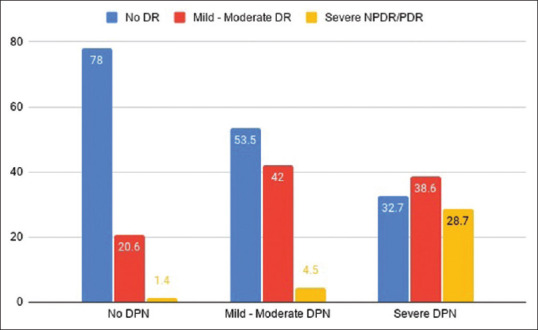
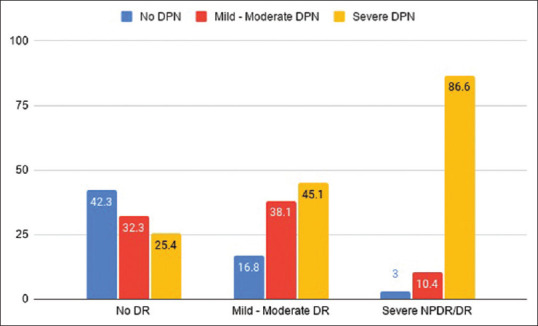
Out of 500 patients, 303 (60.6%) were males and 197 (39.4%) were females. Prevalence of DR was 48% and DPN 71.8%. Risk factors for the development of DR included duration of DM >15 years, HbA1c (glycated hemoglobin) greater than 6.5%, serum creatinine more than 1.5 mg/dl, and the presence of DPN. There was a statistically significant association between DR and DPN. There was significant thinning of GCIPL in patients with moderate to severe neuropathy without DR.
There is a significant association between DR and DPN and their severities. There are early changes in inner retinal layers of diabetic patients without microvascular changes of DR. These neurodegenerative changes parallel DPN in the course of DM. Our study stresses the importance of multidisciplinary approach in the management of diabetes and its complications.
探讨糖尿病视网膜病变(DR)与糖尿病周围神经病变(DPN)的关系及其相关危险因素。
我们对 2017 年 11 月至 2018 年 4 月在喀拉拉邦一家四级保健中心内分泌科就诊的 500 例患者进行了横断面分析。纳入年龄大于 30 岁的 2 型糖尿病(DM)患者。他们接受了详细的病史、散瞳眼底检查以评估 DR、DPN 的评估和分级,以及血液检查。其中,49 例无 DR 的患者随机选择接受光学相干断层扫描检查以评估视盘周围视网膜神经纤维层(RNFL)和神经节细胞内丛状层(GCIPL)。评估不同神经病变分级的 RNFL 和 GCIPL 变化。
500 例患者中,303 例(60.6%)为男性,197 例(39.4%)为女性。DR 的患病率为 48%,DPN 为 71.8%。DR 发生的危险因素包括 DM 病程>15 年、糖化血红蛋白(HbA1c)>6.5%、血清肌酐>1.5mg/dl 和 DPN 的存在。DR 和 DPN 之间存在统计学显著关联。无 DR 的中重度神经病变患者的 GCIPL 明显变薄。
DR 和 DPN 及其严重程度之间存在显著关联。无 DR 的糖尿病患者的内层视网膜有早期变化。这些神经退行性变化与 DM 过程中的 DPN 平行。我们的研究强调了在糖尿病及其并发症的管理中采用多学科方法的重要性。