Department of Solid Tumor Oncology and Supportive Oncology, Levine Cancer Institute, Atrium Health, 1021 Morehead Medical Drive, Charlotte, NC, 28204, USA.
Department of Supportive Oncology, Levine Cancer Institute, Atrium Health, Charlotte, NC, USA.
Support Care Cancer. 2022 Mar;30(3):2237-2244. doi: 10.1007/s00520-021-06612-z. Epub 2021 Oct 28.
In cancer, malnutrition is common and negatively impacts tolerance and outcomes of anti-tumor therapies. The aim of this study was to evaluate the prevalence of malnutrition risk and compare the clinicodemographic features between those with high malnutrition screening tool (MST) scores (i.e., ≥ 2 of 5 = high risk for malnutrition, H-MST) to low scores (L-MST).
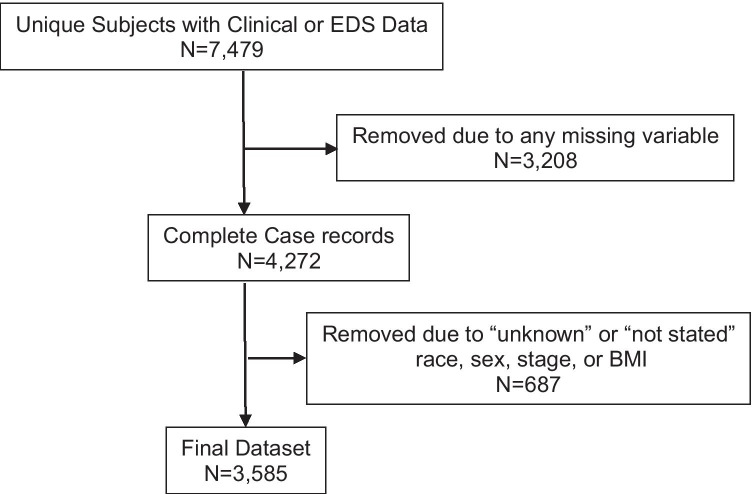
A cohort of 3585 patients (May 2017 through December 2018), who completed the MST at least once at the time of diagnosis of any stage solid tumor, were analyzed. Logistic regression tested for associations between clinicodemographic factors, symptom scores, and H-MST prevalence.
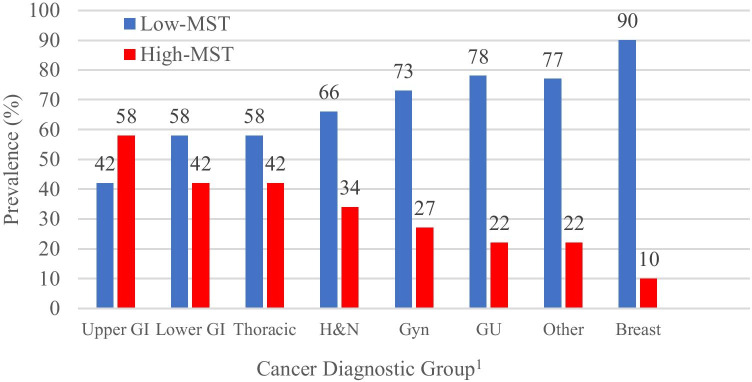
The median age was 64 years (25-75 IQR, 55-72), with 62% females and 81% White. Most common tumor primary sites were breast (28%), gastrointestinal (GI) (21%), and thoracic (13%). Most had non-metastatic disease (80%). H-MST was found in 28%-most commonly in upper (58%) and lower GI (42%), and thoracic (42%) tumors. L-MST was most common in breast (90%). Multivariable regression confirmed that Black race (OR 1.9, 95% CI 1.5-2.4, p = < 0.001), cancer primary site (OR 1.6-5.7, p = < 0.001), stage IV disease (OR 1.8, 95% CI 1.4-2.2, p = < 0.001), low BMI (OR 4.2, 95% CI 2.5-6.9 p = < 0.001), and higher symptom scores were all independently associated with H-MST.
Twenty-eight percent of solid tumor oncology patients at diagnosis were at high risk of malnutrition. Patients with breast cancer rarely had malnutrition risk at diagnosis. Significant variation was found in malnutrition risk by cancer site, stage, race, and presence of depression, distress, fatigue, and trouble eating/swallowing.
在癌症中,营养不良很常见,会对抗肿瘤治疗的耐受性和结果产生负面影响。本研究的目的是评估营养不良风险的发生率,并比较高营养不良筛查工具(MST)评分(即≥5 分中的 2 分=营养不良高风险,H-MST)与低评分(L-MST)患者的临床特征。
分析了 2017 年 5 月至 2018 年 12 月期间,3585 名至少在确诊任何分期实体瘤时完成 MST 筛查的患者队列。逻辑回归检验了临床特征、症状评分与 H-MST 发生率之间的相关性。
中位年龄为 64 岁(25-75 岁 IQR,55-72 岁),62%为女性,81%为白人。最常见的肿瘤原发部位为乳腺(28%)、胃肠道(GI)(21%)和胸部(13%)。大多数患者为非转移性疾病(80%)。H-MST 发生率为 28%-最常见于上 GI(58%)和下 GI(42%)和胸部(42%)肿瘤。L-MST 最常见于乳腺(90%)。多变量回归证实,黑人种族(OR 1.9,95%CI 1.5-2.4,p<0.001)、肿瘤原发部位(OR 1.6-5.7,p<0.001)、IV 期疾病(OR 1.8,95%CI 1.4-2.2,p<0.001)、低 BMI(OR 4.2,95%CI 2.5-6.9,p<0.001)和更高的症状评分均与 H-MST 独立相关。
28%的初诊实体瘤肿瘤患者存在营养不良高风险。初诊乳腺癌患者发生营养不良风险的可能性很小。肿瘤部位、分期、种族以及抑郁、痛苦、疲劳和进食/吞咽困难的存在,均与营养不良风险显著相关。