School of Sustainability, Arizona State University, Tempe, AZ, United States of America.
Minerva University, San Francisco, CA, United States of America.
PLoS One. 2021 Oct 28;16(10):e0254582. doi: 10.1371/journal.pone.0254582. eCollection 2021.
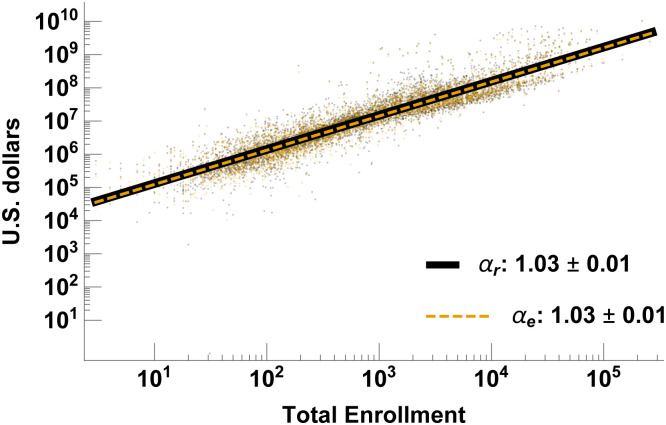
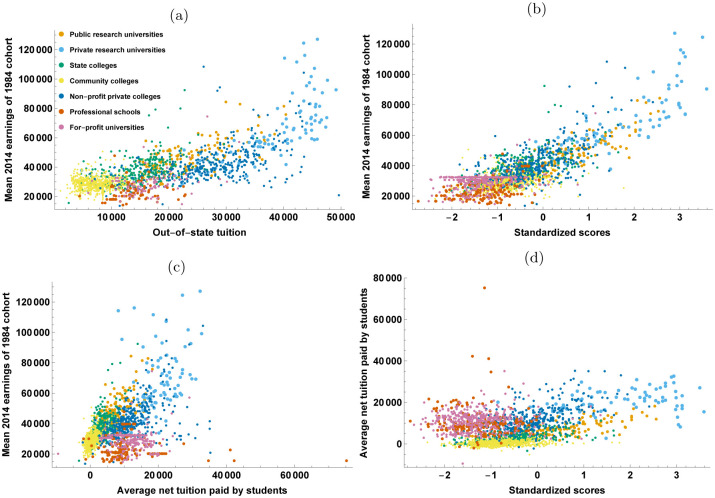
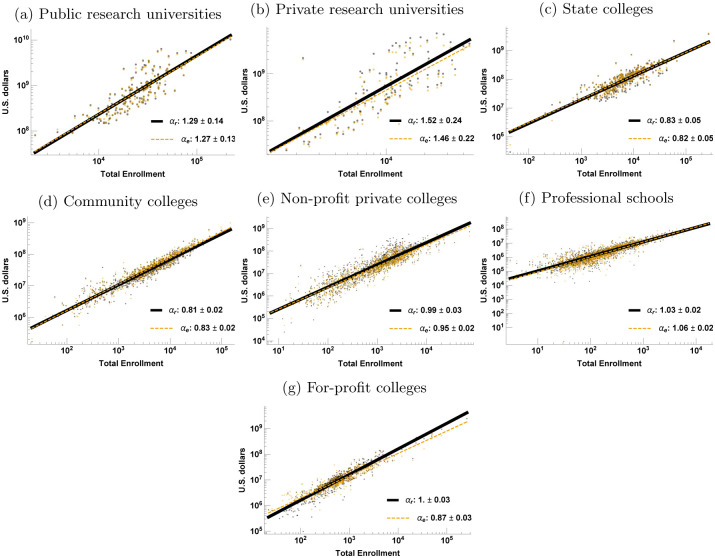
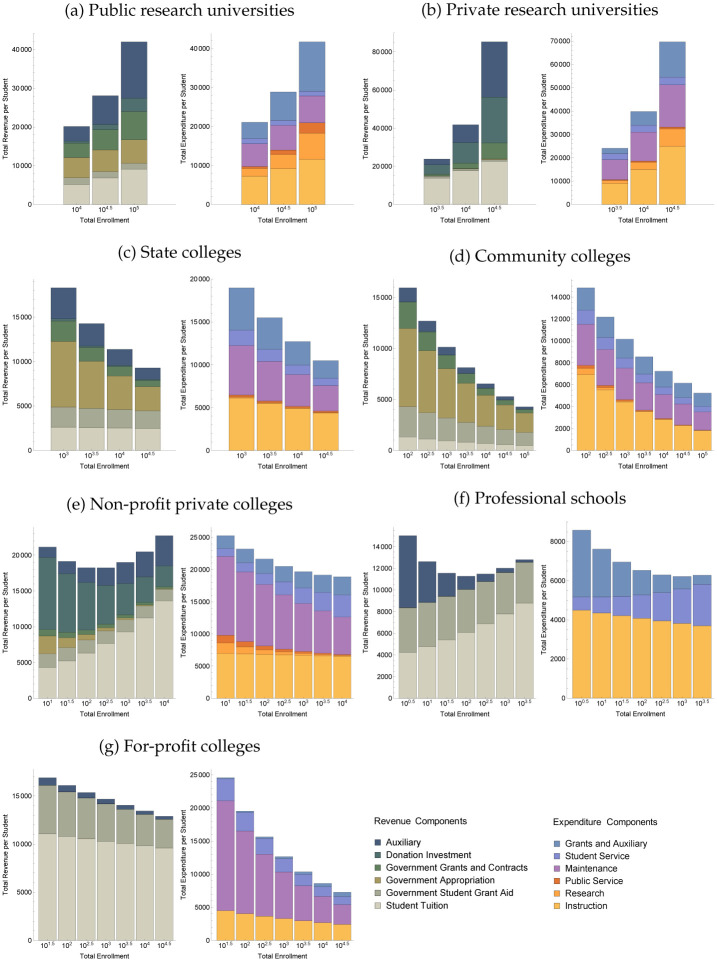
To build better theories of cities, companies, and other social institutions such as universities, requires that we understand the tradeoffs and complementarities that exist between their core functions, and that we understand bounds to their growth. Scaling theory has been a powerful tool for addressing such questions in diverse physical, biological and urban systems, revealing systematic quantitative regularities between size and function. Here we apply scaling theory to the social sciences, taking a synoptic view of an entire class of institutions. The United States higher education system serves as an ideal case study, since it includes over 5,800 institutions with shared broad objectives, but ranges in strategy from vocational training to the production of novel research, contains public, nonprofit and for-profit models, and spans sizes from 10 to roughly 100,000 enrolled students. We show that, like organisms, ecosystems and cities, universities and colleges scale in a surprisingly systematic fashion following simple power-law behavior. Comparing seven commonly accepted sectors of higher education organizations, we find distinct regimes of scaling between a school's total enrollment and its expenditures, revenues, graduation rates and economic added value. Our results quantify how each sector leverages specific economies of scale to address distinct priorities. Taken together, the scaling of features within a sector along with the shifts in scaling across sectors implies that there are generic mechanisms and constraints shared by all sectors, which lead to tradeoffs between their different societal functions and roles. We highlight the strong complementarity between public and private research universities, and community and state colleges, that all display superlinear returns to scale. In contrast to the scaling of biological systems, our results highlight that much of the observed scaling behavior is modulated by the particular strategies of organizations rather than an immutable set of constraints.
为了构建更好的城市、公司和其他社会机构(如大学)理论,我们需要理解其核心功能之间的权衡和互补性,并了解其增长的限制。规模理论一直是解决物理、生物和城市系统等各种问题的有力工具,揭示了大小与功能之间存在系统的定量规律。在这里,我们将规模理论应用于社会科学,从整体上看待一整类机构。美国高等教育系统是一个理想的案例研究,因为它包括 5800 多所具有共同广泛目标的机构,但在战略上从职业培训到新研究的产生各不相同,包含公立、非营利和营利性模式,规模从 10 到大约 10 万名学生不等。我们发现,与生物体、生态系统和城市一样,大学和学院以一种惊人的系统方式按简单的幂律行为进行缩放。在比较高等教育组织的七个常见部门时,我们发现学校的总入学人数与其支出、收入、毕业率和经济附加值之间存在明显的缩放规则。我们的结果量化了每个部门如何利用特定的规模经济来解决不同的优先事项。总的来说,一个部门内的特征的缩放以及跨部门的缩放变化意味着,所有部门都存在通用的机制和约束,这些机制和约束导致了它们不同的社会功能和角色之间的权衡。我们强调了公立和私立研究型大学以及社区和州立学院之间的强大互补性,它们都显示出超线性的规模回报。与生物系统的缩放不同,我们的结果强调了观察到的大部分缩放行为是由组织的特定策略而不是一组不变的约束所调节的。