School of Public and Environmental Health, Hawassa University, Awassa, Ethiopia.
Centre for International Health, University of Bergen, Bergen, Norway.
PLoS One. 2021 Oct 28;16(10):e0258715. doi: 10.1371/journal.pone.0258715. eCollection 2021.
Globally, moderate acute malnutrition (MAM) affects approximately 5% of children below five years of age. MAM is a persistent public health problem in Ethiopia. The current approach in Ethiopia for managing MAM is a supplementary feeding program; however, this is only provided to chronically food-insecure areas. The objective of the study was to compare a local-ingredients-based supplement (LIBS) with the standard corn-soy blend plus (CSB+) in treating MAM among children aged 6 to 59 months to test the hypothesis that the recovery rate achieved with LIBS will not be more than 7% worse than that achieved with CSB+.
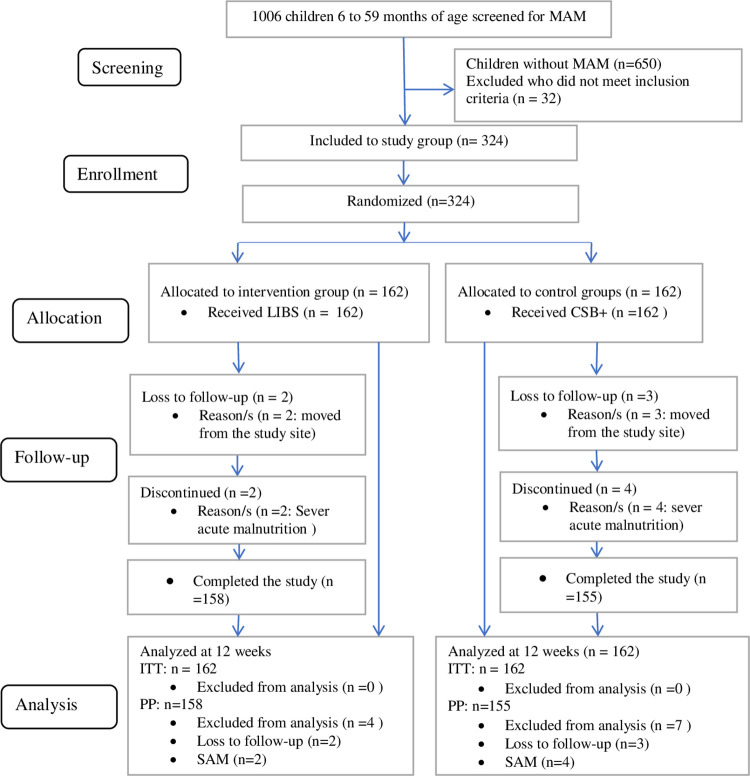
We used an individual randomized controlled non-inferiority trial design with two arms, involving 324 children with MAM aged 6 to 59 months in Wolaita, Southern Ethiopia. One hundred and sixty-two children were randomly assigned to each of the two arms. In the first arm, 125.2 g of LIBS with 8 ml of refined deodorized and cholesterol-free sunflower oil/day was provided. In the second arm, 150 g of CSB+ with 16 ml of refined deodorized and cholesterol-free sunflower oil/day was provided. Each child was provided with a daily ration of either LIBS or CSB+ for 12 weeks. Both intention-to-treat (ITT) and per-protocol (PP) analyses were done. ITT and PP analyses showed non-inferiority of LIBS compared with CSB+ for recovery rate [ITT risk difference = 4.9% (95% CI: -4.70, 14.50); PP risk difference = 3.7% (95% CI: -5.91, 13.31)]; average weight gain [ITT risk difference = 0.10 g (95% CI: -0.33 g, 0.53 g); PP risk difference = 0.04 g (95% CI: -0.38 g, 0.47 g)]; and recovery time [ITT risk difference = -2.64 days (95% CI: -8.40 days, 3.13 days); PP difference -2.17 days (95% CI: -7.97 days, 3.64 days]. Non-inferiority in MUAC gain and length/height gain was also observed in the LIBS group compared with the CSB+ group.
LIBS can be used as an alternative to the standard CSB+ for the treatment of MAM. Thus, the potential of scaling up the use of LIBS should be promoted.
Pan-African Clinical Trial Registration number: PACTR201809662822990.
在全球范围内,中度急性营养不良(MAM)影响了约 5%的五岁以下儿童。MAM 是埃塞俄比亚持续存在的公共卫生问题。埃塞俄比亚目前管理 MAM 的方法是补充喂养方案;然而,这仅提供给长期食物无保障的地区。本研究的目的是比较基于当地原料的补充剂(LIBS)与标准玉米-大豆混合补充剂(CSB+)在治疗 6 至 59 个月大的 MAM 儿童方面的效果,以检验以下假设:LIBS 的恢复率不会比 CSB+差 7%以上。
我们使用了个体随机对照非劣效性试验设计,有两个手臂,涉及沃莱塔,埃塞俄比亚南部的 324 名 6 至 59 个月大的 MAM 儿童。162 名儿童被随机分配到两个手臂。在第一只手臂中,每天提供 125.2 克 LIBS 和 8 毫升精制脱臭无胆固醇葵花籽油。在第二只手臂中,每天提供 150 克 CSB+和 16 毫升精制脱臭无胆固醇葵花籽油。每个孩子每天都要服用 LIBS 或 CSB+中的一种,持续 12 周。均进行了意向治疗(ITT)和符合方案(PP)分析。ITT 和 PP 分析表明,LIBS 与 CSB+相比,恢复率无差异[ITT 风险差异=4.9%(95%CI:-4.70,14.50);PP 风险差异=3.7%(95%CI:-5.91,13.31)];平均体重增加[ITT 风险差异=0.10 克(95%CI:-0.33 克,0.53 克);PP 风险差异=0.04 克(95%CI:-0.38 克,0.47 克)];以及恢复时间[ITT 风险差异=-2.64 天(95%CI:-8.40 天,3.13 天);PP 差异=-2.17 天(95%CI:-7.97 天,3.64 天)]。LIBS 组在 MUAC 增加和长度/身高增加方面也表现出与 CSB+组的非劣效性。
LIBS 可作为治疗 MAM 的标准 CSB+的替代方法。因此,应推广扩大使用 LIBS 的潜力。
泛非临床试验注册处编号:PACTR201809662822990。