Centre for Studies on Human Stress, Institut Universitaire en santé mentale de Montréal, Research Center, CIUSSS Est-de-l'Île-de-Montréal, Montreal, Quebec, Canada.
Department of Psychology, Université de Montréal, Montreal, Quebec, Canada.
PLoS One. 2021 Oct 28;16(10):e0259094. doi: 10.1371/journal.pone.0259094. eCollection 2021.
We read, see and hear news from various media sources every day. A large majority of the news is negative. A previous study from our laboratory showed that reading negative news is associated with both increased stress reactivity (measured via the stress hormone cortisol) and recall of the negative news segments in women.
The present study investigated the effects of positive news on cortisol stress reactivity, memory and affect using a methodology highly similar to the study on negative news that was previously used by our team.
Sixty-two healthy participants aged between 18 and 35 years (81% women) were randomly exposed to either positive or neutral news segments, followed by a laboratory stressor. We assessed participants' affect three times during the procedure and measured cortisol in saliva eight times (at 10-minute intervals). Twenty-four hours later, participants were contacted by phone to assess their recall of the news segments.
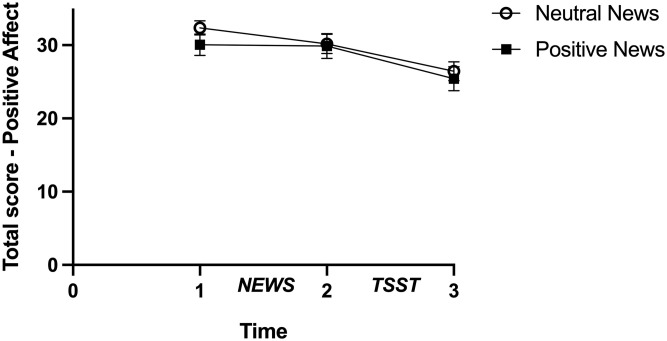
Results showed that exposure to positive news, relative to neutral news, did not modulate participants' cortisol levels in response to the laboratory stressor. Positive news had no impact on memory recall of the news and did not change participants' positive or negative affect. Bayes factors suggested that these nonsignificant results are not attributable to low statistical power.
Contrary to negative news, positive and neutral news do not modulate stress reactivity, memory and affect. These results suggest that people can stay informed without physiological and psychological costs when the news to which they are exposed adopt a positive or neutral approach.
我们每天从各种媒体来源阅读、观看和收听新闻。绝大多数新闻都是负面的。我们实验室的一项先前研究表明,阅读负面新闻与应激激素皮质醇的应激反应增加以及女性对负面新闻片段的回忆有关。
本研究采用与我们团队之前使用的研究负面新闻非常相似的方法,调查积极新闻对皮质醇应激反应、记忆和情绪的影响。
62 名年龄在 18 至 35 岁之间的健康参与者(81%为女性)被随机暴露于积极或中性新闻片段,然后接受实验室应激源。我们在整个过程中三次评估参与者的情绪,并在八次(每隔 10 分钟一次)测量唾液中的皮质醇。24 小时后,通过电话联系参与者以评估他们对新闻片段的回忆。
结果表明,与中性新闻相比,接触积极新闻并不会调节参与者对实验室应激源的皮质醇水平。积极新闻对新闻的记忆回忆没有影响,也没有改变参与者的积极或消极情绪。贝叶斯因子表明,这些无显著差异的结果并非归因于低统计功效。
与负面新闻相反,积极和中性新闻不会调节应激反应、记忆和情绪。这些结果表明,当人们接触的新闻采用积极或中性的方式时,他们可以在不产生生理和心理成本的情况下保持消息灵通。