Bouzidi Amira, Labreche Karim, Baron Marine, Veyri Marianne, Denis Jérôme Alexandre, Touat Mehdi, Sanson Marc, Davi Frédéric, Guillerm Erell, Jouannet Stéphanie, Charlotte Frédéric, Bielle Franck, Choquet Sylvain, Boëlle Pierre-Yves, Cadranel Jacques, Leblond Véronique, Autran Brigitte, Lacorte Jean-Marc, Spano Jean-Philippe, Coulet Florence
Sorbonne University, INSERM, Research Unit on Cardiovascular and Metabolic Disease UMR ICAN, Department of Endocrine Biochemistry and Oncology, AP-HP, Hôpital Pitié Salpêtrière, Paris, France.
Sorbonne University, INSERM, Pierre Louis Institute of Epidemiology and Public Health, Paris, France.
Front Cell Dev Biol. 2021 Aug 3;9:661272. doi: 10.3389/fcell.2021.661272. eCollection 2021.
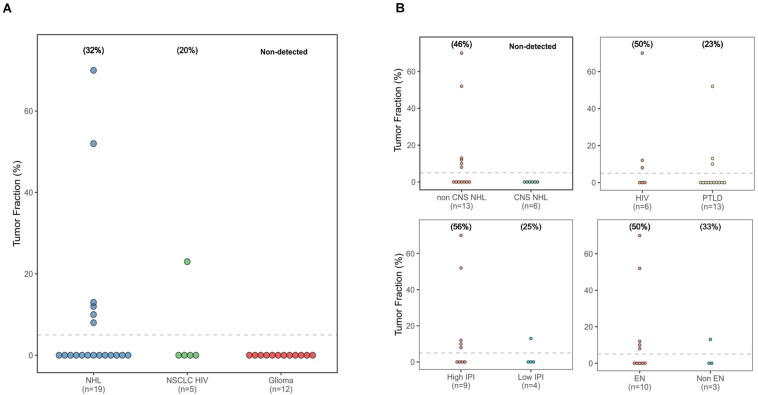
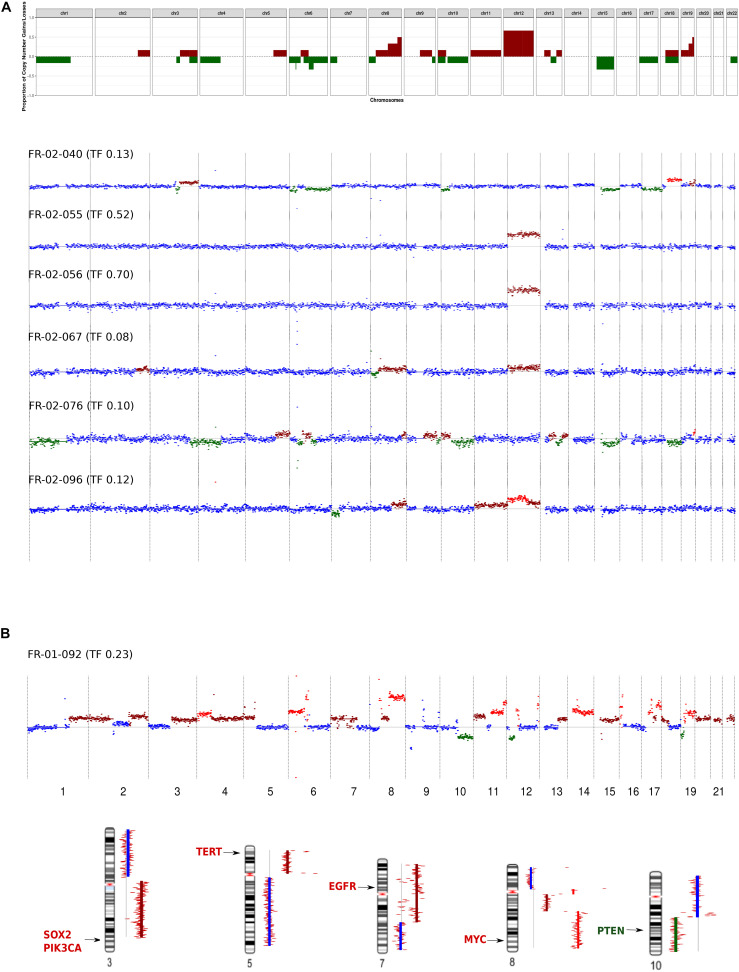
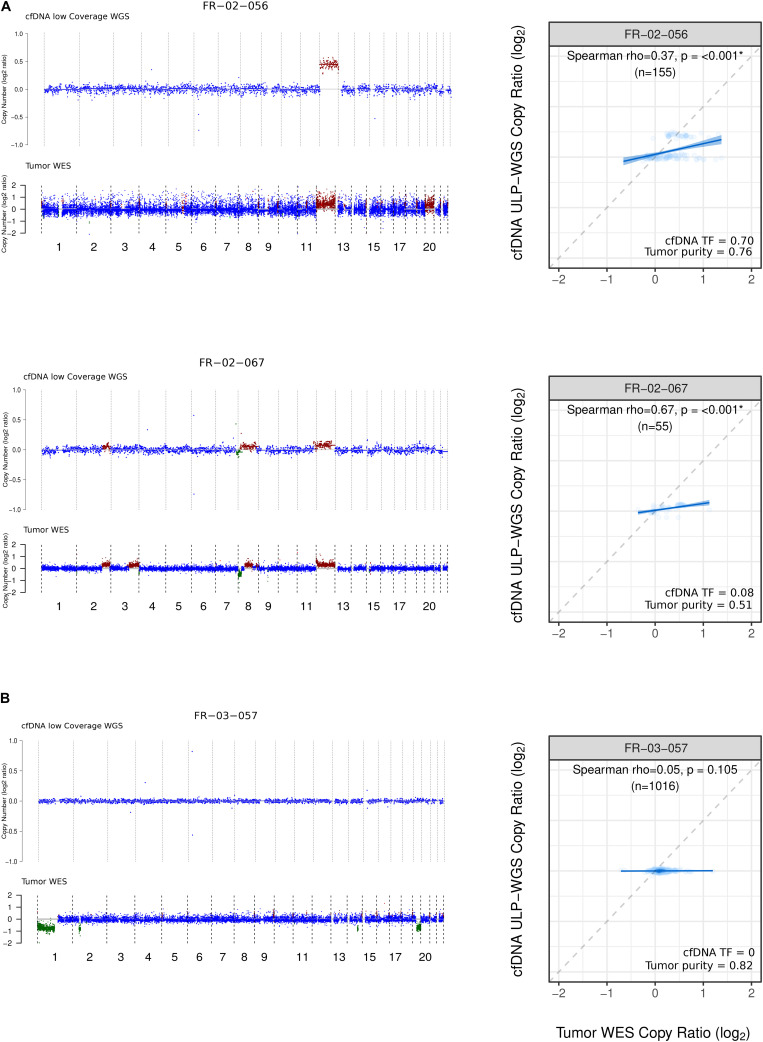
Cell-free DNA (cfDNA) analysis is a minimally invasive method that can be used to detect genomic abnormalities by directly testing a blood sample. This method is particularly useful for immunosuppressed patients, who are at high risk of complications from tissue biopsy. The cfDNA tumor fraction (TF) varies greatly across cancer type and between patients. Thus, the detection of molecular alterations is highly dependent on the circulating TF. In our study, we aimed to calculate the TF and characterize the copy number aberration (CNA) profile of cfDNA from patients with rare malignancies occurring in immunosuppressed environments or immune-privileged sites. To accomplish this, we recruited 36 patients: 19 patients with non-Hodgkin lymphoma (NHL) who were either human immunodeficiency virus (HIV)-positive or organ transplant recipients, 5 HIV-positive lung cancer patients, and 12 patients with glioma. cfDNA was extracted from the patients' plasma and sequenced using low-coverage whole genome sequencing (LC-WGS). The cfDNA TF was then calculated using the ichorCNA bioinformatic algorithm, based on the CNA profile. In parallel, we performed whole exome sequencing of patient tumor tissue and cfDNA samples with detectable TFs. We detected a cfDNA TF in 29% of immune-suppressed patients (one patient with lung cancer and six with systemic NHL), with a TF range from 8 to 70%. In these patients, the events detected in the CNA profile of cfDNA are well-known events associated with NHL and lung cancer. Moreover, cfDNA CNA profile correlated with the CNA profile of matched tumor tissue. No tumor-derived cfDNA was detected in the glioma patients. Our study shows that tumor genetic content is detectable in cfDNA from immunosuppressed patients with advanced NHL or lung cancer. LC-WGS is a time- and cost-effective method that can help select an appropriate strategy for performing extensive molecular analysis of cfDNA. This technique also enables characterization of CNAs in cfDNA when sufficient tumor content is available. Hence, this approach can be used to collect useful molecular information that is relevant to patient care.
游离DNA(cfDNA)分析是一种微创方法,可通过直接检测血液样本用于检测基因组异常。该方法对免疫抑制患者尤为有用,这些患者因组织活检而出现并发症的风险很高。cfDNA肿瘤分数(TF)在不同癌症类型以及患者之间差异很大。因此,分子改变的检测高度依赖于循环TF。在我们的研究中,我们旨在计算TF,并对免疫抑制环境或免疫豁免部位发生的罕见恶性肿瘤患者的cfDNA拷贝数畸变(CNA)谱进行表征。为实现这一目标,我们招募了36名患者:19名非霍奇金淋巴瘤(NHL)患者,他们要么是人类免疫缺陷病毒(HIV)阳性,要么是器官移植受者;5名HIV阳性肺癌患者;以及12名胶质瘤患者。从患者血浆中提取cfDNA,并使用低覆盖度全基因组测序(LC-WGS)进行测序。然后基于CNA谱,使用ichorCNA生物信息学算法计算cfDNA TF。同时,我们对患者肿瘤组织和具有可检测TF的cfDNA样本进行了全外显子组测序。我们在29%的免疫抑制患者(1名肺癌患者和6名全身性NHL患者)中检测到了cfDNA TF,TF范围为8%至70%。在这些患者中,cfDNA的CNA谱中检测到的事件是与NHL和肺癌相关的已知事件。此外,cfDNA CNA谱与匹配肿瘤组织的CNA谱相关。在胶质瘤患者中未检测到肿瘤来源的cfDNA。我们的研究表明,在晚期NHL或肺癌的免疫抑制患者的cfDNA中可检测到肿瘤遗传物质。LC-WGS是一种省时且经济高效的方法,可帮助选择对cfDNA进行广泛分子分析的合适策略。当有足够的肿瘤含量时,该技术还能够对cfDNA中的CNA进行表征。因此,这种方法可用于收集与患者护理相关的有用分子信息。